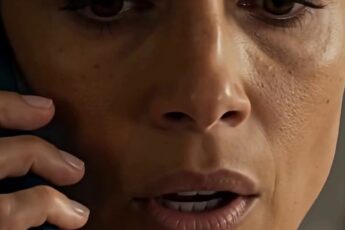
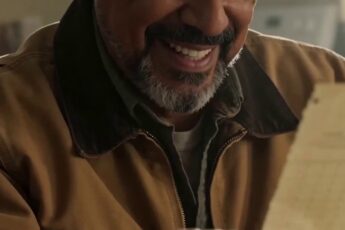
Cal Hartmann heard the bass before his key touched the lock. The front door of the Sequoyah Hills house was vibrating in its frame. Brooks & Dunn at full volume. He set his leather case down on the brick steps and felt the music in the roots of his back teeth. He owned three building supply yards from Knoxville to Maryville, and his house had exactly one rule: no sudden moves around Jesse. Somebody had broken that rule before he got home.
He went down the hall. The den door was open.
Jesse’s rehab room had become a dance floor. Arlene Boone, the new housekeeper, had the boy under the arms. She was stepping side to side, half carrying him, half spinning him in a clumsy two-step. Jesse’s legs dangled in gray sweatpants. His sneakers made shallow marks on the oak. His head was back, and he was laughing so hard he had the hiccups. Not a polite kid laugh. The kind that leaves your shirt wet.
Cal didn’t see that. He saw the T12 fusion. The brace. The surgeon’s voice: one bad twist, one shoulder slip, and that hardware could turn into a knife.
“Out of my house!” he yelled.
Arlene wobbled, bumped her hip against the physical therapy table, and set Jesse back in his chair without letting him drop. The speaker cut off. The room went still.
“Out,” Cal said again. “You are done.”
He thumbed six one-hundred-dollar bills from his money clip and let them scatter near her sneakers. “Fifteen minutes. Get your things.”
Arlene bent down, gathered the money, and smoothed it flat on the corner of the desk. Then she turned to Jesse.
“Be good, big man. Don’t let them stuff you in a box.”
After the front door slammed, Jesse wheeled himself to the window and pulled his hood up. Cal tried to talk to him about safety, about spinal fusions, about what could have happened. The boy didn’t answer. When Cal came back with a new remote-control rock crawler, Jesse said only, “I’m tired.”
The next three days were worse.
Cal hired a rehab assistant named Denise through a national agency. She wore maroon scrubs, kept a tablet strapped to her arm, and used words like “protocol” and “pain response.” She counted out knee bends like a metronome: one, two, rest. One, two, rest. By the second day, Jesse had stopped looking at the door when Cal came in. By the third, he didn’t even look up.
That evening Cal found the address on Jesse’s dry-erase board.
Arlene B — 1146 Raccoon Valley Road, Heiskell.
He didn’t know when the boy had written it. Maybe the day she left. Maybe later. The marker line had been gone over twice.
Cal drove his GMC Yukon north past the last gas station, past the point where the road lost its center line. Heiskell was the kind of place where the dollar store parking lot had more trucks than cars. At 1146, a beagle lay on a sagging porch with one eye open. A red clothesline ran from the trailer to a pine tree. Near the steps sat a pair of rubber boots with duct tape on one toe.
Arlene opened the door holding a socket wrench and a chipped mug. She didn’t look surprised.
“You came all this way to fire me twice?”
“I need to talk to you.”
“Then get your shoes off if you’re coming in. I just mopped.”
He left his oxfords on the mat next to the boots. The kitchen smelled like onion, Crisco, and burnt coffee. The table was covered in a vinyl cloth printed with cardinals. On the wall above the doorway hung a set of deer antlers, a braided lanyard looped over one point. The TV was on mute.
Cal sat on a stool that creaked under him.
“Jesse wrote your name on his board,” he said.
Arlene set down the wrench. “That boy told me on day two that he wished he’d been left at the bottom of that climbing wall.”
Cal felt the words hit under his sternum.
“I was trying to protect him,” he said. “The surgeon said no unsupported vertical movement. You don’t know what a fall could do.”
“You know what I know?” She wiped her hands on a rag. “I know you built him a very nice cage. You put ramps in it and a pressure-relief mattress and a big TV. But you forgot to leave a reason for him to wake up.”
Cal opened his mouth. Closed it. The dog outside scratched at the screen door.
“I want you to come back,” he said.
“No.”
“I’ll triple your pay.”
“Same money. Nineteen dollars an hour. I don’t want your guilt money.”
She pulled out the chair across from him and sat.
“I’ll come back on my terms. I take him to Food City to pick out a watermelon if I want. I take him to the drive-in. I let him eat a hot dog too close to the fence at Dumplin Valley. We play music loud. If he laughs until he chokes, you leave the room.”
Cal stared at the cardinals on the tablecloth. Arlene went on.
“And I don’t want that woman in maroon scrubs reading him another paragraph out of a manual. She can take her tablet and go.”
Cal called the agency from inside his truck before he even left the gravel lane. The cancellation fee was two thousand dollars. He gave them the card number and did not ask for a waiver.
Arlene showed up the next morning with a paper sack of sweet potato biscuits and a jar of apple butter.
“Miss Arlene!” Jesse’s voice came from the kitchen before Cal could say anything. “Did you bring the speaker?”
“It’s in the truck. Eat first. Then we’re going down to the duck pond unless it rains.”
Cal stood in the hallway, doing nothing with his hands. He could hear the wheelchair wheels rolling across the floor.
That spring, the house changed.
Jesse came back from Arlene’s truck with red mud on the chair tires. He dropped a whole bowl of buttermilk while they were making cornbread, and Arlene made him wipe it up with paper towels, and they both laughed until Cal had to leave the room because he didn’t know what to do with his face.
One night at the kitchen table, Jesse said around a mouthful of pulled pork, “You know what I haven’t smelled in two years? Burned castor oil and red clay. The 411 Speedway. You used to take me on Saturday nights.”
Cal set his fork down.
“I remember.”
“I can’t drive anymore.”
“Maybe not the way you used to. But maybe there’s a way.”
The next morning Cal skipped a supplier meeting and drove to Alcoa. The property was an old marble finishing shed: twelve acres of cracked concrete, a cinder-block warehouse, busted skylights. The asking price was $1.4 million. He paid $1.3 million and didn’t blink.
He called a company in Indianapolis about hand controls. He ordered eight karts. He had the door tracks ground flush with the concrete. He put in a washroom that could fit a chair without a single reach bar missing. He hung a sign over the wide metal doors: “Jesse’s Track — Inclusive Karting.”
On the first Saturday in May, the lot was full.
Cal stood by the Yukon while volunteers helped kids into the karts. Some walked on their own. Some did not. A boy with a green helmet rolled up to Jesse and said, “You’re the new kid with the red chair?”
Jesse said, “I’m not new. This place is mine.”
Cal caught Arlene before she headed to the pit lane. He handed her a manila envelope.
“What’s this?”
“Your contract,” he said. “Program director. You start Monday. Seventy-two thousand five hundred a year, health insurance, and a four-thousand-dollar sign-on bonus if you get us through the first summer without a lawsuit.”
She opened the envelope. The paperwork said Arlene Boone had final authority over all day-to-day operations. The founder shall not vote. The deed to the property was already signed over to the East Tennessee Adaptive Sports Foundation. Cal kept no shares. The board had seven members. Arlene chaired it. His name was nowhere.
Arlene read every line. Then she took a chewed pen from her shirt pocket, flattened the papers on the hood of the Yukon, and signed both copies. She kept one. She slid the other back to him.
“You still can’t make cornbread,” she said.
Cal folded the contract and put it in his back pocket. “Probably not.”
Arlene took the master keys from the envelope and walked toward the track.
Jesse put the #7 kart into the first turn. The rear tire caught a seam in the concrete and the motor screamed. Cal didn’t call out any instructions. He stood behind the fence, listening to the engines, the gravel, the hot May wind. A small brown dog had wandered over from somewhere and sat down next to his shoe. Cal didn’t move it. The dog stayed for the whole race.