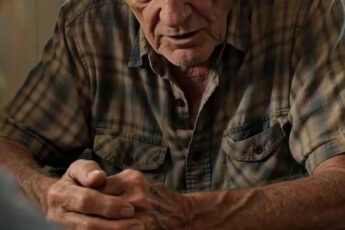
The mail carrier in Ossining still remembers the return address on that envelope: 14 Birchwood Lane, no apartment number, just a house that had stood since 1958. Rosalind Petty was eighty-one when she opened it on her back porch, coffee going cold beside her, and found a photograph of thirty-one children standing in front of a brick schoolhouse that didn't exist anymore.
She'd taught fourth grade at that school — P.S. 6, before the county consolidated it into something with a mascot and a football budget — for thirty-four years. One classroom, one blackboard, and a coffee can full of pencil stubs she sharpened herself every Sunday night so Monday morning wouldn't start with somebody crying over a broken point.
The photo came from a man named Walter Grasso, who she hadn't seen since 1974, when he was nine years old and wore his older brother's hand-me-down corduroys with the knee patched in a fabric that didn't match. He was sixty-one now, ran an HVAC company out in Poughkeepsie, and had tracked her down through a church bulletin his mother still got mailed to her.
Inside the envelope, along with the photo, was a letter. Rosalind read it three times, not because she didn't understand it the first time, but because she wanted to sit with it a little longer.
He wrote about the winter his family couldn't afford boots, and how she'd shown up at their door on a Saturday with a pair that "just happened" to be his exact size, still had the tag folded inside the tongue so nobody would think it was charity. He wrote about the time he got the times tables wrong for the ninth day in a row and she kept him after school not to punish him, but to sit with him at her desk with two mugs of Ovaltine and go through them slow, no bell ringing, no other kids watching him fail. He wrote that he'd become a small-business owner who paid his guys on time and never once looked down on a customer who couldn't pay the full bill up front, and he traced that straight back to a woman who never had more than one bag of chalk and a coffee can of pencils but somehow gave every kid in that room the sense that they mattered.
"You didn't have much to give us," he wrote, "but what you gave us wasn't small."
Rosalind folded the letter back into its envelope and carried it inside. On the kitchen table sat a shoebox she hadn't opened in maybe fifteen years — report cards she'd kept copies of, a few crayon drawings, a Mother's Day card from a kid whose mother had passed and who'd given it to her instead. She added Walter's letter to the box.
She thought about her late husband, Earl, who used to tease her for grading papers at the kitchen table until eleven at night for a salary that barely covered the mortgage on this same house. She thought about the year the school board cut her supply budget to almost nothing and she'd started buying composition notebooks herself at the Woolworth's downtown, the one that's a nail salon now. She thought about how none of her students back then had a computer, or a phone, or even much of a winter coat sometimes — how they'd walk two miles in weather that would make a modern parent call the school district — and how somehow none of them had ever once told her they felt poor. Because what she gave them wasn't measured in dollars, and they knew it, even at nine years old.
Three weeks later, Walter drove up from Poughkeepsie with his wife and the small dog that rode shotgun in his truck everywhere he went, some kind of terrier mix named Bolt who wouldn't stop sniffing at Rosalind's porch railing. They sat out back with lemonade and she showed him the shoebox, and he laughed until he had to wipe his eyes when he found his own third-grade spelling test with a large red 62 circled at the top and her handwriting underneath: "You'll get there. — Miss P."
"I did get there," he said. "Took me a while."
Before he left, he handed her a check. Not a large sum by anyone's standard who deals in real money — four thousand dollars — but it wasn't the number that mattered. It was made out to the Ossining Public Library, in her name, for a children's reading corner, with a small brass plaque he'd already had made: In Honor of Miss Rosalind Petty, Who Taught Us What Mattered.
She didn't cry, not really — just sat there running her thumb along the plaque's edge while Bolt chewed at her shoelace and Walter's wife asked if those really were homemade oatmeal cookies on the porch table, because they smelled like something her own grandmother used to make.
Rosalind mailed the check to the library herself, in an envelope she addressed by hand, the same steady cursive she'd used to write "Class of 1974" on thirty-one report cards half a century ago. The librarian called her two days later to ask if she wanted to be there when they installed the plaque. She said she'd think about it, folded the phone shut, and went back out to the porch, where the light was doing that low gold thing it does in late September, and the shoebox was still sitting open on the table, waiting for whatever came next.