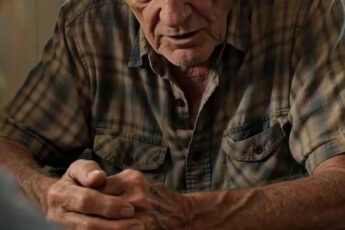
At 9:40 in the morning, the front desk of the Sierra Vista police station smelled like burnt coffee and the city’s mango hand sanitizer. Harlan Peck, eighty-one, set both hands on the counter. He wore a faded mesh cap from his son’s old Army recruiting office. His left hand had a tremor that matched the flicker of a dying fluorescent tube above the records window.
Officer Kyle Briggs, twenty-eight, was working the desk. He had an open protein bar next to the keyboard and a small plastic hula dancer on the corner of his monitor. He didn’t look up when Harlan slid a piece of paper across the counter.
“Help you?”
Harlan said, “I need to file a complaint.”
Briggs peeled the protein bar wrapper down another inch. “What kind?”
“Noise. My neighbors on Avenida del Sol.” Harlan gave the address twice because the air conditioner kicked on and swallowed the first try. “A man and a woman. They had some kind of party at two this morning. Subwoofer against the wall. I knocked, asked them to turn it down. The woman laughed. The man told me to take a sleeping pill and shut the door.”
Briggs did look up then. His mouth was full. “You call dispatch?”
“I called non-emergency at 2:14. A car never came. Music stopped around 4:30, so I drove here.”
Briggs shook his head. “Neighbor noise is city code, sir. We don’t handle that unless somebody gets hurt. You want the magistrate.”
“I want a report. The property manager over at Sun Ridge says she can’t do anything without one.”
Briggs picked up the paper with two fingers. He read the first line, then let it hang. Harlan had written the whole thing in block letters: time, address, names, what the man said. At the bottom he had signed it, and under that, he had written his son’s old phone number. He had never been able to cancel it.
Briggs wadded the page into a ball and dropped it into the trash can next to the desk. The lid swung and wobbled.
“No case,” Briggs said. “No number. Go talk to your property manager.”
Harlan’s mouth went dry. He kept both hands on the counter. “I’ll wait for your boss.”
Briggs laughed once. “Then you’ll wait until tomorrow. Chief’s not in.”
A pain started high in Harlan’s chest, like a zipper closing from the inside. He reached into his shirt pocket. The nitroglycerin bottle came out, and with it a photograph. The photo slid, spun, and landed faceup next to the trash can. A young soldier in a dress uniform stood under a wooden arch. His name tape said PECK.
At that moment the front door wheezed open. A man in a tan chief’s uniform walked in carrying a paper coffee cup. He was built like a fireplug, his sleeves tight at the shoulders. Chief Tomás Herrera. He saw the pill bottle first, then the photograph. He set the coffee on the windowsill and picked up the photo.
The fluorescent tube stopped flickering.
Herrera turned the photo over. On the back, in blue ink: Danny, 2005.
“Danny Peck,” he said.
Harlan drew a breath. “My son.”
“I knew him,” Herrera said. “He was my squad leader outside Baqubah. We were clearing a market street in 2006. A frag came over the wall. Danny knocked me into a doorway. Then he went down on it.” He paused. “I lived. I got out seven months later. Your son didn’t.”
Harlan’s face did not change. He had spent nineteen years not letting it change.
Herrera turned to Briggs. “Pick the complaint out of the trash and smooth it out.”
Briggs opened his mouth. The chief didn’t raise his voice. “Now.”
Briggs bent, retrieved the paper, and smoothed it with the heel of his hand. His ears were red.
“Get a clean intake form,” Herrera said. “Type it exactly. Address, names, what the neighbor said. When you get to the time, use 2:14 a.m., not ‘late.’ Then log it.”
Briggs started to say something. The chief set his coffee on the desk. A few drops splashed onto the keyboard. “I’m not repeating it.”
Briggs typed with two fingers. Harlan read the screen from the other side of the counter. In the box for complainant, Briggs had typed “Harlan Pack,” missing the e.
“It’s Peck,” Harlan said. “P-E-C-K.”
The system generated a number: case 24-0319. Harlan took a small spiral notebook from his back pocket and wrote it down. Then he asked for a printed copy. Briggs printed it. The paper was warm.
Herrera looked at Briggs. “You’re on unpaid suspension for one week. At the end of it, you’ll work the front desk with Mr. Peck’s complaint taped to the monitor.”
Briggs didn’t speak.
“Now,” Herrera said, “you’re going to drive me to Mr. Peck’s house.” He wasn’t asking. “And you’re going to hear what I say to the people who told him to take a sleeping pill.”
They went outside. The monsoon air sat on the parking lot like a wet blanket. The temperature was already ninety-four. A roadrunner stood on the hood of Harlan’s 1998 Buick LeSabre, blue-headed and unbothered.
In the chief’s SUV, Herrera drove. Briggs sat in the back, looking out the window. The chief said, “I’ve had nineteen years to say something to you, Mr. Peck. I wrote your name on envelopes I never mailed. Your son’s face is in my son’s room.” He kept both hands at ten and two. “I didn’t know you were in Sierra Vista.”
Harlan looked at the case number in his notebook. “I kept the house.”
The SUV turned onto Avenida del Sol. The duplex was beige with a carport. A black Ford Ranger sat in the neighbor’s side with the driver’s door open. The subwoofer was off. Kylie and Deke were on the porch. She had a can of Truly, sweating in the heat.
Deputy Alonzo from patrol was already at the curb. He walked up. Herrera stayed by the SUV with Harlan.
Harlan took his front door key from his shirt pocket. But he didn’t go inside. He stood on the sidewalk with the complaint copy in his hand.
Deputy Alonzo went to the porch. “We got a noise complaint for this address from last night.”
Deke came down one step. “It’s daytime.”
Alonzo didn’t take the bait. “City code’s pretty clear after two a.m. You get one warning. But you also told a resident to take a sleeping pill. That’s harassment, if he wants to sign it.” He looked at Harlan. “You can sign the statement.”
Harlan walked over. He took the pen from the deputy. He didn’t say a word. He signed the bottom of the statement on the deputy’s clipboard. The pen made a small scratch, loud in the humid air.
Alonzo tore off a copy and said, “Three hundred fifty dollars.”
Kylie reached past Deke and snatched the copy. “For music?”
Alonzo said, “For a second call, I’ll write it as a class 1 misdemeanor. That’s up to six months, if the judge wants to prove a point.”
Harlan opened his notebook. He wrote 24-0317 under 24-0319. He did not look at Kylie. He said to Deke, “Two numbers. One for the city. One for your landlord. You can move. I’m not going anywhere.”
The chief didn’t speak. He walked around the front of the SUV and stood with the deputy until the porch door closed.
Harlan unlocked his front door. The key stuck for a second, the way it always did. Inside, he went straight to the refrigerator. It was covered with magnets from his wife’s collection: a pizza place in Bisbee, a public library, one shaped like a peach from a roadside stand in Georgia. He put the complaint copy under a magnet shaped like a slice of pie. The paper hung there, case number facing out.
He took the photograph from his shirt pocket and set it on the kitchen table. He sat down. Rain started outside, fat drops on the metal awning.
Through the open window he could hear the deputy still on the porch. Deke said something. Kylie said the word “unbelievable.” Then the patrol car door shut. The bass never came back on.
Harlan opened the bottle of nitroglycerin, shook one into his palm. He took it with a glass of lukewarm water. It tasted like dust.
The last thing he did before the rain cleared: he reached for the phone and called the property manager. The machine beeped.
“This is Harlan Peck on Avenida del Sol. I have a police report number. Case 24-0319. Your renters cost me another night. Next time I’m going to the city attorney.”
He hung up.