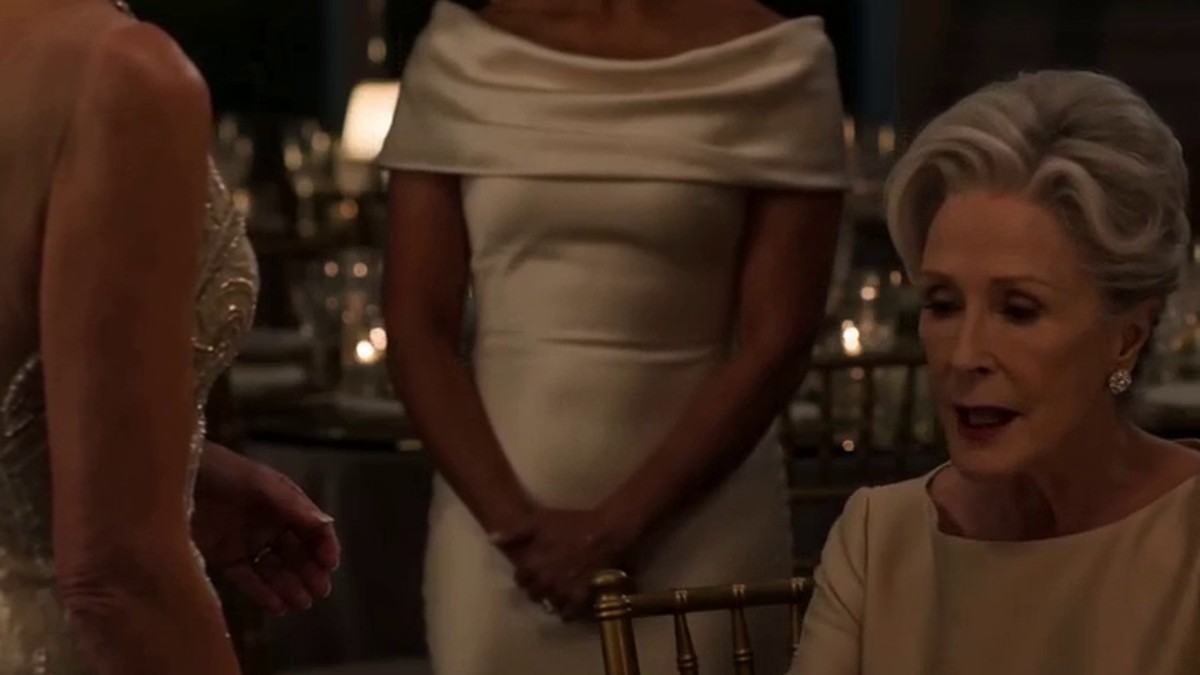
The Ritz-Carlton ballroom on Lake Shore Drive was dripping in champagne light and peonies. Lily had spent fourteen months planning this night. Now, standing beside her new husband, she felt like a piece of sheet music finally being played—every note exactly where it belonged. The string quartet paused. Glasses were raised. A hundred and twenty guests in black tie and silk turned toward the head table.
And then Tom’s mother, Patricia, let her gaze drift across the seating chart and land on the quiet woman in the corner.
“What is that woman doing at the family row?” Patricia asked, not bothering to lower her voice.
Her son-in-law, a vice president of something, smirked into his whiskey. A few cousins glanced sideways. Tom’s father, a man who had long ago learned to let his wife’s weather roll through the room, fixed his eyes on his dessert fork.
Lily’s hand tightened around her flute. “That’s my mom, Patricia. You met her at the rehearsal dinner.”
Patricia tilted her head like a botanist examining an unlabeled weed. “Oh. Right. The one with the… sensible shoes.”
Lily’s mother, Eleanor, was sixty-three years old. She wore a shift dress the color of oatmeal, no jewelry except a thin gold band on her left hand, and she carried a handbag that had been out of fashion for a decade. At that moment, she was placing a napkin on her lap with the same focused care she gave to everything.
Patricia leaned toward Tom. “I thought we agreed the front tables were for people who could carry a conversation. Not… this.” She gestured vaguely.
“Mom, stop it.” Tom’s voice was a tight wire.
But Patricia was a performer and an audience had assembled. “I mean, honestly. We have the Morettis from the club. We have Judge Halstead. And then we have… her.” She looked directly at Eleanor. “No offense, dear. It’s just—well, you might be more comfortable at the back with the photographer’s assistant. People tend to sit where they… fit.”
Lily’s face drained of color. A muscle in her jaw jumped. She set down her glass and half rose, but her mother’s hand, dry and warm, came to rest on her wrist. Eleanor didn’t look at her daughter. She looked at Patricia with a mild, unbothered expression, the kind you’d give a stranger who’d just stepped on your foot in a grocery line.
Patricia laughed, a tinkling bell of condescension. “She doesn’t even speak.”
“Maybe she’s just not interested in your little performance,” Lily shot back, voice shaking.
“Careful, darling. I’m just trying to help. This is a certain caliber of evening, and standards have to be maintained. It’s not a potluck at the VFW hall.”
The quartet struck up again, a nervous fill-in by the bandleader, and conversation at nearby tables stalled. Everyone was watching now. The linen, the flowers, the careful choreography of a perfect wedding—all of it suddenly became set dressing for a live humiliation.
Eleanor finally moved. She bent down, lifted her worn leather handbag onto the table, and set it beside the bread plate.
“Are you leaving?” Tom’s father asked, a note of hope in his voice. If she left, the scene would end.
“No, Michael,” Eleanor said. It was the first full sentence she’d spoken all evening, and her voice was steady, the voice of a woman who had once calmed scared horses during a barn fire.
She unclasped the bag and began to remove a series of manila folders. Not just any folders—heavy, legal-sized, tabbed with names like *Continental Atlantic* and *Lake County Holdings*. Patricia stopped swirling her wine and watched the slow parade of paper. A prosecutorial instinct kicked in somewhere under her Botox.
Eleanor placed the first folder on the tablecloth and turned it so the letterhead faced Patricia. The logo was a blue compass rose. Patricia’s expression didn’t change—she didn’t recognize it. So Eleanor placed a second folder on top of it, this one with a bright green header: *Compensation Review — Q3 — Executive Board*.
Now Patricia’s lips parted. The green header was the exact shade her husband’s company used on internal memos. Michael craned his neck and his face went slack.
“What is that?” Patricia asked, her voice suddenly thin.
Eleanor didn’t answer. She placed a third document on top—a copy of an operating agreement with a signature block at the bottom. Michael’s signature was on page four. Eleanor’s was on page one, one inch to the left, under the word *Owner*.
Patricia’s eyes skipped across the page. Then she stopped. She read again. She looked up at Eleanor, then back at the document, then at her husband.
“Michael? What does she have?”
Michael’s mouth was a straight line. His Adam’s apple bobbed twice. He was looking at Eleanor the way a parishioner looks at a saint’s relic that might bleed.
“Patty…” he managed.
“Michael, what is this?” Her socialite armor clanged as it broke. “Why does she have your employment contract? Why is her name on it?”
Eleanor stacked the folders neatly, aligning the edges with her fingertips. Then she picked up her water glass and took a small sip. The quartet finished a phrase and fell silent again, and in that silence, two hundred people heard a woman in an oatmeal dress say:
“Three years ago, Continental Atlantic was forty-eight hours from Chapter 7. Your husband and his partners didn’t know that because the books had been papered over by a CFO who was buying time in a bottle. I bought the debt on a Thursday night in November. All of it. Seventeen million four hundred thousand dollars. On Friday, I became the majority shareholder. Michael kept his title and his corner office because I saw he was a decent man who happened to have married a woman with the emotional depth of a cocktail napkin.”
Patricia’s mouth worked but produced no language.
Eleanor put the folders back into her bag. She didn’t hurry. “For three years I’ve signed off on Michael’s salary. The bonus you used for this reception. The car lease on your Audi. The country club dues. I never once thought to mention it because, Patricia, I am not in the business of performing dignity. I just have it.”
Lily was staring at her mother as though the ceiling had split open and a hawk had flown out carrying a dictionary.
Tom looked like a man who’d just discovered the last ten minutes of his life had been a fever dream.
Eleanor stood, picked up her handbag, and smoothed the front of her dress. She walked the three steps to where Patricia sat frozen, leaned down, and said in a voice only that table could hear:
“The next board meeting is the twelfth. I’ll save you a seat. But you might want to bring your own chair. This one’s already taken.”
Then she straightened, caught her daughter’s eye, winked, and walked out of the ballroom into the Chicago night. Behind her, the string quartet started up again, a little too fast, and a hundred and twenty people watched Michael loose his tie with a hand that shook like a flag in a gale.
Lily didn’t sit back down. She looked at her husband, then at his mother’s ashen face, and she began to laugh—a bright, unleashing sound that cracked the ice in every glass on the table.