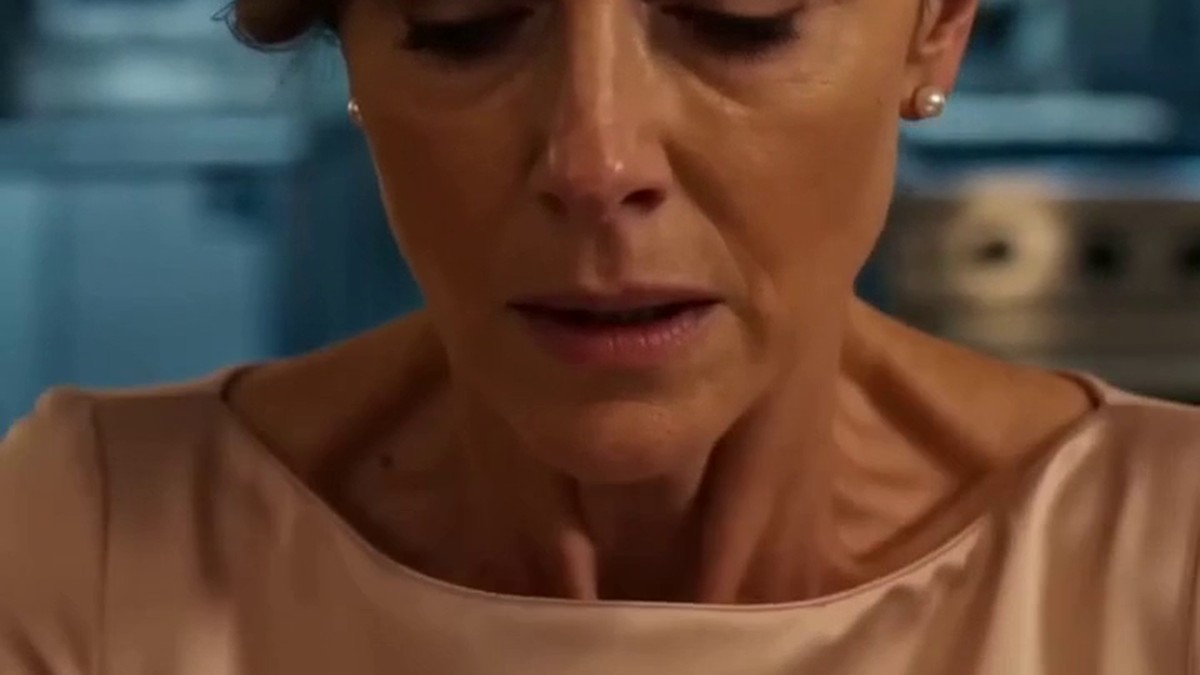
The champagne flute was halfway to her lips when my step-sister’s voice sliced through the toasts. “Oh, that’s Lyla. She’s… well, she’s just a nurse.”
Tiffany laughed like it was the funniest thing she’d said all afternoon, and half the ballroom chuckled along with her because the bride was a Whitmore now, and Whitmores got the laughter they wanted. My dad, Carl, tilted his head back first, his loud, awkward boom drowning out the clinking glasses. He always laughed that way around Meredith’s crowd—too much, too quick, a man who’d climbed out of a tract house in Escondido and never stopped letting the rich know he was grateful to be in the room. My stepmother, Meredith, gave a tight, satisfied smile, the kind that didn’t need teeth. I stood there in my forty-eight-dollar blush dress from the outlet off I-5, surrounded by women in silk and diamonds, and did exactly what I’d done my whole life: I fixed my eyes on the water rings my glass was leaving on the tablecloth and let the laughter roll past until my shoulders ached.
One hundred and fifty guests filled the Whitmore Estate’s Grand Ballroom that afternoon, all there to celebrate Aidan Whitmore marrying the daughter of a man who’d climbed high enough to touch the family’s money. I was seated at Table 15, right next to the swinging kitchen doors, exactly where the bride had put me. Every time the servers pushed through, a wave of garlic butter and something burnt rolled over me, and I hadn’t eaten since the stale granola bar I’d scarfed at three in the morning. I wasn’t part of the bridal party—Tiffany had told her new in-laws I was “emotionally fragile” and couldn’t handle the pressure. The truth was I’d spent the last three years handling everything a twelve-hour ER shift could throw at me while living on coffee and spite.
I work nights at Del Mar General, just north of San Diego, triage and trauma bays, Thursday through Sunday, seven to seven. The plaque they gave me last year for Excellence in Emergency Response still sits in my locker behind a half-empty bottle of hand sanitizer, because the one time I brought it home, Tiffany said, “They give those to staff now? Like, not real doctors?” and my dad nodded along. By then I’d learned to keep my world sealed tight from theirs.
The night that mattered most happened four years ago, on a storm-soaked stretch of the 5 freeway near Oceanside. I was crawling home after a double shift in my ‘08 Corolla that smelled permanently of damp sneakers and coffee, the heater barely blowing, when I spotted a mangled luxury sedan crushed against the median. Inside, a man was pinned from the waist down, conscious but bleeding badly. I couldn’t get the door open—fire rescue was still seven minutes out, the dispatcher kept saying—so I knelt in the rain, braced his head in my lap, and talked to him. Not medical talk. Just stories. He asked about the pearl earrings I was wearing, the ones that had belonged to my mother. I told him everything: how she’d saved up an entire year waiting tables at a diner off the 78, how she’d said pearls meant quiet strength, how I’d never taken them off since she died. Forty-three minutes we waited like that. When the paramedics finally pulled him free, he reached for my hand and couldn’t quite manage the words. I never learned his name. He was just “Trauma Patient 21” in my head.
Back in the Whitmore ballroom, Tiffany was still holding court, her voice bright and sharp. I busied myself with the stem of my water glass and let my mind drift far from the laughter still bouncing off the crystal chandeliers. That’s when I felt it—a stare from the head table that wasn’t casual.
Douglas Whitmore, Aidan’s father, was staring at me like I was a photograph he’d stepped out of. The man was a legend down here: commercial real estate, charity boards, the kind of old money that moved cities. He wasn’t laughing at Tiffany’s joke. He wasn’t even looking at her. His eyes were locked on my earrings, those tiny tear-shaped pearls I’d polished with a dab of toothpaste that morning because I couldn’t find the jewelry cloth, and his face had gone pale.
I saw him lean toward his wife, whisper something. She turned sharply, scanned me, and her mouth opened slightly. “Are you certain?” I saw her mouth. Douglas didn’t answer. He pushed his chair back and stood.
The band’s light dinner music faltered. A server froze mid-pour, a bottle of Cakebread angled over a glass. Slowly, the chatter died section by section, until the only sound was the rustle of Douglas Whitmore’s suit as he walked toward Table 15. Toward me. Tiffany’s smile was still painted on, but it had grown uncertain, the way a person looks when the ground shifts and they don’t yet know why.
He stopped directly in front of my chair. Up close, I saw the faint scar along his jaw that I hadn’t noticed from across the room, the one I’d pressed a sterile pad against four years ago in a downpour. Through my own pulse thudding in my neck, I heard him speak.
“It’s Lyla, right? Lyla Brennan? I heard your stepsister.” His voice was low but carried.
I nodded, my throat too tight for words.
“Forgive me,” he said. “But were you driving home from the hospital on January 17th, 2020? On the 5, just after three in the morning?”
I set my glass down. The champagne shivered in the flute. My hand wasn’t steady, and I didn’t care who saw it. I nodded again.
His eyes glistened. “You stayed. In the rain. You held my head and told me about your mother and her pearls. You told me she’d said to you, ‘Pearls are class, baby, and class doesn’t scream.’”
Now my own vision swam. That exact phrase. The one thing I’d never written down in any report.
“Yes,” I whispered. “That was me.”
Douglas Whitmore straightened, and when he turned back to the room, his voice was no longer low, but it wasn’t a speech. It was just a man who’d been looking for someone for four years and had finally found her. “Everyone, I need you to hear this. Four years ago, I was in a crash that should have killed me. I was pinned, bleeding out, and this woman—Lyla—kept me alive with nothing but her hands and her voice. She knelt in the rain for forty-three minutes, holding my head in her lap, talking to me about pearl earrings and her mother. She’s a nurse. And apparently somebody here thought that deserved a joke.”
Not a single person laughed now. Carl’s face had drained of color. Meredith’s perfect smile was gone. Tiffany’s lips moved, but no sound came out. Her champagne glass dangled uselessly in her fingers.
Douglas didn’t look at her again. He turned back to me and, in the quietest voice meant only for me, said, “I’ve been looking for you for four years. Every investigator, every hospital record—nothing. You gave the paramedics a fake name. I had them searching for a Jane Moss who didn’t exist.” He let out a breath that was almost a laugh. “Why?”
I blinked, and the pressure behind my eyes finally spilled over. “Because you were just a patient. I didn’t want the attention. I’d been awake for twenty-two hours, and I just wanted to go home.”
He nodded slowly, reached into his jacket, and pulled out a business card. “If you ever need anything—a job, a reference, a seat at a table where someone doesn’t call you ‘just a nurse’—you call the number on the back. That’s not an offer. That’s the least I can do.”
I took the card, my fingers brushing his. The edges were soft, as if he’d carried it for a while.
The wedding planner click-clicked across the marble floor and tried to cajole him into returning to the head table for the cake cutting, but he didn’t move. The room was still stuck in a strange, suspended silence, silverware abandoned on plates.
Tiffany’s eyes found mine then, and what I saw in them wasn’t anger—it was the look of someone who had just realized the audience had stopped clapping, and that she’d been the punchline all along. She grabbed Aidan’s arm, but he was staring at me too, his expression unreadable.
I finally took a small breath, stood up from my chair beside the kitchen doors, smoothing the wrinkled chiffon over my knees. “Thank you, Mr. Whitmore,” I said. “But I think I need some air.”
Then I turned and headed for the French doors that opened onto the veranda.
Outside, the twilight had softened the manicured gardens into shadows and gold. I leaned against the stone balustrade and let the salt-tinged air fill my lungs. My face was wet, and I didn’t wipe it. Behind me, I heard the low murmur start up again, the band struggling to pick up where they’d left off. A minute later, the door clicked open and closed. I didn’t turn. I already knew the perfume.
“Lyla.” Meredith’s voice was stripped of its usual syrup. “That was… quite a scene.”
I kept my gaze on the hills. “Yes.”
She stood beside me, not quite touching. “Your father didn’t know. I didn’t know. You never told us about any of that.”
“Would you have listened?”
She was quiet for a long time. Then she said, “Probably not,” and the honesty caught me off guard. “He’s embarrassed now. Carl. He’s sitting in there realizing he laughed at his own daughter in front of the Whitmores.” She paused. “Tiffany’s crying in the powder room. The photographer caught the whole thing.”
I let out a small, unsteady laugh through my nose. “Good.”
Meredith didn’t scold. She just stood there until a server opened the door and called her back for the dessert toast. She hesitated, squeezed my wrist once—a gesture she’d never made before—and disappeared inside.
I stayed on the veranda while the first stars blinked awake. Through the glass, I watched Douglas Whitmore raise a glass. I couldn’t hear the words, but I saw him point to the door where I’d disappeared, and I saw Tiffany, now back in her chair but utterly still, not laughing at all. My dad sat frozen, the wine glass trembling in his hand. I didn’t need an apology from him. The silence at that table said more than any sorry ever could.
An hour later, when I finally slipped out through the side gate and called for a car, a young valet jogged up with an envelope. I gave him a five, and he vanished back inside. The envelope was plain white, no logo. Inside, a short note on a torn piece of paper, handwritten in neat blue ink: *The story you told me in the rain—about your mother telling you never to yell when you could be quiet instead—that’s the thing that kept me awake. I’ve never forgotten it. — D.W.* Under his signature, he’d included the same number from the business card.
I folded the note carefully, tucked it into my clutch next to my hospital ID badge, and climbed into the sedan. The driver asked if I wanted the freeway or the coast. “The coast,” I said. “It’s longer.”
He pulled onto the old highway, and I cracked the window. The air smelled like wet stone and brine. Outside, the Pacific was a black smudge against a blacker sky, throwing ribbons of foam against the rocks. I took the earrings off and held them in my palm—two small moons, warm from my skin, catching the dashboard lights every time we hit a bump. I didn’t put them back on. The pearls sat there, quiet, while Del Mar blurred by, and I let my head fall back against the seat and closed my eyes.