The night Harper Hayes ruined my life, I was standing in a service corridor off the Waldorf Astoria ballroom, discussing a legitimate shipping contract with a senator who laundered his kickbacks through dog tracks. Enzo, my head of security, was three feet away. We’d just shaken hands when the side door swung open hard enough to crack against the wall.
A woman stumbled through it, her emerald gown catching the low sconce light like a ripple of oil on asphalt. She didn’t look at me. She looked back over her shoulder, then forward, and her face was a mask of controlled terror.
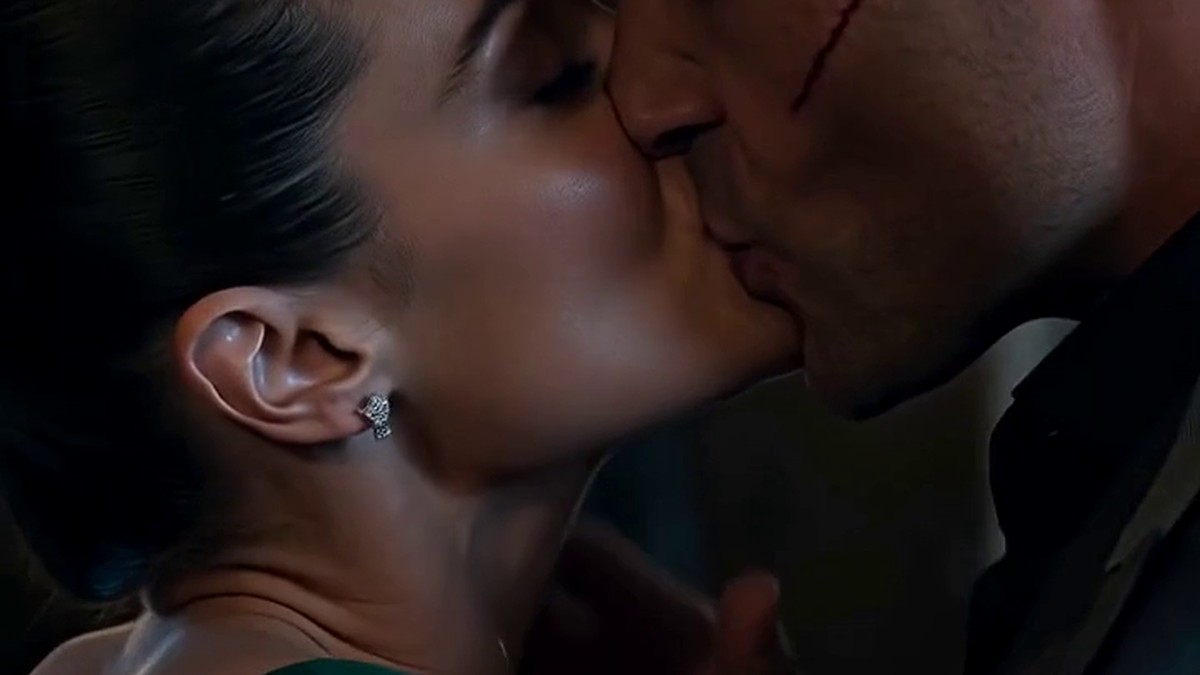
Before I could move or Enzo could draw, she closed the distance. Both her hands grabbed the lapels of my suit—a Brioni charcoal that I’d had fitted in Milan two weeks prior—and jerked me toward her. Then she kissed me.
I froze. Not from shock—I’ve survived six assassination attempts and an improvised bomb beneath my Maybach. I froze because no one had touched me without permission in eleven years. Her mouth was warm and unskilled, and it tasted of cheap champagne and fear. Then I heard heavy, unsteady footsteps rounding the corner, a man’s slurred voice calling her name.
I understood in that fraction of a second. She was running from someone, and she’d used me as camouflage.
A decent man might have pushed her away gently and dealt with the pursuer. I am not a decent man. I am a syndicate leader who last month watched a rival’s fingers be removed without blinking. But the way her fingers clutched my jacket, the way she held her breath against my mouth—this was a creature trying not to drown, and drowning is the only thing I’ve ever respected.
So I put a hand on the back of her neck. Her hair was pinned up, but a few loose strands stuck to my palm. I held her in place and kissed her properly, the way you kiss a woman you’ve been waiting all evening to see. I took control without hesitation, and she let me. When I finally broke the kiss and scanned the corridor, the drunk—a pale, sweating man in a three-thousand-dollar tuxedo—was already stumbling backward. He saw my eyes, not hers, and the color left his face like water draining from a basin.
He ran. I wiped a smear of coral lipstick from the corner of my mouth with my handkerchief and looked down at her. She was young, late twenties, with dark hair and a borrowed-wine sort of elegance that didn’t come from money. Her breathing was ragged, and a single tear had tracked through her powder.
“Thank you,” she said, stepping back. “He wouldn’t leave me alone. I needed him to believe I was with someone.” She stopped when she saw the other men. Three of my soldiers had emerged from the shadows near the private elevator. Each one had a suppressed Glock trained on her ribcage.
“Hold,” I said. The weapons lowered. I tucked the handkerchief away. Her eyes flicked to the scar along my jaw, the line of my shoulders, the way Enzo deferred to me, and I watched her reassess the entire evening. She had no idea whose neck she’d nearly bitten off.
“Do you usually throw yourself at men in dark hallways, or am I special?” I kept my voice low.
She swallowed. “I made a mistake. I apologize. Have a pleasant evening.” Then she gathered that ridiculous skirt and ran. Her heels echoed all the way to the service entrance, and the door slammed shut behind her.
Enzo shifted his weight. “Want me to find out who she is?”
“Later.” I adjusted my cufflinks. “Finish the senator’s paperwork. And get me the surveillance feed from the corridor cameras. I want to know who the drunk was. And why he’s still breathing.”
Over the next forty-eight hours, I learned everything about Harper Hayes. Magna cum laude, heavy student loans, a mother in a memory care unit outside Columbus. No arrests, no dangerous ex-boyfriends, no gambling habit. She worked for a midsized auditing firm and drank her coffee black because milk cost extra. The drunk was a senior partner at a rival company named Braden Ellis. He’d been harassing her for months. That was all manageable.
What was not manageable arrived via an encrypted message from a contact inside Victor Romano’s operation. Victor, the snake who ran the South Side docks, had been probing for weeks. He’d gotten hold of a photograph taken from a hotel security camera—a photograph of me kissing Harper Hayes with enough passion to suggest a decade-long affair. The angle made it look like she was mine, and the caption going around underground channels was even worse: *Russo’s New Bird—Auditor from the North.*
Victor was going to use her. He’d snatch her off the street, break her fingers one by one, and leave what was left of her in the Chicago River. All because she’d grabbed my lapels to escape a pathetic drunk.
I stood in my study at the Lake Forest estate, the photo lying on my mahogany desk, and felt an unfamiliar sensation. Not guilt. Responsibility, hard and immediate, like a rifle bolt sliding home. Harper Hayes was nobody. But she was nobody who’d had the bad luck to bruise her lips against mine, and in my world, that made her blood my debt.
I had Enzo pick her up that Friday evening. She was working late, hunched over tax returns in a cubicle farm on Wacker Drive, and when she walked into the parking garage, I was waiting in the Escalade with the engine running and the folder open across my lap.
She saw the vehicle blocking her ancient Honda. She saw Enzo materialize behind a support column. She saw me through the tinted glass, and her expression didn’t shatter—it hardened. That was the first moment I considered that I might not be dealing with a mere civilian. A cornered rabbit runs. A cornered animal with teeth waits.
She got into the car. I showed her the photograph, the reports, and Victor’s probable timeline. I laid out the only viable option: for the next month, she would play the part of my devoted fiancée. We’d attend enough public functions to make Victor believe she was untouchable, while my people rooted out the traitor in my organization—Harrison, I already suspected—and dismantled Victor’s entire network. If she refused, I’d leave her in this garage, and Victor’s men would find her before dawn. I was not offering a choice. I was offering a calculation.
Harper’s hands were trembling, but her voice came out steady. “You want me to be your bait.”
“I require you to be convincing.”
I expected tears. I expected bargaining. She gave me neither. She looked at the photo, then at me, and said, “Fine.” A single tear tracked down her nose, but she didn’t wipe it. She just said, “I’ll do it.”
That night, I moved her into the east wing of my estate. I handed a pearl-handled derringer to Penelope, my stylist, and told her to fit a holster inside every dress Harper would wear. The derringer had been my grandfather’s, a 1934 Remington over-under that fit in the palm like a prayer. I showed Harper the safety, the trigger pull, and the exact spot beneath her thigh where it would ride. When I slid the cold metal against her skin, my knuckles brushed the warmth of her leg, and I saw her catch her breath. I pretended not to notice. I also pretended not to notice the way my own pulse jumped.
The next two weeks were a slow-burn education in deception. Harper learned to lean into my shoulder when cameras were near, to let my thumb rest in the hollow of her hip, to laugh at the right moments while I whispered Italian threats into her ear. I bought a diamond choker that cost more than her annual salary and fastened it around her neck myself. My fingers grazed the flutter of her pulse. She didn’t flinch. She looked up at me, and somewhere in that gaze was a question I wasn’t ready to answer.
I found myself noticing things about her that had nothing to do with the operation. The way she hummed a fragment of some indie song while sorting silverware in the kitchen at 2 a.m. The way she could tell an Enzo lie from a Maria truth within three seconds. The way she never asked for anything—not better towels, not information about Harrison, not reassurance. She once caught me in my study, going over shipping manifests, and without a word, poured two fingers of Macallan and set the glass beside my elbow. She didn’t stay. She just padded out in her bare feet, and I stared at that glass for five minutes without drinking.
On the night of the auction, everything was set. The event was held at the St. Regis penthouse, a private diamond exhibition where half the state’s corrupt power brokers would be sniffing each other’s pockets. I knew Harrison would be there, standing beside Victor, thinking he was untouchable. I planned to expose him in front of everyone and kill Victor in the same motion. Harper’s job was to be the beautiful focal point that drew their attention just long enough for my men to close the perimeter.
I told her to wear the red dress—the one with the high slit and the low back, the one that left no possibility of hiding a weapon except where the derringer sat against her upper thigh. When Penelope finished pinning her hair, Harper looked like a blade wrapped in silk. I felt something dangerous tighten behind my ribs.
In the Escalade, rain drummed against the roof. I told her, “You don’t have to understand the entire world tonight. You just have to look like you belong beside me.”
She didn’t answer. She just reached over and straightened my tie pin without being asked. The gesture was so casual, so practiced, that for one second I forgot she wasn’t actually mine.
The penthouse chandeliers dripped light onto an ocean of champagne and concealed weapons. When we entered, the room’s temperature shifted. I was used to that. What I wasn’t used to was the way Harper’s hand settled into the crook of my elbow as if she’d been doing it for years. She lifted her chin and shaped a smile that could’ve cut glass.
Victor stood near the diamond displays with Harrison, who was sweating through his shirt. The snake noticed Harper immediately. He made some greasy comment about my “remarkable woman,” and I heard my own voice announce her as my fiancée without any prior plan. The word came out before I could stop it, and I didn’t want to stop it. I just wanted to see Victor’s face tighten.
I told Harper to play it through. She touched my chest, ran a finger along my lapel, and asked Harrison to fetch her a glass of champagne. The way she said it was a death sentence with a smile. Harrison’s hand shook toward his jacket. Victor’s smile cracked. And then the trap snapped.
Harrison drew a pistol and grabbed Harper, dragging her against his chest. The muzzle dug into her temple. My entire field of vision narrowed to that point of contact. I’d been shot before, stabbed, broken bones in three countries, and nothing had ever sparked this kind of cold, elemental killing rage. It wasn’t the tactical failure that angered me. It was his hand on her arm. His blood was on my throat an hour later because of that.
I told him I’d put ten bullets in his skull if he didn’t release her. I meant one.
Harper, with her auditing spreadsheets and her quiet humming, didn’t freeze. She went deadweight. Her full weight dropped like a sack of stone, and Harrison stumbled. Her hand disappeared through the slit of that crimson dress, and when the derringer came up, she fired before I could draw my own weapon. The bullet shredded his collarbone. He dropped the gun. I was already moving.
My first shot didn’t go to Harrison. It went through Victor Romano’s throat. He was raising his own piece; he never pulled the trigger. I fired three more times as I crossed the marble floor, and then I had her. My arms wrapped around her, my hands checking for blood, my forehead pressed to hers while the room erupted and my men cleaned up the survivors.
Her face was pale, but her eyes were clear. “You said I belonged to you,” she said, and her voice shook only slightly. “I wasn’t going to let him take me.”
I kissed her then. Not for cameras, not for strategy. I kissed her with the taste of gunpowder between us and the scar on my jaw pressed to her cheek, and she kissed me back with the same desperate, impossible certainty that had started this whole disaster in a hotel corridor.
By the time the sirens started in the distance, I’d already decided what I would do. I owed her freedom. She hadn’t chosen this life; she’d been shoved into it by a moment’s panic and my own criminal gravity. I had Enzo bring her coat, and I walked her toward the stairwell, away from the bodies.
In the private service elevator, I reached into my interior pocket and withdrew a sealed manila envelope. Inside were a new passport under a different last name, a plane ticket to Edinburgh departing at six a.m., and a cashier’s check for $500,000 drawn on a Cayman account. I held it out to her.
“You’re free,” I said. “Viktor is dead. Harrison is dead. No one will come for you. Take this and walk out before the police cordon forms. I’ll have Enzo drive you to O’Hare.”
She looked at the envelope. She looked at my hand, still smeared with Harrison’s blood. Then she reached up and pressed her palm against my face, her thumb tracing the ridge of the scar.
“You think I want to run?” Her voice was quiet but solid. She pulled the envelope from my hand, not to take it, but to place it on the little metal shelf beside the elevator buttons. She left it there, unopened.
“I’m not a guest you can check out of your life when the operation ends, Dominic. I’m not a loose end.”
She stepped into my space, and her fingers found my lapels again, the same motion from the gala. This time, there was no fear in it. “I already chose. That night, in the corridor. When I grabbed you instead of running in the other direction. I just didn’t know it yet.”
I covered her hands with mine. The elevator chimed and the doors slid open to a loading dock wet with rain. Enzo was waiting by the Escalade, and the sirens were closer now, but I couldn’t move.
I looked down at the woman who had kissed the most dangerous man in Chicago and somehow unraveled thirty-two years of cold calculation without meaning to. I didn’t grin. I’d lost the habit. But something in my face must have shifted, because she gave a small, fierce nod and then stood on her toes and kissed me again, right there in the open doorway while the rain hissed on the concrete.
Enzo cleared his throat. “Boss—the cops.”
“Tell them I’ll give a statement tomorrow.” I pulled Harper into the car before she could change her mind. She settled against my side, her wet hair leaving dark streaks on my jacket, and I realized the envelope was still sitting in the elevator, forgotten. A half-million dollars, a new life, and she’d set it aside like a receipt she didn’t need.
As the Escalade pulled into the rain-slicked streets, I made one phone call. To my lawyer, to initiate the paperwork that would transfer ten percent of my legitimate holdings—about four point two million in real estate and a stake in a shipping company—into a trust with Harper’s name on it. Not because she asked. Because this was no longer a performance. She’d put a bullet in a man for me, and I wasn’t going to let her wake up tomorrow thinking she was still just bait.
Harper fell asleep with her head against my shoulder before we reached the estate gates. I watched the city lights blur past the window and let myself feel, for the first time, the weight of a life I’d chosen instead of one I’d inherited.
The next morning, she’d wake up in my bed for the first time, and I’d tell her that her mother’s care facility had been paid in full for the next decade. I’d hand her a set of keys to an account in her own name, and I’d watch her realize she wasn’t trapped anymore—not by debt, not by fear, and not by me.
But I already knew she wouldn’t leave. Because she’d already thrown away the exit. Because when she’d kissed me that first time, she hadn’t just picked a stranger in a hallway. She’d picked the one man in Chicago who would burn the city down before he let anyone touch her again. And somewhere along the way, I’d stopped pretending that was just part of the job.