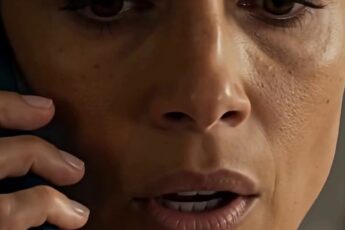
The bread wasn't just stale. It had a gray-green patch the size of a quarter, and when Elena Vasquez poked it with her plastic knife, the crust crumbled like drywall.
She pressed the call button without looking up from her book. The chime sounded twice before a pair of polished oxfords stopped at her row.
"Something wrong?" The flight attendant's voice had that practiced, melodic pitch they teach in airline customer service seminars. His name was Dale Morton, according to the brass pin above his pocket. Elena had noticed him earlier because his tie matched his socks, and that mattered to him.
"The bread on my tray has mold," she said. "I'd like a replacement meal. Same as everyone else got."
Dale's eyes traveled over her, taking inventory. The worn Braves cap pulled low. The faded Georgia Tech hoodie with a coffee stain on the sleeve. The sneakers with the left toe scuffed white from a hundred airport floors. He'd already made his decision before he opened his mouth.
"Mold?" He leaned forward, eyebrows raised in theatrical concern. "Huh. Should feel like home, then. Rat traps don't usually complain about the crumbs they find."
His laugh was a short, dry bark. A woman across the aisle pretended not to hear.
Elena closed her paperback and set it on her tray table, spine facing up. *Fundamentals of Composite Wing Design*, fourth edition. She had read the section on fatigue tolerances three times that morning, mostly because her mind kept drifting to the emergency cabin light prototype waiting for her in Phoenix.
"Your name is Dale?" she asked.
"That's right."
"Dale, I'd like to speak with the purser."
He clicked his tongue. "The purser doesn't handle complaints from people who wander in from the terminal floor. But I'll tell you what I'll do." He reached down and plucked the bread from her tray with two fingers, the same way someone would pick up a dead roach. "I'll bring you a fresh roll. Warm. How's that for service?"
He was gone before she could respond, already greeting the suited man in 3C with a "Good morning, Mr. Cartwright! Your usual?"
The cabin smelled like coffee and hand sanitizer. The weather outside was Atlanta gray, thick with May humidity that fogged the jet bridge windows. Elena's wife, Priya, had called at 5:12 that morning to say their daughter had lost her first tooth, and would Elena be home for dinner to see the gap. The connection had been lousy, the words breaking up, and then the call dropped altogether.
Elena pulled out her phone to text Priya: *Boarding now. Home by six unless this storm delays us again.* Then she deleted it and wrote: *Tell Sofia the tooth fairy accepts credit cards now. Inflation hit the fairy market too.*
Seat 2A had the best view of the wing. That was why she booked it every time. Not for the legroom, not for the champagne. For the wing, and for the hum of the hydraulics before takeoff, and for the way the morning light hit the trailing edge flaps at exactly 9:40 on a southbound departure.
Under her thumb, the cover of the paperback was warm and a little damp. She rubbed at a smear on the corner — coffee, maybe, from the terminal — and thought about the emergency floor lighting sitting on her lab bench back in Phoenix, still failing its cold-soak test at eleven degrees below spec. Her company, Vasquez AeroSupply, had won the contract to build those units for part of this fleet, and the failure was hers to fix by Friday, not some abstraction on a spreadsheet. She hadn't slept well because of it.
The purser, a compact woman with silver-streaked hair and a Jacksonville drawl, appeared at Elena's side while Dale was still laughing with Mr. Cartwright about something in the aisle.
"Mrs. Vasquez? I'm Teresa. I understand there was an issue with your meal."
Elena told her what happened, using Dale's exact words. Teresa's expression changed like someone had flipped a switch.
"I am so sorry," she said. "That's completely inappropriate. I'll speak with him right away."
"Don't fire him," Elena said. "Just have him understand."
Teresa blinked. "I—of course. We'll handle it internally."
"Good. And the bread?"
"Right away."
Behind the thin curtain, in row 21, a retired bookkeeper named Margaret Okafor watched through the gap. She was flying to Phoenix to meet her first great-grandchild, a two-day-old girl named Amara, and she had caught the entire exchange in first class. She had seen the way the young flight attendant's shoulders tightened, the way the woman in the black hoodie kept her hands flat on her tray table, the way she didn't raise her voice even though her jaw was set.
Margaret had worked at a county courthouse in DeKalb County for thirty-one years before retiring. She knew what quiet authority looked like. It looked like a woman who didn't need to tell you who she was.
Part 2: The Captain's Personal Welcome
The flight was twenty minutes from Phoenix when the cockpit door opened.
Captain David Ruiz stepped into the cabin at 35,000 feet, stretching his legs. He was a tall man, silver-haired at the temples, with the kind of unhurried walk that made nervous fliers relax. He exchanged a few words with a teenage boy who had been invited to see the cockpit in Denver. He signed a boarding pass for an older couple celebrating their fiftieth anniversary. Then he stopped at row 2.
"Elena Vasquez," he said. "I thought that was you."
She looked up from her book. "David. They got you doing the Phoenix run now?"
"Three months. My wife got transferred to Banner Health." He crouched in the aisle, lowering his voice. "Listen, I know you don't like the fuss, but my first officer's got two hundred hours in this fleet. You mind signing something for him? His kid wants to be an aerospace engineer. Girl, twelve years old."
"Signing what?"
"His logbook. Just your name. He'll know."
Elena glanced toward the galley. Dale was standing near the beverage cart, watching the captain with the kind of frozen expression that comes from realizing you've made a very expensive mistake.
"Bring him out," Elena said. "I'll say hi."
The first officer, a red-haired man named Kowalski, emerged looking like he'd just won a scratch-off ticket. He held out a worn logbook, and Elena wrote: *To Emily — keep your eyes on the math. It never lies. — Elena Vasquez.*
The captain spoke again, a little louder than before, though not for effect — he simply forgot to check himself. "We've got Vasquez AeroSupply to thank for part of the emergency lighting on this bird. My crew ran an evacuation drill last month, shaved fifteen seconds off the old numbers. That's not nothing."
Dale had gone very still by the galley, organizing sugar packets that were already organized.
"You should make an announcement," Captain Ruiz said to Elena, his tone lighter now. "First class could use a little excitement."
"I'll leave the announcements to the professionals, David. You just get us home."
The captain touched the brim of his cap, a small salute, and disappeared back into the cockpit with his first officer trailing behind like a puppy.
Part 3: The Woman in Row 21
The cabin had settled into that lazy hum that comes before descent, when people start gathering their magazines and checking their seatbelts. Elena was writing in the margins of her book, something about high-cycle fatigue in aluminum-lithium alloys, when she heard a soft voice behind her.
"Excuse me."
She turned. A woman with beautiful dark skin and silver braids, wearing a peach-colored cardigan, was leaning across the aisle from the economy section. Her eyes were kind, but there was something fierce in them too.
"I saw what he did to you," the woman said. "The way he spoke. That wasn't right."
"I appreciate that," Elena said.
"I worked forty years in a courthouse," the woman continued. "I've seen people judged by the shoes they wear more times than I can count. Judges with dirty sneakers. Lawyers with wrinkled suits."
"Some habit of yours, watching people that closely?"
Margaret laughed, a short surprised sound. "Occupational. You spend three decades in a courthouse, you learn to read a room before it opens its mouth. I'm Margaret."
"Elena."
"A beautiful name. Your parents?"
"Guatemalan. My father came over in '82. Worked assembly lines in California before he got his green card."
Margaret nodded, the way people nod when they recognize the shape of a story. "My grandmother was a midwife in Sierra Leone. Died before I was born, but my mother said she could tell a person's whole life story from the way they held a cup."
"What does mine tell you?"
Margaret studied her for a moment — the hoodie, the dog-eared paperback, the two hands still pressed flat against the tray table, like they'd forgotten how to unclench. "That you've been holding something back since that man opened his mouth, and you're not sure yet if you're going to let it go."
Elena didn't answer that. She looked down at the book instead, at a sentence about stress concentrations she'd already read twice.
The two women talked for another few minutes, voices low. Margaret was going to meet a great-granddaughter two days old, named Amara, and she said the baby's mother had wanted a name that meant "grace." Elena said that was a good thing to be named, and meant it, and didn't say much else about her own family — just that there was a wife who worked in pediatric oncology, and a daughter who'd recently lost a tooth.
When the seatbelt sign chimed, Margaret said, "I'll be praying for your safe landing."
"Thank you," Elena said. "I could use that today, actually."
She didn't say why. Margaret didn't ask.
Part 4: The Descent
The plane touched down at Phoenix Sky Harbor at 2:47 PM, seven minutes ahead of schedule. The captain's voice came over the intercom, smooth and practiced: "Ladies and gentlemen, welcome to the Valley of the Sun. Local time is 2:47, and we're looking at a warm 96 degrees outside."
Elena gathered her duffel from the overhead bin, a worn leather bag she'd bought in Marrakesh twelve years ago, and slipped her book inside. She was one of the last to deplane, pausing to shake Captain Ruiz's hand at the cockpit door.
"Tell your first officer his kid's got good instincts," she said.
"She's got her mother's brain," Ruiz replied. "My wife's the engineer."
"Smart family."
"Always has been."
Dale was standing by the forward exit, his face fixed in a rigid customer-service smile. He held out a small white paper bag.
"Mrs. Vasquez," he said. "I wanted to apologize. And to give you this. It's a pastry from the first class galley. Cinnamon roll, warmed."
She stopped. The bag was crinkled, like it had been handled too much.
"Who told you to do that?" Elena asked.
"No one. I just—I realized who you were. The captain said—" He stopped, swallowed. "I made a mistake. I'm asking you to accept my apology."
The other passengers filed past, glancing sideways. Margaret was still in row 21, watching through the gap.
Elena felt something tighten low in her chest, an old, familiar heat she'd learned a long time ago not to let reach her face. She thought of her father, thirty years in a paint shop in Fresno, coming home some nights with his jaw clenched the same way hers was clenched now, saying nothing about it at the dinner table. She breathed once, slow, and let her shoulders drop half an inch.
"I don't want the pastry, Dale."
"I understand. I just—"
"You don't, actually. Not yet." She looked at the bag in his hand, at the grease spot already spreading through the white paper. "Bread with mold on it, and a joke about rat traps. That's what I'll remember about this flight. Not the captain, not the logbook. That."
Dale's jaw worked. He didn't say anything.
"I'm not asking the airline to fire you," she said. "That's not why I'm standing here, and it's not my job." She picked up her suitcase. "I hope you're better at this tomorrow than you were today."
She stepped past him and walked into the jet bridge, leaving him holding the bag.
Part 5: The Baggage Claim
Elena found her suitcase at carousel 4 and was wheeling it toward the exit when she felt, more than heard, someone fall into step a few feet behind her. She glanced back. It was Margaret, moving slower with her cane but closing the distance with the kind of determination that comes from having somewhere specific to be.
"Mrs. Vasquez."
Elena stopped. "You heard him call me that."
"I heard the captain call you that. And I did some arithmetic on the way down the jet bridge." Margaret's eyes crinkled, not unkindly. "Vasquez AeroSupply. I read the annual report once, years back, when my grandson worked for one of your suppliers. Didn't put the name to the face until just now."
"It's not a secret."
"No. But you let that boy hand you a cinnamon roll like you were a stranger to him, when you could've said your name at the start of this whole thing and watched him fall over himself." Margaret shifted her weight onto the cane. "Why didn't you?"
Elena looked toward the sliding doors, where the heat outside blurred the parking garage into a shimmer. "Because it wouldn't have taught him anything. It would've just taught him to be careful around people who might be important. That's not the same as being decent to people who aren't."
Margaret considered that for a moment, turning it over like she was still deciding whether she agreed.
"My great-granddaughter's two days old," she said finally. "I'm going to go meet her in about forty minutes, and I intend to tell her, someday, about the woman on the plane who didn't raise her voice." She reached out and touched Elena's arm, briefly, the way you'd touch a rail to steady yourself. "That's all. I just wanted to say it before we walked out different doors."
"Congratulations, Margaret. On Amara."
"Grace," Margaret said. "That's what it means."
She turned and made her way toward the taxi line, cane tapping an unhurried rhythm on the tile, and didn't look back.
Elena stood there a moment longer, then picked up her suitcase and walked toward the sliding doors. The automatic glass parted, and the Arizona heat came at her like a wall, dry and total, the kind that made the inside of your nose feel like paper. She stepped through it without breaking stride, already thinking about the cold-soak test waiting on her bench, about Sofia's gap-toothed smile, about the wing at 9:40 catching the light exactly the way it always did.
Behind her, through the glass, Dale was still standing near the crew exit with the paper bag in his hand, the grease spot now the size of his palm, watching her walk into the heat until the doors closed and the reflection swallowed him whole.
—
**Epilogue**
Three weeks later, Elena sat at her desk in the Vasquez AeroSupply offices in north Phoenix, going through a stack of vendor invoices, when her phone buzzed. Priya, calling from the hospital between shifts.
"Sofia lost the second tooth," Priya said. "Top one this time. She looks like a jack-o'-lantern."
"Tell her the tooth fairy's running a two-for-one special."
"You're going to spoil that kid's understanding of currency."
"She's seven. Currency can wait."
Priya laughed, then paused. "Hey — you never told me how the Phoenix flight was. You sounded off when you landed."
Elena looked at the invoice in front of her, a routine order for LED strip lighting, three thousand units, destined for a regional carrier's new fleet. She thought about the grease-stained bag, about Margaret's cane tapping away toward the taxi line, about the gray-green patch on a piece of bread that had cost a young man nothing to replace and everything to admit.
"It was a good flight," she said. "The wing looked nice at 9:40."
"That's all I get?"
"That's all there is." She signed off on the invoice and set it in the outbox. "I'll be home for dinner. Tell Sofia to put the pillow out early — I want to see her face."
She hung up, slid the phone into her pocket, and got back to work.