The line clicked and my son’s voice came through before I could even say I’d landed. “Mom, just grab a cab. We’re tied up.” I gripped the phone and watched a family of four melt into a hug ten feet away. Denver International was all wet coats and the hum of a floor waxer somewhere behind me. I hadn’t slept since the Zurich departure gate. Forty-one years of marriage had ended with Arthur lowered into frozen ground in the village where he was born, and now my legs felt like wet wool.
“Kyle, I haven’t slept in three days.”
“Dad’s gone, Mom. You can’t guilt everyone into your grief.” He exhaled into the receiver. In the background a child shrieked, my grandson, then something about the truck. “I already told Melissa I’m taking Grandpa’s Silverado. Don’t make it weird.”
My throat shut. The phone stayed warm against my ear long after the line went dead. I scrolled to my daughter’s number and tried her. Melissa answered with a sigh that could have peeled paint. “We knew Dad was sick, Mom. It wasn’t a surprise. You can get yourself home.”
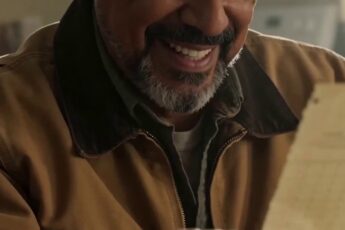
I sank onto a bench near the baggage carousel and watched a young couple argue over whose suitcase was whose. My bag hadn’t made the connection through O’Hare — the woman at the counter had been kind about it — so there was nothing to wait for. Outside the tall windows, a January sleet needled the tarmac. I thought about Arthur, who every morning of our life together slid a small sealed envelope into the breast pocket of his coat before leaving for the hardware store. “Bills,” he’d say, patting the pocket. I never asked. Forty-one years and I never once asked.
The cab driver leaned on his horn and pointed at my empty hands. “No luggage, ma’am?”
“No luggage.”
He drove me to a house on Cottonwood Lane in Fort Collins. The porch light was on. I could hear the grandkids through the front door. My key still turned the lock.
Inside, the first thing I saw was the tape. Blue painter’s tape, the cheap kind. Strips of it stuck to the rocking chair Arthur’s father built. To the cherrywood china cabinet. To my jewelry armoire. Names in my son’s handwriting: KYLE. MELISSA. CODY. They’d labeled forty-one years of marriage like a garage sale.
Melissa appeared from the kitchen with a dish towel on her shoulder and glanced at the cab pulling away. “Finally. What took so long? We had to feed the kids without you.”
I didn’t answer. I walked past her toward the stairs, my carry-on thumping each step.
“Fine. Give me the silent treatment. Real mature.”
I closed the bedroom door and sat on the edge of the bed Arthur and I had shared since Carter was president. His flannel shirt was still folded on his pillow where I’d left it before Switzerland. I held it to my face.
Then I remembered the Zurich cemetery. A young man in a borrowed blazer, two sizes too big, had waited near the grave until everyone else drifted toward the cars. “You’re Eleanor?” he’d asked. “Your husband paid for my mother’s cancer surgery. Eleven years ago. She’s still alive because of him.”
I still didn’t know what to say.
Now, in the bedroom, I pulled out my phone and found the number a producer from the local NBC affiliate had left the week before Arthur died. Rebecca Hart. She’d wanted to do a profile on him after hearing about some anonymous donations. I’d said no then, told her Arthur was a private man.
She picked up on the second ring. “Eleanor. I heard. I’m so sorry.”
“Rebecca,” I said. My voice came out steadier than I felt. “Is that offer still open?”
A pause. “It was always meant to be.”
“Come at six. I’ll have his records ready.”
“Eleanor…” She hesitated. “I need to tell you something. Arthur came to the station three months ago. He asked me to wait until you called. He said I’d know when.”
My hand tightened. “What did he want?”
“He insisted I explain in person. At six.”
I hung up and looked at the flannel shirt in my lap. I didn’t go down for dinner.
Before dawn I let myself into Arthur’s study and opened the bottom drawer of his desk. Inside lay a leather portfolio I’d never seen. In forty-one years I’d have closed the drawer and walked away. This time I opened it.
A ledger in his small, careful print. One line stopped my breath: March, three years prior. $22,000 transferred to a Denver children’s hospital. In the margin: *Kyle’s debt resolved.*
My son had told me he’d “sorted out” that bankruptcy himself.
I took the portfolio, slipped out the back door, and did the one thing Rebecca had asked. I walked through the dark house and pulled back every curtain. Gray January light spilled into every room. Nobody noticed me leave.
At six that evening the family gathered in the living room with plates of pot roast. Kyle had already claimed Arthur’s recliner, the one with the blue tape strip still on the armrest. “Once we sort out the truck,” he was saying to Melissa, “we should unload the cabin in Estes Park.”
“Fine by me, long as I get my share.”
A commercial for a local dealership ended, and the anchor’s voice cut in. “Tonight, a story forty-one years in the making.”
The screen filled with my face, sitting in Rebecca’s studio that morning, hands folded in my lap. My granddaughter Lily’s fork hit her plate. I heard her whisper, “Grandma?”
I spoke about a man who mailed letters every morning. About sealed envelopes I’d never opened. Then Rebecca’s narration took over, steady and precise, as the screen showed photographs. “Over the last thirty years, Arthur quietly funded cancer treatment for seven local children. Sent four veterans through trade school. Paid off a widowed neighbor’s mortgage. Established a community college scholarship under a name that wasn’t his.”
Melissa’s mouth hung open, a piece of meat forgotten on her fork. A woman appeared on screen, dabbing her eyes. “I never knew who paid until the funeral home handed me a letter last week.” A young mechanic in grease-stained coveralls: “Arthur saved my daughter’s life. I figured he was just some guy passing through.”
Kyle was halfway out of the recliner. “Turn this off.”
Nobody moved.
Then my voice returned, quiet through the speakers. “His name was Marcus. I met him at the burial in Zurich. My husband had paid for his mother’s heart surgery ten years ago.”
The image cut to our living room, filmed through the front window that morning. The blue tape on the rocking chair. My son’s handwriting on my jewelry armoire. A slow pan across the labeled furniture as Rebecca’s voice-over said, “Arthur came to our station with one condition. Whatever we aired about his life, we aired only when his wife was ready. And he asked us to stand between her and anyone who tried to take what was hers.”
Kyle lunged for the remote, but Lily already had it. She stared at the screen, tears cutting tracks down her cheeks.
Rebecca’s voice softened. “Arthur left his entire estate to a charitable trust, finalized the day of his burial. His sole trustee: his wife, Eleanor.”
The room went airless. Melissa whirled on me. “Mom, what did you do?”
Kyle’s face was blotched red. “Was there a codicil to the will? Is there something you’re not telling us?”
I opened the ledger to the marked page and held it out. “Three years ago, when you came to him for help, he didn’t hesitate. He paid the $22,000 you owed and never asked for a dime back. Never mentioned it again.”
Kyle’s mouth worked soundlessly. Melissa stared at him like she’d just found a stranger in her kitchen.
“And instead of thanking your father after he died,” I said, “you walked into this house and labeled his furniture while I was still in the air.”
“We didn’t know you needed us that much,” Melissa whispered.
“Neither of you came to the funeral.”
The news segment ended. The anchor moved on to weather. No one moved.
Lily crossed the room and put her hand on my wrist. “Grandma, I’m sorry.”
I lifted her chin. Then I walked upstairs, peeled the blue tape off Arthur’s rocking chair, and sat down. For the first time since Switzerland, I slept.
Weeks passed. I was at the foundation’s small office downtown, a converted dry cleaner’s on College Avenue, with a stack of scholarship applications in a manila folder. Rebecca brought me coffee without asking how I take it. She already knew.
My phone lit up on the desk. Lily’s name. A single line underneath: *Can I come this weekend?*
I poured a second mug of coffee, set it across from mine the way Arthur had done every morning for forty-one years, and typed back one word: *Yes.*
Then I opened the top application, from a girl in Greeley who wanted to study nursing, and signed my name on the approval line. The fund’s first check — $4,500 — clipped to the page. I didn’t hear Arthur’s voice in my head or feel some grand cosmic shift. I just heard the scratch of the pen and the hum of the heater, and I knew that the mail would go out tomorrow morning, same as it always had.