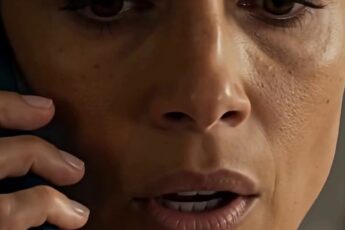
The rain didn't care about anything. It hammered the awnings along Southeast Hawthorne, turned the gutters into creeks, and plastered yellow leaves to the sidewalk. Jenna Harper had stopped noticing the wet three blocks ago. Her jacket clung to her shoulders, and her son Eli was tugging her sleeve, asking if they could stop for hot chocolate at the shop with the red door.
"After we get your tooth fixed," she said, though the dentist's office was still half a mile away.
Eli was six, small for his age, with dark hair that curled at the ends when it got wet. He walked half a step behind her, splashing in puddles on purpose. She didn't scold him. She never did. There was a reason.
Six years ago, Jenna had walked out of St. Vincent's Hospital with one baby in her arms instead of two. The second one—a twin, a boy, barely three hours old—had vanished during the fire evacuation. Smoke, panic, a broken sprinkler system, and a hospital administrator who kept saying the records showed only one live birth. She'd spent the next six years trying to prove him wrong.
She'd failed.
Now she was just a mother taking her son to get a cavity filled. The storm was just weather. The world was just damp.
Then Eli stopped dead on the corner of 39th and Division.
"Mom."
Jenna walked three more steps before realizing he wasn't beside her. When she turned, he wasn't pointing at a puddle or a dog tied to a bike rack. He was pointing across the street.
"Look."
Under the blue tarp strung between a shopping cart and a plywood wall, a boy sat on a milk crate. He looked about Eli's age. His T-shirt was the color of dishwater, his jeans ripped at both knees, his sneakers had holes where the toes should have been. In his hands he cradled a half-eaten burger from the 24-hour stand on Powell. He ate it slowly, like each bite was a coin he couldn't afford to spend.
A small brown dog lay at his feet, matted and shivering, one eye half-closed.
Jenna's breath caught. Not because of the dog. Not because of the boy's clothes.
It was his face.
That dark hair. Those eyes, set just so. The way he tilted his head when he chewed, like he was listening to something no one else could hear.
Eli took a step toward the crosswalk. "He looks like me, Mom."
Jenna put a hand on Eli's shoulder, but her fingers didn't feel like her own. She was seeing double. Two boys. One in a yellow raincoat and dinosaur boots. One on a milk crate in the rain.
The boy lifted the burger to his mouth. The sleeve of his T-shirt slid down. And there, just below his left ear, was a round red birthmark the size of a dime.
Jenna's umbrella hit the sidewalk.
She didn't pick it up.
Because that mark. She had kissed that mark on a baby's neck. She had traced it with her finger through the plastic of an incubator while a nurse told her to rest. She had watched the security footage of a hallway, over and over, looking for a glimpse of that mark, and found nothing.
She had been told, by a man in a white coat with a clipboard, that she was confused. That the fire had been traumatic. That there had only been one baby. That the other one had been a stillbirth, and the body had been lost in the fire.
But there it was. On a boy under a tarp in Portland, Oregon, eating a cheeseburger like it was the last thing he'd ever own.
Jenna's legs went out from under her. She grabbed the pole of a parking meter to stay upright. The cold metal bit into her palm.
"Mama?" Eli's voice was small again.
Jenna couldn't answer. She was six years in the past, in a hospital hallway, wearing a paper gown, screaming at a man named Dr. Orson who wouldn't look her in the eye. The smoke had been thick. The alarms had been deafening. A nurse had pressed a bundle into her arms—one bundle, not two—and said, "We need to get you out now." She'd tried to tell them. She'd tried to show them the marks on her arm where the IV had been, tried to tell them there should be two. But the records had been "lost" in the fire. The security footage had been "corrupted." The case had been closed in eleven weeks.
Eleven weeks. Not six years. Eleven weeks was all it took for the system to decide she was delusional.
Now the rain fell harder, and the boy under the tarp looked up.
His eyes locked on hers.
He didn't run. He didn't look away. He just kept chewing, slow and deliberate, like he'd been waiting for her to see him.
Eli tugged her hand. "Mom, that's my brother, isn't it?"
Jenna just started walking across the street. The crosswalk signal was red, but she didn't care. A car honked. A bicycle swerved. Eli followed, gripping her jacket.
The boy didn't move. The dog stood up and growled, a low rumble.
Jenna stopped at the edge of the tarp. The rain dripped off the plastic onto her hair. She could smell wet cardboard, old grease, and the sour tang of unwashed clothes.
"What's your name?" she heard herself ask.
The boy swallowed. He set the burger down on a piece of newspaper, careful, like it was a jewel.
"Joey," he said.
Jenna's heart cracked. Joey. She'd named him in her head, all those nights alone. Joseph, after her father. But the hospital had never let her sign a birth certificate for him. The state had said there was no record of a second child.
"Joey," she repeated. The word felt like a key turning in a lock that had been rusted shut.
The boy reached into the pocket of his jeans and took out something small and flat. A plastic hospital bracelet. Cracked and yellowed, but the lettering was still faintly visible. "Baby Boy H." was all it said. The H was smudged, but Jenna knew.
Her own bracelet, the one from that night, was in a shoebox under her bed. It said "Harper, J." on one side and "Baby Boy/1" on the other. The state had issued a new one for the baby she took home. There had never been a bracelet for the second one. Or so they said.
"Where did you get this?" Her voice came out like a wire pulled too tight.
The boy shrugged. "The lady. She said a nurse gave it to her in the parking lot that night. She said my real mom would come find me. She said to keep it."
The lady. The woman who had taken him. The woman who had lied to the police, who had hidden him for years, who had raised him in a trailer in Gresham until she died of a fentanyl overdose in a motel room on 82nd Avenue. The boy had been on the streets for nine months. He'd been seven blocks from Jenna's apartment the whole time.
Jenna's hands shook. She took out her phone and dialed 911.
The operator asked what her emergency was.
"I found my son," Jenna said. "The one the hospital said didn't exist. He's been living under a tarp. I need an officer here now. And I need a DNA test. Not the kind you can lose. The kind you can't."
The operator asked for the location. Jenna gave it.
Then she turned to Joey. She knelt in the wet, ignoring the puddle soaking through her jeans. The dog sniffed her hand, then licked it.
"You're coming home with me tonight," she said. "You and the dog."
Joey looked at Eli. Eli looked at Joey. Neither of them smiled. They just looked at each other like two mirrors set at an angle.
The police came. A social worker came. A detective came. Jenna refused to let Joey out of her sight. She didn't take her eyes off him. She reached for his hand and gripped it, hard enough to feel the bones. The police took her statement. The social worker took Joey's. They took the bracelet as evidence. They took a cheek swab from both boys.
The test would take five days. Jenna didn't leave the station for the first twelve hours. Then she went home, with Joey and the dog. She made up the couch in the living room. She gave the dog a can of tuna. She sat on the floor and watched Joey sleep.
For five days, she didn't sleep. She didn't eat. She just watched the two boys breathe in the same room. Eli in his bed, Joey on the couch, the dog at their feet.
On the fifth day, the phone rang at 7:14 a.m. The detective said, "It's a match. 99.99%."
Jenna put the phone down. She walked to the closet in the hallway. She took out the shoebox. Inside was the bracelet from the hospital, a photo of herself pregnant, and a letter she'd written to Joey every year on his birthday—six letters, never sent. She took the letters and the bracelet and put them in a manila envelope.
Then she called Dr. Orson's office.
She didn't make an appointment. She didn't ask to speak to him. She just said, "Tell him Jenna Harper is coming in at 2:00 p.m. with the proof he said didn't exist. Tell him to bring his attorney."
She hung up.
At 2:07 p.m., Jenna walked into the office on Southwest Barnes Road. The receptionist tried to stop her. Jenna didn't slow down. She walked past the desk, down the hall, and into the corner office with the big window and the diploma from OHSU on the wall.
Dr. Orson was sitting at his desk. He looked up, and his face went the color of old concrete.
Jenna dropped the manila envelope on his desk. It landed with a thud.
"Open it," she said.
He didn't move.
"Open it, or I'll open it for you and read it out loud in the waiting room."
He opened it. Inside was the DNA report, the copy of the police report from the night of the fire, the six unsent letters, and a photograph of the two boys standing side by side in Jenna's kitchen, both holding the same half-eaten cheeseburger.
Dr. Orson read the DNA results. The paper shook in his hands.
"That's your signature on the discharge report," Jenna said. "The one that says 'single live birth.' The one that got the case closed in eleven weeks."
"I—" he started.
"Don't," she said. "You don't get to talk. Not after six years."
She reached into her purse and took out one more thing: a small brass key. She set it on top of the envelope.
"That's the key to my front door," she said. "The one I'm giving to my son when I get home. The one I never got to give him because you decided he didn't exist."
She turned and walked out.
The last thing she heard was the sound of the key sliding off the envelope and hitting the desk.
That evening, Jenna stood in the doorway of the spare bedroom. The one that had been locked for six years. The one with the crib still in it, covered in a white sheet. She yanked the sheet away. The crib was dusty. The mobile still worked. It played "Twinkle, Twinkle, Little Star."
She took Joey's hand and placed the brass key in his palm. She folded his fingers over it.
"This is your room now," she said. "The crib goes out tomorrow. We'll pick out a bed."
Joey looked at the key, then at the crib, then at the open door of Eli's room across the hall.
"Can Eli sleep in here too?" he asked.
Jenna's throat closed. She didn't smile. She just said, "Yeah. We'll figure it out."
The dog padded into the room, sniffed the crib, and curled up on the floor.
Jenna closed the door behind them.
The rain had stopped.