Marlene Cutshaw hadn't spoken to her father in eleven years when the letter showed up in her mailbox on a Tuesday in March, wedged between a Lowe's flyer and the water bill.
She recognized the handwriting before she read the return address. Small, cramped, slanting hard to the left — the same hand that used to sign her school absence notes when he bothered to sign anything at all.
*Marlene — your dad's in Riverside Rehab on County Road 12. Broke his hip. Doctor says he needs someone to help with the house after. — Aunt Peg*
She stood at the counter in her kitchen in Elkhart, Indiana, still in her scrubs from the overnight shift at St. Joseph Regional, and read it twice. Outside, a garbage truck was working its way down the block, and two doors down the Hendersons' beagle was losing its mind at it, same as every Tuesday. She set the letter on top of the microwave and made coffee like it was any other morning.
It wasn't any other morning. It was the first time in over a decade that Denny Cutshaw had asked his daughter for anything.
—
Marlene was forty-three. She had a nine-year-old son, Cody, a mortgage on a three-bedroom ranch, and a job doing twelve-hour shifts in the ICU that left her feet aching by hour six. She did not have a father, not really — not since she was seventeen and standing in a Greyhound station in South Bend with a duffel bag, waiting for a bus to nowhere in particular, because staying in that house one more year wasn't a thing she could survive.
Denny Cutshaw ran an auto body shop off Route 9 back then — Cutshaw's Collision — and he ran his house the same way he ran that shop: loud, and only when it suited him. He missed her middle school graduation because a Cadillac needed to go out by Friday. He missed the hospital the night her mother, Rosalie, died of a stroke, because he was three states away with a woman named Denise who sold insurance in Fort Wayne. Marlene was fifteen. She sat in a waiting room chair with a school counselor she barely knew, and nobody came.
By the time she left for good, Denny had sold Cutshaw's Collision to his younger brother, moved into a double-wide outside Bristol, Indiana, and stopped calling. Not stopped trying and failing — stopped. No birthday cards. No call when Cody was born. Once, at a Walmart in Goshen, they'd passed each other by the seasonal aisle, and he'd looked at her like she was someone he vaguely recognized from church.
So when Aunt Peg's letter said *he needs someone,* Marlene laughed out loud in her empty kitchen. Alone. Cody was at school. The coffee maker sputtered behind her like it was laughing too.
—
She didn't call for four days.
On the fifth day, her husband Ray found her sitting on the back porch step at eleven at night, phone in her lap, the letter refolded so many times the creases had gone soft as cloth.
"You gonna go see him?" Ray asked. He wasn't pushing. Ray never pushed. He sat down next to her, close enough that their shoulders touched, and waited.
"He didn't come when Mom died," Marlene said. "He didn't come when you and I got married at the courthouse. He didn't send Cody so much as a five-dollar bill on his birthday."
"I know."
"So why do I feel like a bad person for not wanting to drive out to Bristol?"
Ray didn't answer that. He just reached over and turned off the porch light, because the moths were getting bad, and they sat there another twenty minutes in the dark saying nothing.
The next morning Marlene called Riverside Rehab, not the double-wide. She talked to a nurse named Bonnie who told her Denny Cutshaw was seventy-one, had a hip fracture and early-stage emphysema from forty years of Marlboros, and had listed no emergency contact on his intake form except "sister, Margaret Osei, Elkhart."
"He didn't put me down," Marlene said. It wasn't a question.
"No, ma'am, there's no daughter listed," Bonnie said, gentle about it. "You're welcome to visit if you'd like. Visiting hours are two to six."
—
She went on a Thursday, alone, because she wasn't ready to bring Cody into a room with a grandfather he'd met exactly twice.
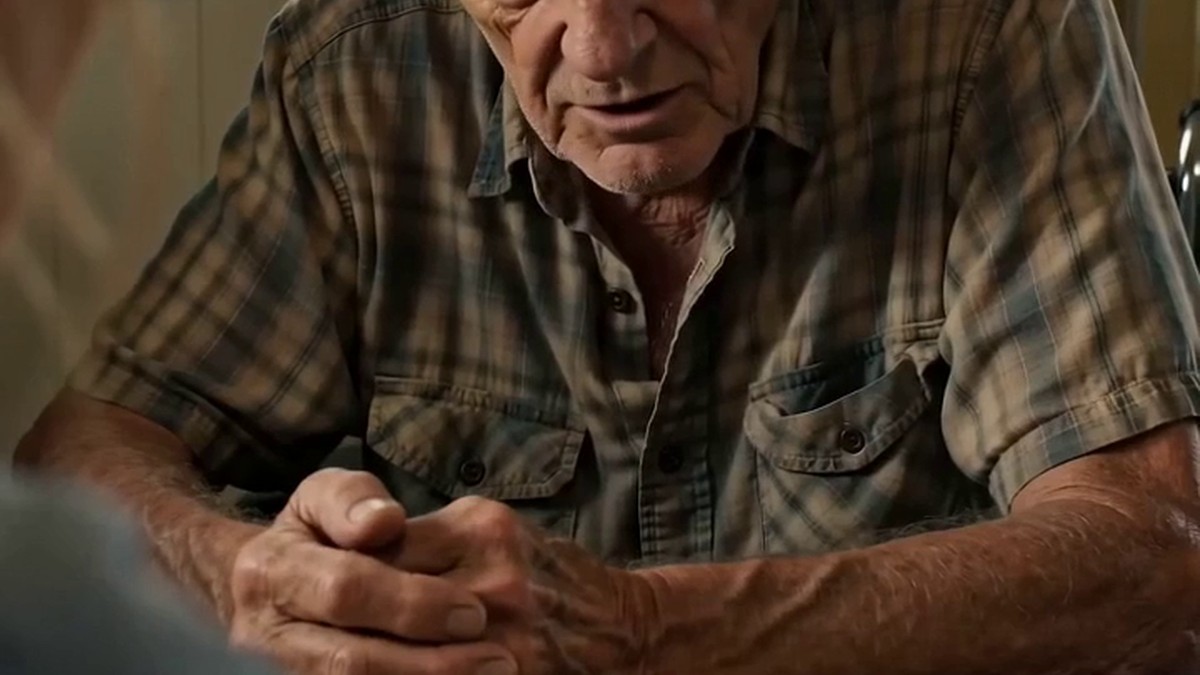
Denny was smaller than she remembered. That was the first thing. The man who used to fill a doorway with his shoulders was propped up in a hospital bed with a blue gown gapping at the collar, an IV taped to the back of a hand spotted with age, a tray table pushed off to the side with a plastic cup of orange Jell-O nobody had touched.
He looked at her for a long moment. His jaw worked like he was chewing on something before he said it.
"Didn't think you'd come."
"I almost didn't."
"Peg shouldn't have written you." He turned his face toward the window, where a hospital parking lot and a Speedway gas station sign were the whole view. "I told her not to bother you."
"Then why'd she do it anyway?"
"Because she's my sister and she's got more heart than sense," he said, and something in his voice cracked just slightly, like a door hinge that hadn't been used in years. "I don't need you to fix this, Marlene. I got Peg. I got Medicare. I'll figure the house out."
"Okay," Marlene said, and picked her purse back up off her lap. "Good luck with that."
She was almost to the door when he said her name again — not sharp, not the way he used to bark it across the shop floor when she was a kid handing him wrenches. Just quiet.
"I know what I didn't do," he said. "I'm not asking you to forget it."
She stood in the doorway with her hand on the frame. "Then what are you asking?"
He didn't have an answer. That was the truth of it — he didn't have one, and they both knew it, and she left him there with the untouched Jell-O and the Speedway sign in the window.
—
She didn't go back for two weeks. In that time, Aunt Peg called three times, and Marlene let two go to voicemail. On the third, she picked up while she was folding laundry in the garage, Cody's Little League uniform still smelling like grass stains and dryer sheets.
"He's out of rehab," Peg said. "Home health comes twice a week, but that trailer's got steps he can't manage yet, and I'm sixty-eight years old, Marlene, I can't be lifting him."
"I'm not saying I won't help, Aunt Peg. I'm saying I need to think about what helping looks like."
"What's that mean?"
Marlene folded a small red T-shirt into a square and set it in the basket. "It means I'm not moving him into my house. It means I'm not quitting my job. And it means before I do one single thing, I want to see a lawyer, because I know exactly how this goes — I show up, I do the lifting and the driving and the doctor's appointments for two years, and then it turns out Denise from Fort Wayne's name is on the deed to that trailer and I get a thank-you card."
Peg was quiet on the other end. "That's fair," she finally said. "That's more than fair."
—
The lawyer's office was above a nail salon in downtown Elkhart, and the appointment cost Marlene an afternoon off and eighty dollars for a consultation. His name was Gary Prewitt, and he'd handled her aunt's will years back, so he already knew half the family history before Marlene said a word.
"Here's what I'd tell any client," Gary said, leaning back in a chair that squeaked. "There's no law that says a grown child has to be a caregiver. Indiana's got a filial responsibility statute on the books, technically, but it's basically never enforced — mostly it just means, in theory, the state could go after adult kids for a parent's nursing home bill if the parent's broke and there's no other way to pay. That's rare. Nobody's coming after you for money."
"That's not what I'm scared of."
"I figured." Gary tapped a pen against a legal pad. "What you're scared of is doing the work and getting nothing — not the money, the acknowledgment. Watching him let some woman from Fort Wayne, or the state of Indiana, end up with what's left, after you did the driving."
Marlene didn't say anything, because he'd said it better than she could have.
"So don't do it blind," Gary said. "If you're going to help — and that's your call, not mine — do it with paper. Get durable power of attorney if he'll sign it, know exactly what he's got, and don't let anybody move money or property around behind your back while you're the one showing up."
She left his office and sat in her Chevy Equinox in the parking lot for ten minutes before she started the engine.
—
She went back to the trailer outside Bristol on a Saturday in April, Cody in the back seat this time because she'd decided if she was going to do this, she wasn't going to hide her son from where half of him came from.
Denny answered the door on a walker, moving like each step cost him something. He looked at Cody first, and something passed over his face — Marlene couldn't have named it, but it wasn't nothing.
"You must be Cody," he said.
"You're my grandpa," Cody said. Not a question. A fact he was still testing out loud.
"I guess I am." Denny stepped back to let them in, and the trailer smelled like cigarettes long since quit but never aired out, and a TV was playing a rerun of *Wheel of Fortune* to nobody.
They sat at his kitchen table — Formica, chipped at one corner, a coffee ring stain that had probably been there since the Clinton administration — and Marlene laid it out plain, the way Gary had told her to.
"I'll help. I'm not doing it for free labor and a funeral, Dad. If I'm driving you to appointments and dealing with home health and whatever else comes, I want it on paper. Power of attorney, so nobody can move things around I don't know about. And I want to know now — is there a will? Is Denise anywhere in it?"
Denny's hands, folded on the table, tightened. "Denise and I split up nine years back. There's no will. There's the trailer, there's about six thousand dollars in a Fifth Third savings account, and there's the truck outside that doesn't run half the time."
"Okay," Marlene said. "Then we go to Gary Prewitt's office together and we do this right, or I walk out that door and Aunt Peg deals with it. Those are the two options."
He looked at her a long moment — longer than she expected — and then at Cody, who was inspecting a chipped ceramic rooster on the windowsill like it was the most interesting thing he'd ever seen.
"Your mother would've liked you standing up like that," Denny said. "She never could, with me."
"Don't," Marlene said. "Don't put her in this."
"You're right. Sorry." He nodded once, toward the door. "Get your coat. We'll go now, before I lose my nerve."
—
They went to Gary's office that same week. Denny signed a durable power of attorney naming Marlene, and a simple will leaving the trailer and the savings account to her and, in a smaller line Marlene hadn't asked for and didn't expect, five thousand dollars set aside in a separate account "for Cody's schooling," the number written out plain on the paper Gary slid across the desk — a figure Denny had apparently been sitting on since before the hip fracture, money he'd never once mentioned in eleven years of silence.
It didn't undo anything. Marlene told him that straight, sitting in Gary's squeaky chair with the signed papers in a manila folder on her lap.
"This isn't a do-over," she said. "You don't get eleven years back because you signed a form."
"I know that."
"I'm going to drive you to your appointments. I'm going to make sure home health shows up. I'm not going to pretend we're something we're not."
"I know that too," Denny said, and for once he didn't argue, didn't turn it into something about himself, just sat there with his walker propped against the chair and let her have the last word.
She drove him home that afternoon with the folder on the seat between them, past the old lot on Route 9 where Cutshaw's Collision used to be — it was a Dollar General now — and neither of them said anything about it. In the back seat, Cody had fallen asleep against the window, the ceramic rooster from the trailer windowsill wrapped in a napkin in his lap, because Denny had told him to take it, no argument, first thing he'd given the boy in nine years.