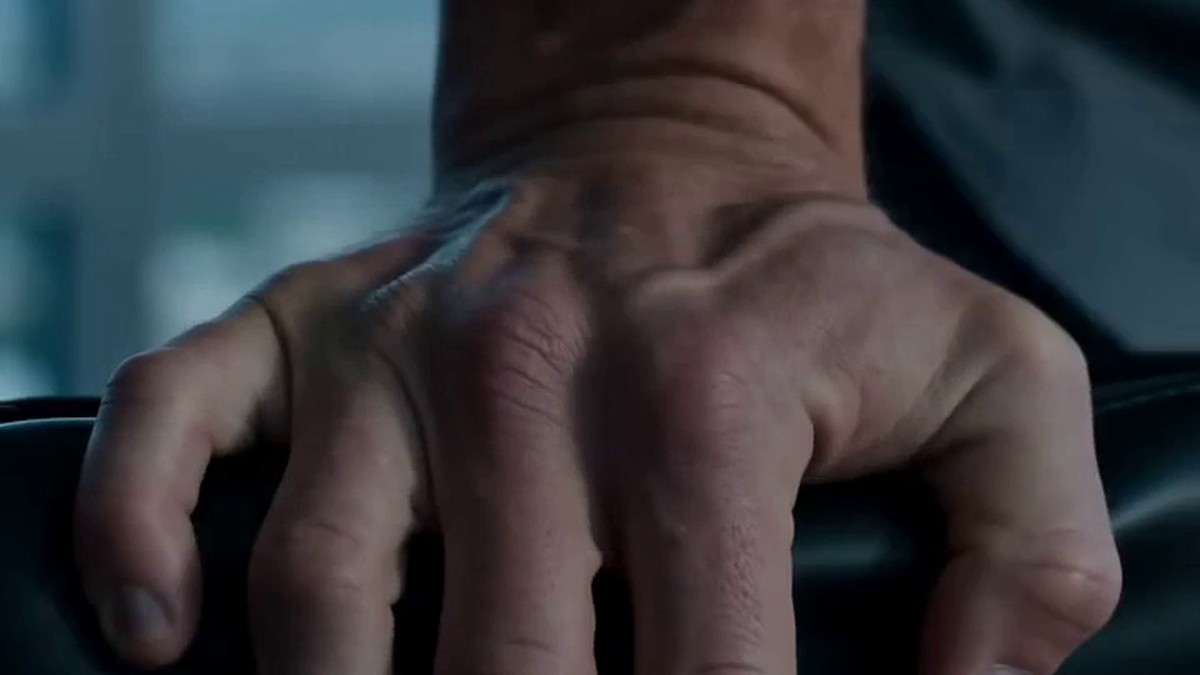
The lobby of Shaw Hospitality Group smelled like fresh orchids and carpet cleaner. Wes Delgado stood in the middle of it wearing steel-toed boots, jeans with a tear at the knee, and a flannel shirt rolled to the elbows. On his left forearm, the crescent-shaped scar from a childhood bicycle-chain accident stood out against his tan. He had paid four dollars for two hours of parking on 17th Street, and he figured he had maybe twelve minutes left.
The receptionist — a woman in a gray blazer with a name tag that read Barbara — watched him approach the desk. She didn't ask if she could help him. She just waited.
"I need to see Veronica Shaw," Wes said.
"She's in meetings."
Wes set his coffee cup on the marble counter and asked for a pen and a slip of paper. Barbara slid both across the counter without speaking. He wrote four words: Crescent scar. Eight years.
Barbara read the note. Her expression didn't change, but her hand moved to the phone. She spoke into the receiver too low for him to hear, then set it down.
"Twenty-second floor. Elevator's on your left."
The elevator hummed upward. Wes leaned against the back wall and counted the floors on the digital display. Eleven, twelve, thirteen. When the doors opened on twenty-two, the first thing he saw was a framed photograph on the wall opposite the elevator: three identical girls in matching red dresses at a company picnic, one of them holding a paper plate with a wedge of watermelon. The middle girl had a barrette shaped like a crescent moon. Wes stood there, his boots rooted to the carpet, until a voice came from behind him.
"Mr. Delgado."
Veronica Shaw stood by a wall of windows that looked out over downtown Denver and the flat brown spread of the plains beyond. She wore a white suit, pearl earrings, heels that added three inches to her frame. Her hair was pulled back. Her fingers, resting on the back of a leather chair, pressed into the seam so hard the leather puckered.
"Tell me," she said, "how you found out."
Wes walked into the office. The carpet was so thick his boots sank into it. "Three little girls in a park told me their mother has the same crescent scar as mine."
Veronica's jaw tightened. She didn't sit down. Neither did he.
"They're yours," she said. The words landed between them like a dropped glass. "Hannah, Hazel, and Holly. They're seven. They'll be eight in November."
Wes reached for the back of the chair nearest him. The room seemed to tilt. He could feel the leather grain under his fingertips.
"Eight years," he said. "You kept them from me for eight years."
"I didn't know your last name. I didn't have your real number. I didn't even know if you'd want—"
"Want what? To know I had three daughters?"
Veronica crossed to her desk and picked up a paperweight shaped like a tiny brass hotel. She turned it over in her hands. "The company was failing. My father had just had a stroke. The board was looking for any reason to push me out. A pregnancy with triplets, no husband, no explanation — they would have eaten me alive. And the press would have eaten the girls alive." She set the paperweight down with a click. "I thought I was protecting them."
"You were protecting yourself."
"Maybe." Her face changed, the executive line of her mouth breaking for just a second.
Wes said, "I'm not rich. I fix bicycles for a living. I have a daughter from my marriage, Quinn, who's seven. I live in a one-bedroom apartment off Colfax. I know I'm not what you'd want for them." He paused. "But I'm their father. And I didn't come for your money. I came because three girls in a park told me their mother had my scar on her shoulder."
Veronica touched her left shoulder. "The scar. I got a tattoo of it after they were born. So they would have something of you. A crescent moon, just like yours."
Wes shut his eyes for a second. He saw the barrette in the photograph, the watermelon wedge, the grass stains on the little girl's knees.
"I want to meet them," he said. "Not in a courtroom. Not through lawyers. Just meet them."
Veronica hesitated. Then she said, "Tomorrow. Noon. At my house in Cherry Hills. No press. No scenes."
Wes picked up his coffee cup from the corner of her desk. It had left a wet ring on the mahogany. "I don't make scenes, Veronica. I just appeared in a story I was erased from."
—
Eight hours earlier, Wes had been sitting on a bench in Washington Park, watching a golden retriever named Biscuit drop a slobbery tennis ball at his feet for the fourth time. The afternoon sun was warm for late September, and cottonwood fluff drifted across the path like dirty snow. He had bought an oat milk mocha for $4.75 at a cart near the boathouse, and it had gone cold in his hand. He rolled up his sleeves to get the last of the afternoon sun on his skin.
That's when he saw them: three identical girls in beige coats and patent leather shoes, standing in a row on the path in front of him. They looked too clean for a park, too curious to pass by.
"Your arm," one of them said. The middle one. She pointed at his crescent scar. "Our mom has the same thing on her shoulder."
Wes looked at his scar, then at the girls. The words hit him like a punch to the sternum.
"What did you say?"
"Our mom has a crescent just like that," the middle girl repeated. "But it's not a scar. It's a tattoo. She got it before we were born."
Wes's mouth went dry. His phone buzzed in his pocket — a text from his ex-wife about Quinn's soccer practice — and he ignored it. He didn't remember the name of the woman from that night in a bar in Boulder eight years ago. He'd been back from a mountain bike race, celebrating with cheap beer and a girl who said her name was Vee. She'd left before sunrise, and he'd never seen her again. Or so he thought.
"What's your mom's name?" he asked.
The middle girl opened her mouth to answer, but a woman in a gray uniform came running up the path, out of breath. She grabbed the girls by their shoulders, apologizing to Wes, saying they weren't supposed to talk to strangers. The retriever bounded over and snatched the tennis ball from the grass, spraying slobber across the woman's shoes.
"Please," Wes said, standing. "I just need to know their mother's name."
The nanny — if that's what she was — looked at him with a mixture of fear and annoyance. "Mrs. Shaw," she said. "Veronica Shaw. And she's going to be very upset if I let this go any further."
Veronica Shaw. The name landed like a brick. Wes had seen her face on the cover of a business magazine at the checkout line at King Soopers. She ran a hotel chain. He'd never connected her to the girl in the bar. But the crescent, the timing, the triplets — it all fit.
The middle girl turned back before climbing into a black Escalade parked by the curb. She had hazel eyes, like his mother's. "I'm Hazel," she said. "I'm the one who noticed your arm."
Then the door closed, and the Escalade rolled away, and Wes stood alone on the path with a cold mocha and a dog named Biscuit who kept dropping the ball at his feet.
—
The next day at noon, Wes parked his old Subaru at the gate of a house in Cherry Hills Village that looked like it belonged on a postcard. The gate was wrought iron, the driveway paved with brick, and there was a stone fountain in the shape of a crown near the front door. A woman in the same gray uniform from the park opened the door and led him inside.
The triplets were waiting in the living room, sitting on a cream-colored sofa with their hands folded in their laps. Hannah sat on the left, Holly on the right, and Hazel in the middle. They wore matching blue dresses with white collars. Veronica stood behind them, her arms crossed, looking less like a CEO and more like a woman bracing for impact.
"You're the man with the crescent," Hazel said. "I knew you'd come."
Wes knelt down so he was at their eye level. The sofa was soft under his knees. "I'm Wes," he said. "I'm your dad."
The words felt foreign in his mouth, like a language he'd never spoken. Hannah shrank back against the cushion. "We already have a dad," she said. "In our storybook. He's a prince who lives far away and can't come home."
Wes's throat tightened. "Your mom told you that?"
"I made it up," Hannah said, chin lifting. "It's better than nothing."
"Hannah." Veronica's voice cracked on the single syllable. She came around the sofa and crouched next to her daughter, and for a moment the CEO was gone entirely, just a mother fumbling for words in front of a stranger. "I told you the truth. I told you I didn't know how to find him."
"You could have looked harder." Hannah's eyes were wet, but her voice stayed flat and hard, older than seven. "You look everything up. You looked up which school has the best test scores. You looked up which pediatrician has zero complaints. You didn't look him up."
The room went silent except for the tick of a grandfather clock somewhere down the hall. Holly slid off the sofa and stood behind her mother's shoulder, watching. Hazel didn't move.
Veronica's hands were shaking now, no longer hidden behind a desk or a paperweight. "You're right," she said to Hannah. "I could have. I was scared, and I told myself I was protecting you, and some of that might even be true, but some of it was just me being scared, and that's not fair to lay on you, and I'm sorry."
Hannah studied her mother's face like she was checking it against something. Then she looked at Wes. "Do you know how to fix a bike?" she asked, and her voice wobbled between challenge and hope. "Our nanny said you fix bikes."
"I can fix almost anything with wheels and a chain," Wes said, careful not to reach for her, not yet. "You have a bike that's broken?"
Hazel bobbed her head. "The chain came off last week. We tried to fix it, but Mom doesn't know how, and the nanny said to wait for a professional."
"I can fix that," Wes said. "I can also patch a tire, adjust brakes, and true a wheel."
"What's 'true' mean?" Holly asked.
"It means making the wheel straight so it doesn't wobble."
Hazel squinted at his forearm. "How did you get the crescent?"
Wes sat back on his heels. "I was twelve. My dad's bike chain snapped while I was riding it, and the chain whipped back and caught my arm. Took nine stitches." He touched the scar. "Healed into this shape."
"A crescent is just a moon that hasn't found its full shape yet," Holly said.
"Where'd you hear that?"
"Mom says it. When we ask about you."
Veronica, still crouched by Hannah, didn't look up. Her hand had found her daughter's knee and stayed there.
The afternoon went sideways from careful to something closer to real. Wes fixed the wobbly training-bike wheel in the garage while the girls crowded around, handing him the wrong wrenches on purpose to see if he'd notice. Hannah didn't come out to the garage. She sat on the back steps instead, watching through the open door, arms wrapped around her knees, close enough to hear, too far to be counted as watching.
When he finally left, the sun was low and the shadows of the aspens striped the brick driveway. Veronica walked him out. She didn't stop at the door — she kept walking, past the fountain, to the edge of the driveway, like she needed the extra distance to say what came next.
"Hannah's never done that before," she said. "Not like that, not out loud."
"She's not wrong, though." Wes shouldered his backpack. "You could have looked harder."
"I know." Veronica crossed her arms, uncrossed them. "I've known it for eight years and I've never said it to anyone but myself at two in the morning." She looked back at the house, where Holly's face had appeared briefly in an upstairs window before vanishing. "What do you want from this, Wesley? Some kind of schedule? Holidays? A lawyer sending me letters?"
"I want to be on the birth certificate. I want my name to mean something if one of them gets sick and needs surgery and somebody has to sign a form. I want them to stop having to explain me with a story about a prince who can't come home." He said it flat, no heat in it, just weight. "A handshake in a driveway doesn't hold up in court, Veronica. I've watched that happen before, with Quinn's mom, in a different fight. I'm not doing it on hope this time."
Veronica's mouth opened like she meant to argue, the old reflex of the boardroom rising in her, and then something in her seemed to give way at once. "Fine," she said, and her voice had none of the polish left in it. "File it. Serve me. I'll sign whatever they put in front of me. I just—" She stopped, pressed the back of her hand briefly against her mouth. "I don't want them to hate me for the eight years. That's the part I can't fix with paperwork."
"That part's not mine to fix," Wes said. "That's between you and them. But you telling Hannah the truth just now, in front of me — that's a start you didn't have to give her."
Veronica nodded once, short, like it cost her something. "Tomorrow, then. Do what you have to do."
Wes walked to his Subaru. The engine turned over on the second try. He drove home to his apartment off Colfax.
Quinn was already asleep by the time he got his ex-wife on the phone, but she'd left a note taped to his door from an earlier visit — a crayon drawing of a bike with three extra wheels bolted on wrong, and underneath, in blocky seven-year-old letters: FOR YOUR NEW GIRLS SO THEY CAN RIDE TOO. His ex must have told her something. He stood in the hallway holding the paper too long, then taped it to the inside of his kitchen cabinet, next to the coffee mugs, and set the alarm for six.
—
The next morning, Wes rode his bike downtown to the Denver City and County Building on Bannock Street. He locked the bike to a rack near the steps, shouldered his backpack, and went inside. The hall smelled like floor wax and old paper. At the family court clerk's window, a woman with reading glasses on a chain handed him a stack of forms. He filled them out in block letters, paid $120 with a debit card, and received a stamped copy with a case number: 25-DR-1447.
He stepped outside into the bright October air. The RTD light rail clanged in the distance. Wes took out his phone and called Veronica Shaw.
She answered on the second ring. In the background he could hear kids' voices, an argument over cereal, Holly's voice rising over the others about a bowl.
"I filed for paternity this morning," he said. "Case number 25-DR-1447. You'll be served by the sheriff's office before the end of the week."
There was a pause, cereal-argument still going faintly behind her. "You actually did it."
"I told you I would." He watched a pigeon work at a dropped pretzel on the courthouse steps. "Veronica — Hazel's bike. The chain. I never finished truing that wheel. Tell her I'll come back Saturday and get it right, if that's still all right with you."
Another pause, shorter. "Saturday's fine." Then, quieter, almost to herself: "Hannah asked this morning if the prince story was really over now."
"What'd you tell her?"
"I told her the prince showed up and turned out to fix bikes for a living." A short, unsteady laugh, more air than sound. "She wanted to know if you take the training wheels off too."
"Tell her yes," Wes said. "Saturday. I'll bring the right wrenches this time."
He hung up, unlocked his bike, and rode north on Broadway with the stamped petition pressing flat against his spine through the canvas of his backpack, already thinking about which size Allen key Hazel's bike would need.