The day after the funeral, Mr. Delaney buttoned his coat against the wind off the Illinois River and put a cream-colored envelope into my hand. My name was written across the front in her handwriting — the same block letters she used for birthday cards and the little notes she'd tape to a pan of rhubarb bars.
“She knew this belonged to you,” he said.
Inside, something small and hard shifted against the paper. I almost tore it open right there, standing on the gravel path between the last headstones, with my wife Kate holding both kids by the hands and Eli asking if the man in the dark suit was a detective.
I didn't open it that day. Ruth would have hated that — she was precise about things like timing. She waited forty-six years to win an argument with her husband about whether cinnamon goes in coffee. She could wait one more morning for me to read a letter.
—
Eight years earlier, she moved in next door with three cardboard boxes, a green suitcase, and a framed photograph pressed against her chest. I saw her from the kitchen window, trying to carry all of it at once, the suitcase wheels catching on the cracks in the driveway.
She was seventy-four. Her husband Frank had died that winter.
I didn't know her at all. I noticed the gardening gloves with little strawberries on the cuffs, the row of sunflowers she planted along the back fence before she'd even unpacked the kitchen, and her way of asking a question that kept you talking: *How are the kids? Do the cucumbers like this much sun? Is the mail always this late on Tuesdays?*
It took me a while to figure out she wasn't just being polite. She was stretching every conversation because there was nobody in her house waiting for her to come back inside.
That first spring, I heard a mower sputtering next door one Saturday morning. Ruth was pushing it through grass up past her ankles, the machine coughing and dying every few feet. She kept her hands locked on the bar, forcing it forward like she could bully the thing into working.
I crossed the driveway without thinking.
“Let me finish that.”
She wiped her forehead with the back of one glove. “I'm perfectly capable, dear.”
The mower gave one last cough and died.
Ruth let out a long breath. “I can tell when something's had enough.”
I laughed, took the handle, and finished the yard. When I was done, she came back with a couple of folded bills. I shook my head and pushed them back toward her apron pocket.
“You worked nearly an hour, Ben.”
“I live twelve feet away,” I said. “I don't need your money.”
She studied me for a second, then tucked the bills away and said, “Fine. Then let an old woman thank you properly.”
That was how I wound up on her porch with a glass of iced tea and a wedge of rhubarb pie the size of my hand. We talked until the shadows stretched across the lawn. She told me about Frank, who whistled whenever he fixed something, even when he had no idea what he was doing. She said they spent forty-six years arguing about whether cinnamon belonged in coffee, and she laughed so hard a robin shot off the porch railing.
When I got up to leave, she wrapped the rest of the pie in foil and handed it over.
“Next Saturday,” she said, “I might need a professional opinion.”
“About the grass?”
She just waved at the lawn and shut the screen door.
The next weekend, the grass barely needed a trim. I cut it anyway. Then there was tea, then pie, then more stories. We never talked about turning it into a thing. It just became one.
Every Saturday, I pushed my mower across the narrow strip of pavement. Ruth opened the windows, put the kettle on, and pretended she hadn't already cut the pie before I got there. She always sliced it unevenly and always took the smallest piece. I'd swap the plates when she looked away, and she'd act shocked when she noticed.
The lawn became the least important part of those mornings.
A gray tomcat with a torn ear lived under her porch. Ruth called him Mr. Finch. He'd watch me mow from the top of the fence, and when I shut the engine off, he'd let out one long meow, like he was announcing that the tea was ready.
Over the years, that porch filled up. Kate would stop after grocery runs and get pressed into a chair so Ruth could complain that young mothers never sit down enough. My daughter Mia learned to water the flower beds without flooding them. My son Eli — five years old and convinced he was a private investigator — spent every weekend hunting for Ruth's reading glasses. They were always in the same apron pocket, and he'd hold them up like a trophy.
“Found them!”
Ruth would put a hand over her heart. “How remarkable. Have you considered government work?”
Eli never caught on that she was teasing him, which is probably why she never hid them anywhere else.
Ruth came to school concerts and birthday parties and one legendary backyard campout that ended at midnight when the sprinklers kicked on. She baked Mia a heart-shaped strawberry cake. She showed Eli how to snap green beans without spraying the counter. She remembered our wedding anniversary before Kate did, and the year I forgot it entirely, she handed me a bunch of cut flowers and said, “From a husband who clearly needs administrative support.”
Somewhere along the way, she stopped being the old woman next door and became Miss Ruth.
Every spring, she planted sunflowers along the back fence for Frank. The year Mia turned six, Ruth pressed one extra seed into the soil.
“This one won't be lonely,” she said, and looked away fast.
By late August, two of the flowers leaned toward each other like they'd been talking all summer.
Not that she ever admitted it. Some Saturdays, half the lawn was already mowed before I got there. Ruth would claim the mower had acted up, or that she'd felt restless. The next weekend, the grass barely needed a trim, and she'd be waiting on the porch with the tea already poured and a look on her face that said, *caught me*.
One rainy week, there was no mowing at all. I knocked anyway. She opened the door before my hand finished falling.
“I assume you've come to admire the mud.”
“I heard it's exceptional.”
We sat inside and listened to the rain hammer the gutters. That was the morning I understood something I should have known years earlier: I never went over there because the lawn needed cutting. But neither of us ever said it out loud.
—
Three weeks ago, Kate went over early to borrow Ruth's chicken pot pie recipe. A few minutes later, she called me from Ruth's kitchen. Her voice had that careful flatness people use when they're trying not to scare the kids.
Ruth was in her favorite chair. She'd gone sometime in the night, between turning off the porch light and sunrise. No warning, no lingering illness. Her heart just stopped.
The next Saturday, I stood behind the mower in the driveway and the silence next door felt louder than the engine. Eli came out carrying a little plastic cup.
“Miss Ruth's flowers need water, Dad.”
So we crossed the driveway as a family. Mia watered the two sunflowers. Kate stood on the porch with a pie she'd baked out of habit, holding it with both hands and not knowing what to do with it.
At the funeral, distant relatives filled the front rows. They knew where Ruth was born and what year she married Frank. But when the minister talked about her laugh, they looked down at the programs in their hands.
I knew that laugh. I knew she claimed cinnamon belonged in coffee only because Frank had loved it. I knew she read the last page of every mystery novel before the first. I knew she saved the pie crust for the last bite and always gave the cat the crumbs when she thought nobody was watching.
I was just the neighbor.
—
The envelope sat on our kitchen table until the next morning. At seven, I drank coffee. Kate set out the pie she'd baked. Mia sat by the window in her bathrobe, watching Ruth's porch. Eli climbed onto a chair and tapped the envelope.
“You think there's treasure in there, Dad?”
“What kind of treasure?”
“Metal,” he said, like it was obvious.
Kate pushed the pie tin toward me. “Open it, Ben.”
I broke the wax seal. A brass key slid into my palm — warm from being inside, edges worn smooth from years of use. Mia leaned over.
“Is that Miss Ruth's house?”
“I don't know.”
I unfolded the letter. Two pages, written in that familiar block handwriting. The first line almost made me put it down again.
*If you're holding this, my porch is finally quiet.*
I looked out the window at her house. For eight years, those windows had never been dark on a Saturday morning.
I kept reading.
*Please don't be cross that I left without a proper goodbye. At my age, goodbyes turn greedy. They ask for words people can't say without breaking. Now, before you decide this is all very dramatic and I'm leaving you my house, let me save you the trouble. I'm not.*
I laughed, even with my eyes blurring. That was exactly the thing Ruth would write.
*The house goes to my family. The furniture will be divided. Mr. Delaney has instructions for the rest. This key belonged to my back door. Frank gave it to me the day we moved into our first house. He said a key isn't proof you own a place. It's proof someone trusts you to walk in.*
My thumb moved over the metal.
*I'm giving it to you because for eight years, I slept better knowing you lived twelve feet away. You probably thought you saved me from mowing. Ben, you saved me from Saturday.*
I set the letter down. Outside, a light wind moved Ruth's two sunflowers. One of them leaned toward the other.
*Saturday belonged to Frank. He made the coffee too strong. He cut the grass in crooked lines. He complained about my pie crust and ate two pieces anyway. After he died, Saturday was the longest day of my week. That first morning you crossed the driveway, I really did need help. The second Saturday, maybe not. By the third, I'd figured out something I wasn't too proud to admit.*
I already knew the next line before I read it.
*Every Friday, I left part of the lawn unfinished so you'd have a reason to come back.*
Eli looked up at me. “Was Miss Ruth lonely?”
“Sometimes, buddy.”
“Even with us?”
“Not when she knew we were coming.”
I read the rest.
*You gave me more than company. You gave me people in the yard. Birthdays to remember. Concerts to attend. A little boy who found my glasses every week, even when I made the job embarrassingly easy. Mia gave Frank a second sunflower. Kate gave me a chair at your table. And you gave me the safest thing a widow can hope for. You made me feel expected.*
That was the line that did it. I put the letter flat on the table and pressed the heels of my hands against my eyes. Nobody spoke for a long time. Then Mia's small fingers slid into my hand.
The last paragraph was short.
*The key no longer belongs to my house. It's for whichever door you decide to knock on next.*
Below that, Ruth had added one more note.
*Before you go home, look at the house two doors down. His name is Walter. His Saturdays are quieter than mine ever were.*
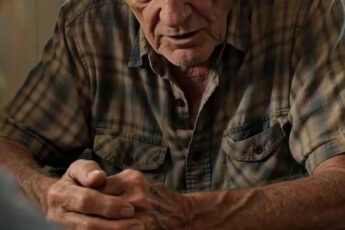
I stood and went to the window. Two houses past Ruth's, an old man sat alone on his front steps beside a yard that hadn't been cut in weeks. I'd seen him a hundred times.
I'd never really looked.
Kate got up without a word. She wrapped the pie in a clean dish towel. Mia carried it with both hands, walking like it might spill, even though it was just a pie. Eli went to the garage.
“I'll get the gas can, Dad.”
I folded Ruth's letter and tucked it into my shirt pocket. Then I clipped the brass key onto my keyring — right next to the key to our front door. It settled there with a small metallic click, like it had been waiting.
I pushed the mower across the driveway for the last time past Ruth's porch. The blue kettle still sat in her kitchen window. The wind moved the porch swing, just a little.
Walter watched us coming like he wasn't sure what we were doing, or maybe like he'd been expecting someone for a long time and had stopped letting himself believe it.
I stopped at the bottom of his steps.
“Good morning.”
He looked from the pie to the mower to the kids. “Morning.”
“Looks like your Saturday could use some company,” I said.
His face changed slowly, the way a dark room fills with light when somebody opens the curtains.
—
Months later, Mia noticed the brass key still hanging on my keyring. We were standing by Ruth's sunflowers, collecting seeds for the next spring.
“Why do you still carry it?” she asked.
I got down on one knee and put the key in her hand. She ran a finger along the worn edge.
“You know it doesn't unlock Ruth's house anymore,” I said.
“What does it unlock?”
I didn't answer right away. From where we stood, we could hear Walter's screen door bang open and Eli laughing about something.
Mia looked over at the porch, where Walter sat with a fresh glass of tea, pretending not to know where he'd hidden his reading glasses.
She closed my fingers around the key.
“When I'm older,” she said, “can I be the next one?”
I couldn't speak for a second.
“I was hoping you'd ask,” I said.