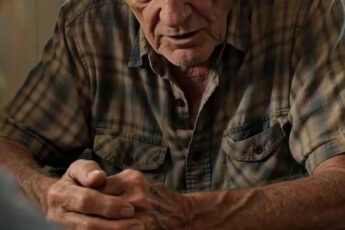
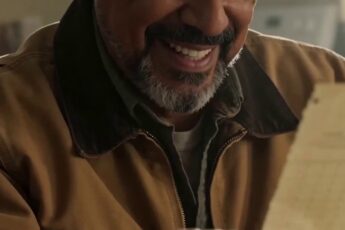
For several seconds, nobody moved.
The black envelope sat in Caleb’s hands like something heavier than paper.
The saleswoman, whose name tag read Marissa, stood frozen beside the center display case. Only moments earlier, she had looked at Eleanor Whitmore as if the elderly woman were a problem to be removed.
Now she looked as if the floor had shifted beneath her expensive heels.
“Mrs. Whitmore,” Marissa said, and her voice suddenly became soft. “I didn’t recognize you.”
Eleanor looked at her calmly.
“That was the point.”
The words landed harder than any shout could have.
Caleb was still kneeling in front of her wheelchair, one hand resting on the envelope, the other still near the shoe he had gently fixed.
“I don’t understand,” he said quietly.
Eleanor turned toward him.
“You understood enough.”
Behind the counter, one of the other employees finally lifted his eyes. Another pretended to straighten a tray of rings, though his hands were shaking.
The boutique remained silent except for the soft music playing near the entrance.
Marissa forced a laugh.
A thin, desperate sound.
“There must be some misunderstanding. I was only trying to protect the store. We get all kinds of people walking in here.”
Eleanor raised one eyebrow.
“All kinds of people?”
Marissa swallowed.
“I mean… people who are not serious buyers.”
Eleanor looked around the store.
At the diamonds.
At the glass.
At the velvet.
At the employees who had watched an elderly woman be humiliated and chosen silence.
Then she looked back at Marissa.
“My husband used to say the most dangerous thing in a jewelry store is not theft,” Eleanor said. “It is forgetting that value is not always visible.”
Marissa’s mouth opened, but nothing came out.
Eleanor extended her hand toward the center case.
“I asked to see the necklace.”
Caleb stood slowly.
The manager, Mr. Harlan, had emerged from the back office by then. He was a polished man in a gray suit, the type who smiled in a way that showed teeth but not warmth.
“Mrs. Whitmore,” he said quickly. “What an unexpected honor. If you had told us you were coming, we would have prepared properly.”
Eleanor turned her wheelchair slightly toward him.
“That is exactly why I did not tell you.”
His smile faltered.
“I’m sure Marissa meant no disrespect.”
Eleanor’s eyes remained steady.
“Then why did it sound so practiced?”
No one answered.
Mr. Harlan adjusted his cuff.
“Perhaps we should continue this conversation privately.”
“No,” Eleanor said.
The word was quiet.
Final.
“This happened publicly. The lesson can begin publicly.”
Marissa’s cheeks flushed.
Caleb looked uncomfortable.
“Mrs. Whitmore, I don’t want anyone to get in trouble because of me.”
Eleanor looked up at him.
“That is kind of you. But this is not happening because of you.”
She turned her gaze back toward the staff.
“This is happening because kindness should not be the unusual thing in this room.”
Mr. Harlan cleared his throat.
“Caleb is a good employee. We all appreciate him.”
One of the younger employees glanced down.
Eleanor noticed.
“Do you?”
The manager’s expression tightened.
“Of course.”
Eleanor looked at Caleb.
“How long have you worked here?”
“Eight months, ma’am.”
“And what is your position?”
“Stock assistant. Sometimes floor support.”
“Sometimes?”
Caleb hesitated.
“I help wherever they need me.”
Marissa folded her arms.
“He mostly handles inventory. Cleaning. Deliveries. Small tasks.”
Eleanor watched her.
“Small tasks?”
Marissa immediately regretted the phrase.
Caleb looked at the floor.
Eleanor saw that too.
She had spent enough years in rooms full of powerful people to recognize the shape of quiet humiliation.
It was not always loud.
Sometimes it wore perfume, polished nails, and a professional smile.
“Caleb,” she said gently, “open the envelope.”
He looked at Mr. Harlan.
Then at Marissa.
Then back at Eleanor.
“Are you sure?”
“I am.”
He broke the seal carefully.
Inside were several documents.
At the top was a formal letter on Whitmore & Hale stationery.
Caleb read the first line.
Then stopped.
His brow furrowed.
“This says…”
“Read it aloud,” Eleanor said.
His voice shook a little.
“Effective immediately, Caleb Brooks is to be appointed assistant manager of Whitmore & Hale Fifth Avenue, pending final board confirmation, with full training, salary adjustment, and authority over customer experience standards.”
The room went completely still.
Marissa whispered, “That can’t be real.”
Eleanor looked at her.
“It is real.”
Mr. Harlan stepped forward.
“Mrs. Whitmore, with respect, appointments require approval.”
Eleanor removed another paper from the envelope.
“Which is why the approval is included.”
He took it with stiff fingers.
His face changed as he read.
Eleanor continued, “My husband founded this store with my father before most of you were born. After his death, I stepped away from daily operations. I trusted reports. Numbers. Polished summaries. I was told the Fifth Avenue boutique had become our crown jewel.”
She paused.
Then looked at the glass cases.
“But jewels can be cleaned until they shine while the inside of a place grows rotten.”
Mr. Harlan’s lips tightened.
“That is unfair.”
“Is it?”
She turned toward the other employees.
“I want honesty now. Not loyalty. Not fear. Honesty.”
Nobody spoke.
Then the youngest employee, a girl named Mia, lifted her hand slightly.
Marissa shot her a warning look.
Mia lowered her eyes.
Eleanor saw that too.
“Mia,” she said.
The girl froze.
“Yes, ma’am?”
“Speak.”
Mia’s voice was small at first.
“Caleb helps everyone.”
Marissa snapped, “That is not relevant.”
Eleanor did not look away from Mia.
“It is relevant to me.”
Mia took a breath.
“He stays late when shipments are wrong. He handles difficult customers when nobody else wants to. Last month, Mrs. Alvarez came in after her husband passed away. She only wanted her wedding ring cleaned. Marissa told her we were too busy because she wasn’t buying anything.”
Marissa’s face went scarlet.
Mia continued, stronger now.
“Caleb sat with her. Cleaned the ring himself. Called her a cab because it was raining.”
Eleanor turned to Caleb.
“You never reported that?”
Caleb shrugged slightly.
“She was sad. It didn’t feel like something to report.”
Another employee, James, cleared his throat.
“He also found that missing emerald bracelet.”
Mr. Harlan looked at him sharply.
James stiffened, then spoke anyway.
“The one we thought had been stolen. Caleb found a paperwork error in the transfer log. Saved us from accusing the cleaning crew.”
Eleanor’s expression darkened.
“You were going to accuse the cleaning crew?”
Mr. Harlan said, “It was an internal matter.”
“No,” Eleanor said. “It was a moral matter.”
The room fell silent again.
Caleb stood with the papers in his hands, looking as though he wished he could disappear into the polished floor.
Eleanor looked at him.
“Why did you kneel?”
He blinked.
“What?”
“When my shoe slipped. Why did you kneel?”
Caleb swallowed.
“My grandmother used a wheelchair for years. People talked over her like she wasn’t in the room. She hated when strangers made her feel like a problem. I just… I didn’t want you to feel that.”
For the first time, Eleanor’s face softened fully.
“What was her name?”
“Ruth.”
“Did she raise you?”
“Yes, ma’am.”
“Then Ruth did good work.”
Caleb looked down quickly.
But not before everyone saw the tears in his eyes.
Marissa tried one last time.
“Mrs. Whitmore, I truly apologize. I didn’t know who you were.”
Eleanor turned toward her.
“That is not an apology. That is the problem.”
Marissa went silent.
Eleanor continued, “You are sorry because I turned out to be important. You are not sorry because I was spoken to cruelly.”
Marissa’s lips pressed together.
“I didn’t mean—”
“Yes, you did,” Eleanor said. “You meant every word. You simply aimed them at the wrong person.”
The words left no room to hide.
Mr. Harlan stepped closer.
“Perhaps we should suspend Marissa pending review.”
Eleanor looked at him.
“And who reviews you?”
He froze.
The soft music near the front desk changed to another song, cheerful and absurdly out of place.
Eleanor folded her hands in her lap.
“I spent the last six months visiting our stores without announcement. Sometimes in old clothes. Sometimes with a walker. Sometimes in this wheelchair. Do you know what I discovered?”
No one answered.
“I discovered that the stores with the highest sales were not always the stores with the most dignity. I discovered employees who smiled at diamonds and looked through people. I discovered managers who praised kindness in meetings and punished it on the schedule.”
Caleb glanced at her.
Eleanor noticed.
“Yes,” she said. “I know about your hours.”
Mr. Harlan stiffened.
Caleb looked confused.
“My hours?”
“You were given fewer shifts after a customer praised you in writing.”
Mia whispered, “Because Marissa said he was making everyone else look bad.”
Marissa turned on her.
“Mia!”
Eleanor lifted one finger.
Marissa stopped.
Eleanor looked at Caleb.
“Is that true?”
Caleb hesitated.
“I didn’t want to cause trouble.”
Eleanor sighed.
“That sentence has protected too many cruel people.”
Then she looked at Mr. Harlan.
“You will step down from store manager pending investigation.”
His face hardened.
“You cannot be serious.”
“I have rarely been more serious.”
He lowered his voice.
“Mrs. Whitmore, this store made record numbers under my management.”
“And lost its soul under the same management.”
His mouth closed.
Eleanor turned to Caleb.
“I am not giving you this position because you fixed my shoe.”
Caleb nodded slowly.
“I understand.”
“I am giving you a chance because you saw a human being where others saw an inconvenience. But kindness alone is not management. You will train. You will learn operations, security, client relations, staff scheduling, and board reporting. You will make mistakes. You will be held accountable. Do you accept that?”
Caleb looked at the papers.
Then at the employees.
Then at Eleanor.
“I do.”
“Good.”
She smiled faintly.
“Your first task begins now.”
Caleb straightened.
“What would you like me to do?”
Eleanor looked around the boutique.
“Ask me again what I came to see.”
For a moment, he did not understand.
Then his expression changed.
He walked to the center case.
Not hurried.
Not nervous.
He put on a pair of gloves, unlocked the glass, and carefully lifted the necklace she had asked about.
It was a delicate piece: a line of diamonds around a single sapphire, deep blue as midnight.
He placed it on a velvet tray and brought it to Eleanor.
“The center necklace, Mrs. Whitmore,” he said. “Would you like me to tell you about it?”
Eleanor touched the sapphire lightly.
“Yes.”
Caleb took a breath.
“This is the Whitmore Blue. It was designed in 1978 by your husband’s first master jeweler. The sapphire was chosen because Mr. Whitmore believed blue stones looked less like wealth and more like memory.”
Eleanor’s eyes glistened.
“Did someone teach you that?”
Caleb shook his head.
“I read the archive book in the storage room. During lunch breaks.”
Mr. Harlan looked away.
Eleanor gave a small nod.
“My husband used to say that exact sentence.”
Caleb smiled faintly.
“Then he was right.”
She looked at the necklace for a long time.
“When Arthur opened this store,” she said, “we could not afford half the lights we needed. The first winter, the front door stuck in the cold. I polished the cases myself. Arthur made coffee in the back room for customers who came in only to get warm.”
She looked toward Marissa.
“Some of those customers later returned when they had money. Some never did. Arthur said both groups deserved chairs.”
Nobody spoke.
Eleanor lifted the necklace from the tray.
“Do you know why I asked to see this piece?”
Caleb shook his head.
“It was the first design Arthur made after we lost our daughter.”
The room changed.
Even Marissa looked stunned.
Eleanor held the sapphire in her palm.
“She was seven. Her name was Clara. For a long time after she died, I could not enter this place. Too much light. Too much sparkle. Too many people celebrating anniversaries and births and futures. Arthur created this necklace not to sell it, but because he said grief needed somewhere beautiful to sit.”
Caleb’s eyes softened.
“I’m sorry.”
Eleanor nodded.
“So am I.”
She placed the necklace back on the velvet.
“Years later, we chose to display it. Not because it was expensive. Because customers would ask about it, and Arthur would tell them that jewelry was not truly about wealth. It was about memory. Love. Apology. Promise. Survival.”
She looked at the employees.
“If you do not understand that, you are not selling jewelry. You are only guarding shiny rocks.”
The words settled over the room.
Marissa began to cry.
This time, it did not look polished.
It looked frightened.
“Mrs. Whitmore,” she whispered, “I need this job.”
Eleanor looked at her for a long moment.
“So do many people who would not have humiliated a woman in a wheelchair.”
Marissa lowered her face.
Eleanor continued, “You will not be dismissed today.”
Marissa looked up, startled.
“You will be removed from the sales floor pending review. You will attend client dignity training. You will write a statement explaining what you believe you did wrong. Not what you regret being caught doing. What you did wrong. After that, Caleb will decide whether he believes you can return to customer service.”
Caleb’s eyes widened.
“Me?”
“Yes. Leadership is not only reward. It is responsibility.”
Marissa stared at him.
For the first time that day, she had to look at Caleb as someone with authority.
Not because he had demanded it.
Because he had earned trust when nobody was watching.
Mr. Harlan was not given the same mercy.
By evening, he had left through the side door with a cardboard box and a face like stone.
The next morning, the story had already spread.
Not the full story.
Eleanor made sure of that.
No one mentioned her test publicly.
No one released the security footage.
But customers noticed when the Fifth Avenue boutique opened under temporary new leadership.
They noticed Caleb at the front, wearing a suit that did not quite fit yet but standing with a calmness that did.
They noticed chairs placed near every display case.
They noticed a handwritten sign by the entrance:
Every guest deserves patience before purchase.
Some people laughed at it online.
Others came because of it.
An old man brought in a pocket watch that had not worked in twenty years. He did not buy anything. Caleb treated him like the watch mattered because the man’s wife had given it to him before she died.
A young couple came in with a small budget and nervous smiles. Marissa, still off the floor, watched from the back as Caleb showed them rings without once making them feel poor.
A woman in nurse’s scrubs came during her lunch break to repair a broken chain. James offered her water. Mia found her a chair.
Slowly, the store began to change.
Not perfectly.
Not magically.
People do not become better just because a new title appears on a door.
But they began to notice what Eleanor had forced them to see.
Tone.
Posture.
The pause before judgment.
The difference between service and performance.
Caleb made mistakes.
His first weekly report was a disaster. He mixed up two vendor calls. He once locked the sapphire case and left the key in the office. He apologized more than necessary and slept less than he should.
But every morning, Eleanor called.
Not to control him.
To ask one question.
“What did you learn yesterday?”
At first, Caleb gave business answers.
Inventory rotation.
Client flow.
Security procedure.
Then, one Thursday evening, after a customer screamed at Mia over a delayed repair, Caleb answered differently.
“I learned that protecting employees is part of protecting customers.”
Eleanor was quiet for a moment.
Then she said, “Good. Now you are learning management.”
Three months later, Eleanor returned to the boutique.
This time, she came in a tailored cream coat, with her hair neatly pinned and a driver waiting outside.
No disguise.
No test.
Caleb met her at the door.
“Mrs. Whitmore.”
She looked around.
The chairs were still there.
The sign was still by the entrance.
Mia was helping a young man choose a locket for his mother. James was speaking gently with a customer whose repair cost more than expected. Marissa stood near the back, quieter than before, observing a client conversation as part of her retraining.
Eleanor noticed everything.
“You kept the sign,” she said.
Caleb smiled.
“You didn’t tell me to take it down.”
“I didn’t tell you to keep it.”
“No. But it was true.”
She looked pleased.
“Walk with me.”
He pushed her wheelchair slowly through the store, though this time she seemed less tired. Or perhaps, Caleb thought, less disappointed.
They stopped at the center case.
The Whitmore Blue rested beneath the glass.
Eleanor looked at it for a long time.
“I used to think Arthur built this store for me,” she said.
Caleb stood beside her.
“Didn’t he?”
“In part. But I think he built it for the people we might become if we remembered what beautiful things are for.”
Caleb did not answer.
He had learned that some sentences needed space around them.
Eleanor turned to him.
“The board confirmed your position.”
His eyes widened.
“Already?”
“Unanimously.”
He exhaled slowly.
“I don’t know what to say.”
“Say you will not become the kind of person who forgets the shoe.”
Caleb looked down at her feet, then back at her face.
“I won’t.”
Eleanor nodded.
“Then that is enough for today.”
Before she left, she asked to see the Whitmore Blue again.
Caleb brought it out.
She held it in both hands, then looked toward the front windows, where Fifth Avenue moved past in a blur of expensive coats, yellow taxis, hurried faces, and people who all carried stories no display case could show.
“I want this moved,” she said.
Caleb blinked.
“Moved?”
“Yes. Not sold. Moved.”
“To where?”
“To the front.”
He hesitated.
“The front display usually holds the newest collection.”
“Then the newest collection can wait.”
Caleb nodded.
“What would you like the card to say?”
Eleanor thought for a moment.
Then she said:
The Whitmore Blue.
Created in memory of Clara Whitmore.
A reminder that beauty without kindness is only decoration.
Caleb wrote it himself.
Carefully.
By hand.
When the necklace was moved to the front window, people stopped to read the card.
Some walked on.
Some came inside.
One elderly woman stood outside for almost ten minutes with her hand over her mouth. Caleb saw her through the glass and went to the door.
“Would you like to come in?”
She looked embarrassed.
“Oh, I’m not buying.”
He smiled.
“That wasn’t what I asked.”
She came in.
Mia brought her a chair.
James brought water.
No one asked what she could afford.
No one pointed her toward the exit.
From then on, Eleanor visited once a month.
Sometimes in fine clothes.
Sometimes in her old brown coat.
Sometimes in the wheelchair.
Sometimes leaning on a cane.
Nobody knew which version would arrive.
And that was good.
Because after a while, it stopped mattering.
The staff learned to greet the person, not the coat.
To open the case, not judge the wallet.
To remember that some customers came to buy diamonds, and others came to touch a memory before going home alone.
Marissa changed slowly.
At first because she had to.
Then because shame, if a person is brave enough to sit with it, can become a doorway.
One evening, near closing, a delivery man came in holding a small velvet box.
His jacket was wet from the rain.
He looked nervous.
Marissa saw him first.
The old Marissa would have looked past him.
The new one walked over.
“Can I help you?”
He placed the box on the counter.
“My mom’s ring,” he said. “Stone fell out. I don’t have much money, but…”
Marissa glanced toward Caleb.
He did not step in.
He simply watched.
Marissa took the box gently.
“Let’s see what we can do.”
The repair ended up being simple.
Almost free.
When the man left, Marissa stood still for a moment.
Then she walked to Caleb.
“I would have sent him away before.”
Caleb did not deny it.
She swallowed.
“I’m sorry.”
“For today?”
“For more than today.”
That was the first apology Caleb believed.
A year after Eleanor first rolled into the boutique in her patched coat, the store held a small private evening for long-time clients, employees, and families.
No red carpet.
No reporters.
Eleanor hated ceremonies that made kindness look like marketing.
But she allowed one thing.
A small plaque beside the entrance.
It read:
Whitmore & Hale was founded on the belief that every person who enters carries something valuable.
Treat them accordingly.
Caleb stood beside Eleanor when the cloth was removed.
His suit fit better now.
His name tag read:
Caleb Brooks
Store Manager
Eleanor looked at it and smiled.
“You grew into the jacket.”
He laughed softly.
“I’m still working on the title.”
“As you should. The day a title fits too comfortably, check your heart.”
He nodded.
Across the room, Mia was showing an elderly man how to fasten a bracelet. James was helping a teenager choose a simple silver chain for his sister’s graduation. Marissa was kneeling beside a woman using a walker, speaking to her directly instead of over her head.
Eleanor watched quietly.
Then she reached for Caleb’s hand.
He looked down, surprised.
Her fingers were thin, but her grip was firm.
“Do you know why I really gave you the envelope?”
He smiled.
“Because I fixed your shoe?”
“No.”
“Because I treated you like anyone else?”
“Closer.”
She looked toward the front window, where the Whitmore Blue shimmered under soft light.
“Because you treated me like someone’s grandmother before you knew I was someone’s owner.”
Caleb’s throat tightened.
“My grandmother would have liked you.”
Eleanor’s eyes warmed.
“I hope so.”
The boutique lights glowed around them.
Diamonds sparkled.
Gold shone.
Glass reflected everything.
But for once, the brightest thing in the store was not the jewelry.
It was Mia offering a chair before anyone asked.
James listening to a story he did not have to hear.
Marissa choosing humility over pride.
Caleb standing at the door, greeting every person the same way.
And Eleanor Whitmore, who had come in looking like someone easy to dismiss, and left behind a lesson no one in that store would ever forget.
Years later, people still told the story of the elderly woman in the wheelchair.
Some told it like a clever test.
Some told it like a rich woman’s surprise.
Caleb never liked those versions.
Whenever someone said, “Imagine if Marissa had known who she was,” Caleb would shake his head.
“That’s not the lesson,” he would say.
“The lesson is what she deserved before anyone knew.”
Because dignity should not depend on a last name.
Respect should not wait for proof of wealth.
And kindness is not customer service.
It is character.
Dear readers, what would you have done if you had been in that store? Would you have spoken up like Caleb, or stayed silent like the others? Share your thoughts in the comments — because sometimes the smallest act of decency becomes the moment that reveals who truly deserves trust.