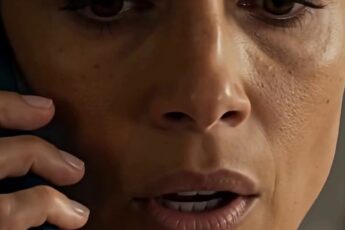
The moment the aircraft door opened, the air inside Flight 402 changed.
Passengers were already standing too soon, pulling bags from overhead bins, checking phones, complaining about tight connections and stiff legs. The ordinary noise of arrival filled the cabin.
But around row 12, everything felt different.
The woman in designer sunglasses, who had called the little girl exhausted, stood quickly.
Too quickly.
She reached for the child’s backpack before the girl could move.
“I’ll take that,” she said.
The girl’s small shoulders tightened beneath the oversized hoodie.
I was standing in the aisle beside them, still smiling the way flight attendants learn to smile when something serious is happening behind the curtain.
“Ma’am,” I said gently, “we’ll need you to remain seated for just a moment. Ground staff will assist you.”
Her head turned toward me.
The sunglasses were still on, though the cabin lights were bright and the plane had stopped moving.
“Assist me with what?”
Her voice was smooth.
Too smooth.
The little girl looked at the floor.
I placed one hand lightly on the seatback, not touching the child yet, not giving the woman anything to react to.
“Just routine arrival paperwork,” I said.
The woman’s mouth tightened.
“There is no paperwork.”
Before I could answer, the captain’s voice came over the speakers.
“Ladies and gentlemen, we’ll be deplaning from the forward door shortly. Please remain patient as airport personnel board first for a brief matter. We appreciate your cooperation.”
A few passengers groaned.
A man in row 10 muttered something about missing his shuttle.
Then the front door opened.
Two airport officers stepped on board first, followed by a woman in a navy blazer with an ID badge around her neck. Behind them came a gate supervisor who kept her expression calm but serious.
The woman in sunglasses stopped moving.
For the first time since boarding, she looked unsure.
The little girl’s fingers found mine.
Not fully.
Just the edge of my hand.
But I felt how cold they were.
The officer spoke quietly.
“Ma’am, we need you to come with us.”
The woman laughed once.
It was not a real laugh.
“This is ridiculous. I’m traveling with my niece.”
The child flinched at that word.
The woman in the navy blazer noticed.
So did I.
“So we’ll clear that up off the aircraft,” the officer said.
“I’m not leaving her.”
The little girl’s grip tightened.
I knelt slightly beside the row and looked at her.
“You’re safe,” I whispered. “You don’t have to go anywhere with anyone until the grown-ups sort this out.”
Her eyes filled.
The woman heard me.
Her face changed.
“You have no idea what you’re interfering with.”
The officer stepped closer.
“Ma’am.”
One word.
Firm.
Enough.
The woman looked around the cabin. Passengers were watching now. Not openly at first, then all at once. The businessman who had complained about his shuttle went quiet. A mother holding a toddler pressed her lips together. An older woman across the aisle clutched her handbag and stared at the child with tears already in her eyes.
The woman in sunglasses slowly stepped into the aisle.
As she passed me, she whispered, “You should have minded your own business.”
I looked at the little girl.
Then back at her.
“A child asking for help is my business.”
She said nothing after that.
The officers escorted her off the plane.
Only when she disappeared through the doorway did the little girl let out a breath so small I almost missed it.
The woman in the navy blazer crouched gently near row 12.
“Hi, sweetheart. My name is Karen. I’m here to help. Can you tell me your name?”
The girl looked at me first.
I nodded.
She whispered, “Emma.”
It was the first time I heard her name.
Emma.
A tiny name for a tiny girl who had carried more fear through the sky than any child should have to carry.
Karen smiled softly.
“Hi, Emma. You did very well.”
Emma blinked.
“I wasn’t loud.”
“No,” Karen said. “But you were brave.”
Emma looked down at the boarding pass still folded in her palm.
“I wrote it while she was asleep in the car.”
My throat tightened.
The lead attendant stood near the galley, one hand covering her mouth.
Karen held out her hand but did not take the paper until Emma gave it to her.
On the back, beneath those five words, there was a phone number.
Please call my real dad.
And below it, in even smaller letters:
His name is Daniel.
Karen read it, then looked at the gate supervisor.
“We have the number?”
The supervisor nodded.
“He’s already here.”
Emma froze.
Her eyes lifted slowly.
“My dad?”
Karen’s voice softened even more.
“Yes, sweetheart. He’s in the terminal.”
The child stared at her as if the words were too large to understand.
“She said he wouldn’t come,” Emma whispered.
Nobody answered right away.
Because there are lies that hurt once when they are told, and again when the truth finally proves how cruel they were.
I sat carefully in the aisle seat across from her.
“Emma,” I said, “he came.”
Her chin trembled.
“She said he stopped looking.”
Karen shook her head.
“He didn’t.”
Emma’s little face crumpled then.
Not loudly.
Not dramatically.
Just a slow breaking, the kind that happens when a child finally feels safe enough to stop pretending.
I reached for her hand.
This time she took it fully.
The passengers remained seated while the officers and Karen helped Emma gather her things. Her backpack was old and small, with a broken zipper tied with pink string. Inside were a stuffed rabbit with one ear sewn back on, a pack of crayons, a sweater, and a photograph folded inside a library book.
Karen found the photograph when Emma pointed to it.
“That’s him,” Emma said.
It showed a man in jeans kneeling beside a little girl on a front porch. Emma was younger in the picture, maybe four. Her hair was in two uneven ponytails. The man had his arms around her, laughing with his whole face.
The back of the picture said:
Daddy and me. Saturday pancakes.
I looked away for a second.
After twelve years in the air, I thought I knew how to keep my face steady.
That photograph nearly undid me.
Karen placed it back carefully.
“We’re going to walk off the plane now,” she said. “You can hold my hand, or Rachel’s hand, or both.”
Emma looked at me.
I had not told her my name.
But she had read it from my uniform badge.
“Both?” she asked.
“Both,” I said.
So that is how Emma left Flight 402.
One hand in mine.
One hand in Karen’s.
Her little backpack on her shoulders.
The blanket still around her like a shield.
As we reached the aircraft door, she stopped.
The jet bridge stretched ahead, gray and plain and ordinary.
But at the end of it, beyond the airport staff and two officers, stood a man who looked like he had forgotten how to breathe.
Daniel.
He had one hand pressed against the glass wall of the jet bridge, the other over his mouth. His hair was messy. His shirt was wrinkled. One shoe was tied badly, like he had dressed while running.
The moment Emma saw him, her whole body changed.
Not into joy.
Not yet.
First into disbelief.
Then fear that joy might be taken away.
“Daddy?” she whispered.
Daniel heard her.
His face broke.
“Emma.”
He did not rush at her.
That was what made me trust him immediately.
He wanted to.
Every part of him looked ready to run.
But he stayed where he was, kneeling slowly on the jet bridge floor, arms open, letting her choose the last few steps.
Emma stared.
“She said you didn’t want me.”
Daniel shook his head, tears falling freely.
“Never. Never, baby. I have wanted you every second.”
Emma took one step.
Then another.
Then the blanket slipped from her shoulders, and she ran.
Daniel caught her as gently as if she were made of glass and held her so tightly that the officers looked away. His shoulders shook. Emma buried her face in his neck and made a sound I will remember for the rest of my life.
Not a scream.
Not a sob.
A child finally coming home.
“I called,” he whispered into her hair. “I called everyone. I went everywhere. I never stopped.”
“She said you did.”
“She lied.”
Emma pulled back just enough to look at him.
“My note worked?”
Daniel gave a broken laugh through tears.
“Yes. Your note worked. You were so smart. So brave.”
Emma looked over her shoulder at me.
“She saw it.”
Daniel lifted his eyes.
For one moment, I saw a father trying to speak and failing because gratitude was too big for words.
Then he mouthed, “Thank you.”
I nodded, but my own eyes were full.
There are moments in this job when you hand someone coffee, show them where the restroom is, calm a nervous flyer, smile through complaints, and wonder whether any of it matters.
And then there are moments when a six-year-old holds your uniform and reminds you exactly why paying attention can change a life.
We were moved into a quiet room near the gate after that.
Not a cold office.
A soft room with chairs, a table, a box of tissues, and a small basket of snacks someone had probably brought for delayed passengers. Emma sat on Daniel’s lap at first, refusing to let go of his sleeve. He did not ask her to. He simply wrapped one arm around her and used his other hand to smooth the hair back from her forehead again and again.
Karen spoke gently with Daniel.
The story came out in pieces.
Emma’s mother had died the year before. Daniel and Emma had been rebuilding their life slowly, one school morning and bedtime story at a time. The woman from the plane was not a stranger, but someone Emma’s mother had once trusted years earlier. She had offered to help for a weekend visit, to take Emma to see “family friends.”
Then she disappeared.
Changed plans.
Changed phones.
Changed the story.
She told Emma that Daniel had signed papers.
That he had moved away.
That he was tired of raising her alone.
Emma had not believed her at first.
Then days passed.
Then more days.
Children believe what they must when the grown-ups around them control every door.
But Emma remembered the photograph.
She remembered the phone number Daniel made her memorize in case of emergencies.
And when the woman told her they were flying to another city where “nobody would ask questions,” Emma knew she had one chance.
In the car before the airport, she found a pen in the seat pocket.
At check-in, she kept the boarding pass.
And when the woman looked away long enough, Emma wrote the note.
Please call my real dad.
Five words.
Five words that had crossed the sky with her.
Daniel held her tighter when he heard that part.
“I’m sorry,” he whispered. “I’m so sorry I wasn’t there before the plane.”
Emma touched his face with both hands.
“You came after.”
He closed his eyes.
“Yes. I came after.”
Karen explained things I only half-heard, because I was watching Emma’s little fingers curl into her father’s shirt as if she needed to keep proving he was real.
Then Emma suddenly turned to me.
“Did I do something bad?”
My heart clenched.
“No,” I said immediately.
The room went quiet.
I knelt in front of her.
“Emma, listen to me. You did exactly what you were supposed to do. You asked for help in the way you could. That was not bad. That was very brave.”
She looked at Daniel.
He nodded through tears.
“You saved yourself, sweetheart.”
Emma’s eyes widened.
“I did?”
“You did,” he said. “And Rachel helped.”
Emma looked back at me.
“You didn’t tell her.”
“No.”
“Even when she was mean?”
“Especially then.”
For the first time, the smallest hint of a smile touched Emma’s mouth.
It lasted less than a second.
But it was there.
Someone brought her apple juice and crackers. This time, no one answered for her.
Karen asked, “Would you like apple juice?”
Emma looked at Daniel.
He smiled.
“You can choose.”
She took a long time to answer.
Then she whispered, “Yes, please.”
Such a small thing.
A cup of juice.
But in that room, it felt like a door opening.
Later, while the proper reports were being handled and Daniel spoke with the airport officers, Emma sat beside me with the stuffed rabbit in her lap.
“His name is Button,” she said.
“That’s a good name.”
“He lost his ear once.”
“I see he got it back.”
“My dad fixed it.”
She touched the uneven stitches on the rabbit’s ear.
“He’s not very good at sewing.”
Across the room, Daniel heard that and laughed for the first time.
A wet, tired laugh.
“I did my best.”
Emma looked at him very seriously.
“It’s crooked.”
“I know.”
“But it stayed.”
Daniel’s face softened.
“Yes,” he said. “It stayed.”
That sentence filled the room in a way Emma did not understand yet.
But every adult did.
Some things do not need to be perfect to hold.
Before I had to return to the crew area, Daniel stood and came toward me.
Emma stayed close to his leg, one hand holding the fabric of his pants.
“I don’t know how to thank you,” he said.
His voice was rough.
I shook my head.
“You don’t have to.”
“I do.”
I looked at Emma.
“She trusted me. I just listened.”
Daniel swallowed hard.
“A lot of people didn’t.”
I thought of the woman’s sunglasses. Her sharp tone. The way she spoke over Emma before the child could breathe.
Then I thought of those tiny fingers catching my uniform.
“Sometimes children tell the truth very quietly,” I said. “We have to be quiet enough to hear it.”
Daniel nodded.
Emma tugged at his hand.
“Can Rachel come to pancakes?”
The question hit me unexpectedly.
Daniel laughed softly through tears.
“Maybe not today, baby.”
Emma looked disappointed.
I crouched again.
“I have to work another flight,” I said. “But I want you to eat pancakes for me too.”
“With syrup?”
“Extra syrup.”
She considered that.
Then nodded.
“I can do that.”
Daniel promised to keep in touch through the airline office, and I did not know if he would. People promise many things in emotional moments. Life gets complicated. Healing takes time. Airports swallow stories the way skies swallow planes.
But two weeks later, a letter arrived at our crew office.
It was addressed to:
Rachel — Flight 402
Inside was a drawing.
A little girl in an airplane seat.
A woman in a blue uniform.
A man kneeling at the end of a long hallway.
And between them, a tiny folded piece of paper with five little lines on it.
There was also a note from Daniel.
Rachel,
Emma asked me to write because she said grown-ups spell better. She is safe. She is sleeping through most nights now, though she still wants the hall light on. She started school again this week. Her teacher says she drew an airplane and told the class, “That’s where someone listened.”
I had to sit down before finishing it.
We had pancakes the morning after the airport. Extra syrup, as requested. She saved one bite for you, then ate it because she said it would get cold.
That made me laugh and cry at the same time.
I will never be able to repay what you did. But I want you to know this: when Emma talks about that day, she does not say she was rescued by officers or paperwork or rules. She says, “I held the lady’s uniform and she came back.”
I read that line three times.
Then I folded the letter and placed it in my locker, behind my spare scarf.
For years, I had kept thank-you notes from passengers. A nervous flyer who made it through turbulence. A mother grateful for help with twins. A man who said I reminded him of his daughter.
But Emma’s drawing stayed at the front.
Months passed.
I thought of her often.
Every time a child boarded too quietly.
Every time an adult answered too quickly.
Every time a passenger said, “She doesn’t need anything,” before the child was even allowed to look up.
I became better at pausing.
Better at kneeling.
Better at asking, “Would you like to answer for yourself?”
Then, one Friday morning, almost a year later, I was working a flight to Denver.
Boarding had just begun when a little voice near the forward galley said:
“Rachel?”
I turned.
There she was.
Emma.
Her hoodie was gone. She wore a yellow cardigan, jeans, and little sneakers with purple laces. Button the rabbit was tucked under one arm, his crooked ear still attached. Daniel stood behind her, carrying two backpacks and looking like every father who had checked the boarding time seventeen times.
Emma did not run.
She walked carefully toward me.
Then she held out something.
A small envelope.
“I drew you a better picture,” she said.
I knelt immediately.
“You did?”
She nodded.
“This one has pancakes.”
Daniel wiped one hand across his eyes and pretended he was fixing his glasses, though he was not wearing any.
I opened the envelope.
The drawing showed an airplane above white clouds. Inside one window was a little girl. Beside her was a flight attendant with a very big smile and a tray of apple juice. At the bottom, in careful letters, Emma had written:
Thank you for hearing my quiet voice.
I could not speak for a moment.
Emma leaned closer and whispered:
“I’m not scared of planes today.”
I looked at Daniel.
His face was full of something deeper than relief.
Hope, maybe.
The kind that comes slowly, after many nights of leaving lights on and many mornings of proving someone is still there.
“That’s wonderful,” I said.
Emma nodded.
“Daddy says we’re going to see the ocean.”
Daniel smiled.
“She picked the destination.”
“I want to show Button waves,” Emma explained.
“Very important,” I said.
“Very.”
Before she went to her seat, Emma reached for my hand again.
Not desperately this time.
Not like it was the last safe thing in the sky.
Just because she wanted to.
That was when I knew she was healing.
Not because she forgot.
Children do not simply forget fear.
But because her hand was no longer asking me to save her.
It was saying hello.
During that flight, I brought her apple juice.
I asked her first.
“Would you like some?”
Emma sat up straight.
“Yes, please.”
Daniel looked out the window for a second.
I knew why.
Sometimes the smallest choices are the ones that prove the world is becoming safe again.
When we landed, Emma gave me a quick hug before leaving.
Button’s crooked ear brushed my cheek.
“Don’t forget pancakes,” she said.
“I never will.”
She took Daniel’s hand and walked down the aisle, pausing once at the aircraft door to look back.
This time she smiled.
Not a big smile.
Not the kind people ask children to make for pictures.
A real one.
Soft.
Brave.
Hers.
And as she stepped into the jet bridge beside her father, I thought about the first day I saw her, hidden under a blanket in row 12, holding a boarding pass like a lifeline.
The sky can feel enormous when you are small.
A plane can feel like nowhere to run.
A room full of adults can feel louder than your own voice.
But Emma had found a way.
She had written five words.
She had reached for one safe seam of fabric.
And she had reminded every person on Flight 402 that courage does not always sound like shouting.
Sometimes courage is a trembling hand under a blanket.
Sometimes it is a note written in shaky letters.
Sometimes it is a child who has been told nobody will listen, trying anyway.
And sometimes one adult paying attention is enough to turn the whole story toward home.
💬 Have you ever seen a child ask for help in a quiet way, or felt that someone noticed your fear when you couldn’t explain it? Share your thoughts in the comments — I’d truly love to know what this story made you feel.