The bus groaned off into the dusk, leaving Ren standing in a cloud of gravel dust with nothing but the whine of crickets and the first sharp chill of late October biting through her hoodie. She couldn’t afford the ride all the way to the farm gate. The last three miles were on her, a long strip of cracked asphalt that state road crews had forgotten since before she was born.
She was thinking about the midterm paper she’d left half-finished on her laptop when she saw it.
A heap of something on the shoulder. Tan and gray. Looked like somebody had dumped a load of old carpet. She almost kept walking—her mom was waiting, and the chili was probably already cold. But the heap moved. A slow, shallow rise and fall.
She stopped.
The shape resolved itself. A head. Massive. Blocky. Jaws that looked like they could crack bone without trying. A Central Asian Shepherd. A livestock guardian breed she’d only ever seen in YouTube videos with titles like “TOP 10 DOGS YOU CAN’T HANDLE.” Her stomach dropped into her sneakers.
She wanted to go. Every sensible nerve in her body screamed at her to cross to the other side of the road, keep her head down, and walk. Fast.
But the dog didn’t lift its head. Didn’t growl. Didn’t even track her movement with its eyes, which were open but fixed on a point somewhere far beyond the soybean field. The kind of stare you see in creatures that have already stopped waiting for anything good to happen.
“Hey,” she whispered.
One ear twitched. Just barely. That was enough.
She ran.
Her boots pounded the gravel driveway. The porch light was on. The screen door slammed open before she even reached the steps. Her cousin, Maddie, stood there, a dish towel over her shoulder, her face halfway between concern and irritation.
“Ren? What the hell—”
“Dog. On the shoulder, just past Miller’s old place. It’s huge. It’s… Maddie, it’s dying.”
“Dying? What kind of dog?”
“A… one of those… the sheepdogs. From the mountains. Central Asian.”
The dish towel slid off Maddie’s shoulder and hit the porch boards. She didn’t pick it up.
“You mean an Alabai? Are you out of your mind? Those things are bred to fight wolves, Ren. Wolves. They don’t need—”
“It can’t get up,” Ren cut in, her voice cracking. “It’s been there. For days, maybe. It’s just bones and fur. It can’t get up.”
A long silence. The wind picked up, rattling the dry corn stalks in the field across the road. Maddie stared at her. Then she sighed the sigh of someone who knows she’s about to do something monumentally stupid.
“Get the emergency blanket from the truck. The wool one, not the mylar. And fill the two-gallon jug. We’re gonna need all of it.”
The neighbor, a retired mechanic named Gus, leaned over his fence as they wrestled the dog into the blanket. The sun was a memory now, just a bruise of purple on the horizon. Ren held her phone flashlight, the beam trembling. Maddie was trying to slide the wool under the animal’s heavy, matted body.
“You girls got a death wish?” Gus hollered, his voice sharp with genuine alarm. “That’s a fighting breed! Back away from it!”
“He’s not fighting anything,” Maddie grunted, not looking up. “He’s half-dead.”
“It wakes up, you’re gonna be half-dead with it! Your ma know you’re out here messing with a guard dog? That thing’s a liability!”
“Thanks for the input, Gus,” Ren said, her voice tighter than she intended.
He stood there another minute, shaking his head, then retreated into the warm yellow light of his own kitchen. A car slowed down. A woman rolled down her window, took in the scene, and said the same thing, almost word for word. Good dogs, if raised right. But a stray? A sick stray? You’re just asking for trouble. The window rolled back up. The car drove away.
Nobody offered to help. Everyone knew the rules. Don’t touch. Don’t risk it. Mind your own business.
The dog just lay there, breathing in shallow, painful hitches.
Ren poured water into a cupped hand. The dog didn’t drink. She wet her fingers and ran them over the cracked, dry lips. Once. Twice. On the third pass, a tongue moved. Slow, heavy, like it had forgotten how. Maddie let out a breath she’d been holding for what felt like an hour.
Getting him into Gus’s dented F-150 required Gus himself. He came back out, still cursing them for fools, but he dug his thick hands under the dog’s chest and heaved without complaint. They drove at five miles an hour, Maddie riding in the truck bed with the dog’s head cradled on her knees, talking to it the whole way.
The real fight wasn’t the carrying. It was the standing.
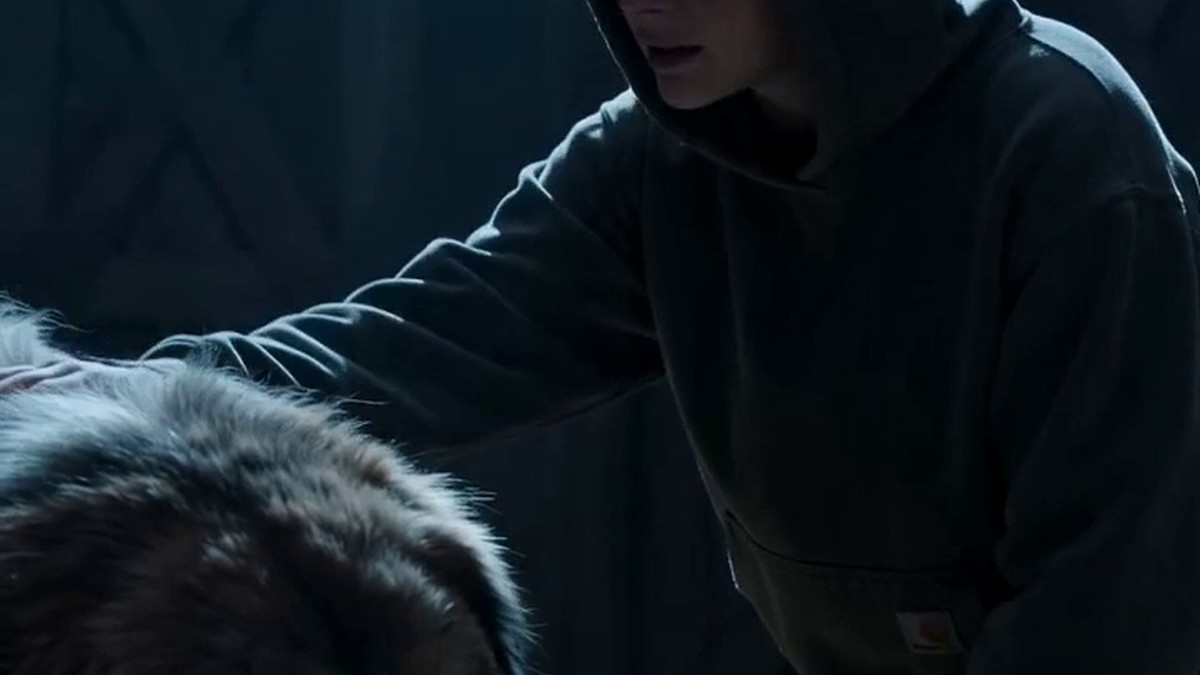
In the barn, on a pile of old horse blankets and a tarp, Ren crouched in front of him. She didn’t give commands. She just talked. About the barn. The heat lamp overhead. The fresh straw. The fact that nobody was going to chase him off or throw rocks or tell him to get lost.
He tried. Front legs, thin as railings, trembled with effort. He lifted his enormous head an inch. Two inches. His shoulders bunched. For a second, Ren thought he had it. Then he collapsed, a heavy thud of bone and disappointment. Second try. Same result. Third try. He got one paw under him, then the other, and then he was up. Swaying. His legs splayed. Ren ducked under his shoulder, taking some of the weight. Maddie steadied his hindquarters. He stood for ten seconds that felt like ten years.
Then he sat down. On his own. And he looked at Ren. Not through her. At her. A direct, searching gaze. A question.
Gus, standing in the barn doorway, lit a cigarette with shaking hands and didn’t say a goddamn word.
Ren trudged up to the house an hour later, the kitchen clock pushing midnight. Her mom sat at the Formica table, a bowl of chili in front of her, long gone cold. The crossword puzzle book was open but she wasn’t looking at it.
“You didn’t eat,” Ren said, her voice scratchy.
“Neither did you,” her mom said. “Is it still alive?”
Ren nodded. Her mom pushed the bowl toward her.
“Then heat that up. Tomorrow we figure out what the hell we’re doing.”
The vet’s office in town was run by a woman named Dr. Alvarez. She was short, silver-haired, and had a reputation for telling owners the blunt truth. When they led the dog in the next morning—a rope looped carefully around his neck because there was no collar—she just stared for a moment.
“You picked up a stray Central Asian?” she said.
“We picked him up,” Maddie said. “He didn’t bite us once.”
Dr. Alvarez’s exam was thorough. She lifted his cracked, raw pads. She combed out the burrs and the mats. She checked his teeth, his ears, his eyes. The dog stood. He just stood and let her do it all. When something hurt, he shifted his weight and glanced at Ren, a quick sidelong check. *You still here? You didn’t leave, right?*
“In twenty-two years,” Dr. Alvarez said quietly, rubbing the back of the dog’s neck, “I’ve never seen a dog this big, this sick, stay this calm. He knows you helped him. They always know.”
She scribbled an estimate on a notepad and slid it across the counter: $216. “That’s just to start,” she said. “More if he needs IV fluids.” Ren pulled a wad of cash from her jacket pocket, her share from the summer job at the truck-stop diner. She counted out two hundred-dollar bills, a ten, and a five. Maddie covered the rest.
They named him Little Dude that night, back in the barn. Maddie said it as a joke, because the dog was a hundred and forty pounds of pure, emaciated responsibility. The name stuck. Little Dude.
The first couple of days he ate. They fed him three times a day—a mush of canned puppy formula from Tractor Supply, $2.79 a can, mixed with water and soaked kibble until it looked like oatmeal. But on the third night, he wouldn’t touch it. Ren sat with him from midnight until the barn clock read 4:22 a.m., a half-empty bowl congealing beside her. Maddie called Dr. Alvarez’s emergency line. The vet drove out in her old Subaru, charged them $150 for a bag of lactated Ringer’s and a vitamin shot, and said, “Some of them don’t make it past the first week. If he’s still like this tomorrow, you’ll have to think about your options.”
He made it. By sunrise, he lapped water from Ren’s palm and ate a few mouthfuls of the canned food. Ren cried into his ruff, and he let her.
After that, he gained weight in stubborn, uneven spurts, finishing a fifty-pound bag of Purina One every five, six days—$42 a pop and worth every penny. Ren picked up extra shifts at the truck stop off I-80, five nights a week, to keep the feed bin full and the vet bills paid off.
By the end of the month, Maddie’s boyfriend, Cole, was spending Saturdays building a proper kennel. Not a cage. A kennel, with a sheltered run and a wooden dog house insulated against the Nebraska wind. The pressure-treated lumber and chain-link panels cost him $180 from Menards. Little Dude sat beside the pile of lumber and watched every nail go in, like a foreman who didn’t much trust the crew but was willing to see the job through.
Winter hit hard that year. Ice storms. Drifts that covered the fences. But by then, Little Dude wasn’t the skeleton on the roadside anymore. His coat grew in thick, a dense double layer the color of winter wheat. He stood at the gate and watched the road with a calm, unnerving authority. Delivery drivers didn’t get out of their trucks. Strangers crossed the street.
Spring came late.
It was a Saturday. Ren was home from State, sitting on the porch steps with a book, half-watching Little Dude as he snoozed in his usual spot by the gate, a mountain of fur in the dappled shade. Cole’s nephew, a five-year-old tornado named Leo, was playing in the yard, running his toy tractor through the dirt. Maddie was in the kitchen, the screen door propped open.
Ren didn’t see the two men until they were already at the fence line. Stray dogs had been a problem in the county all winter, packs of them running deer and raiding chicken coops. But these weren’t strays. Two pit bulls, chests wide, heads low, muscle and intent. They’d slipped through a gap in the back pasture fence. Ren saw one lock eyes on Leo.
Time turned to syrup.
She opened her mouth to scream Leo’s name. She dropped the book.
She didn’t need to. A sound rolled across the yard. Not a bark. A deep, resonant rumble that she felt in her chest before her ears even registered it. Little Dude rose. He didn’t scramble. He didn’t charge. He just stood, and then he moved forward. Not fast. Deliberately. The way a thunderhead moves across the prairie.
He placed himself between Leo and the two dogs. The pits stopped dead. One of them, the larger one, let out a low growl. Little Dude didn’t growl back. He didn’t snarl. He just stood there, his colossal head slightly lowered, his gaze fixed. A silent, immovable wall of flesh and bone and pure, ancient instinct.
The standoff lasted maybe ten seconds.
The big pit bull broke eye contact first. He looked away, a small, almost unconscious gesture. Submission. The two dogs backed up, then turned and trotted, businesslike, back toward the pasture gap. No fight. Just a decision.
Little Dude watched them go. When they were out of sight, he turned, walked back to Leo, and lay down right next to the kid’s dirt pile. Leo, oblivious, patted his head and kept driving his tractor over his haunches. The dog didn’t move.
Maddie came out onto the porch, her face white as chalk. She’d seen the whole thing. Ren was still frozen, her book face-down in the grass, her heart trying to jackhammer its way out of her ribs.
Little Dude yawned. A huge, lazy, cataclysmic yawn that showed every one of his enormous teeth.
That night, they cooked steaks on the grill. Cole gave Little Dude a whole T-bone, and nobody said a word about table scraps. Gus came over with a six-pack of Budweiser and stood at the fence, looking at the dog in the deepening twilight. After a long minute, he reached into the pocket of his coveralls and pulled out a T-bone wrapped in butcher paper. He crouched and slid it through the diamond wire of the kennel, just within reach of Little Dude’s nose. The dog sniffed it. Gus straightened up, gave a small, rough jerk of his head, and walked back toward his house, raising the six-pack in a brief salute but not looking back.
Ren sat on the porch steps, a half-empty Budweiser between her knees. Little Dude opened one eye and found her through the porch screen. The eye closed, and his tail gave a single, heavy thump against the wooden boards.