The breakfast tray didn’t just drop. It launched. Vivian Carrington swept it off her lap with both hands and the silver platter whirled sideways, eggs splattering against the floor-to-ceiling glass in thick yellow coins, orange juice erupting down the pane so it looked like Lake Michigan itself had bled citrus into the summer sky.
No one moved.
The caregiver, Doris, stood with her fingers steepled against her collarbone. Claire, the personal assistant, clutched her tablet like a life raft. The private nurse in navy scrubs by the door closed her eyes for exactly one breath, as if she were counting down from ten. The whole room had seen versions of this before. Vivian Carrington, founder of Carrington Financial, the woman who had carved a real estate empire from Chicago’s Gold Coast to the Loop and back, had not eaten in five days.
She could swallow just fine. Her hands still had limited motion, enough to lift a fork. But she had decided she was finished.
“Get it all out,” she said, voice low and flat. “I don’t want to see a single crumb.”
Doris bent to scrape scrambled eggs off the Italian marble. The nurse nudged a shard of porcelain with her shoe. Outside the glass, the morning sun burned over the city that Vivian had once bent to her will. Taxis threaded through Wacker Drive. Ant-sized pedestrians crossed Michigan Avenue. Somewhere down there, men and women in suits were entering buildings she’d financed, using her name like it still belonged to a living person.
Up here, on the forty-second floor of Carrington Tower, she was a problem to be scheduled, a body to be shifted, a mood to be monitored.
The elevator chimed at 7:52 a.m., and James Donovan stepped out holding a beat-up toolbox in one hand and his five-year-old daughter’s small, sticky fingers in the other.
He didn’t belong on the executive level. Nobody from maintenance belonged on the executive level. James had worked inside Carrington Tower for eight years, long enough to know which steam pipes groaned in January, which HVAC units failed every August, and which condo owners left their terrace doors wide open during a lake-effect squall. He knew the building as deeply as he knew the rumble of the elevated train outside his apartment—by feel, by sound, by the way trouble announced itself before anyone else noticed.
But the penthouse corridor was a different world. The carpet swallowed every footstep. The air smelled of citrus oil and money. The lighting was so soft it felt like a hospital hallway designed by a luxury spa.
“Daddy,” his daughter whispered as they walked down the long silent hall, “how come nobody’s talking?”
“Because people up here pay extra for no noise,” James said.
Emma looked up at him with the same judgy squint she used when adults tried to explain why the moon follows the car.
“We don’t pay extra,” she said.
“No, baby. We do not.”
He squeezed her hand and kept walking.
The call had come in at six-fifteen: temperature irregularity in the penthouse suite, possible vent blockage in the northwest auxiliary line. Normally James would’ve gone up alone, popped the vent cover, cleared the damper, and been back in the basement before the second cup of coffee. But Emma’s pre-K had closed after a water main burst on Armitage and flooded the entire ground floor. His mom was in Indianapolis. His neighbor Rosa, who usually pinch-hit, was out of town at her sister’s wedding. He’d called his supervisor, Frank Tremblay, who had sighed into the phone like a man re-evaluating every life decision.
“Just keep her with you, Donovan. And for the love of God—”
“Don’t let her touch anything. I know.”
“You don’t know. She touched the sump pump last time and we almost lost half the sub-basement.”
James had repeated the entire instruction to Emma on the elevator ride up. Twice. Emma had nodded so earnestly both times that he immediately knew she would ignore every word.
The penthouse door swung open before James could knock a second time. The woman standing there looked thirty-nine or maybe forty-five, dark hair scraped into a sleek low bun, exhaustion painted under her eyes like a bruise beneath expensive concealer. A tablet was tucked under her arm like a shield. She glanced at James, the toolbox, then at Emma. Her expression flickered through confusion, alarm, disbelief, and then a weary surrender.
“I called ahead,” James said. “James Donovan, facilities. Frank cleared it for the vent.”
“Claire Hendricks,” she said. Her voice was polite but hollow, the voice of someone who hadn’t slept more than four hours in weeks.
Emma lifted one hand. “I’m Emma. I’m five. My dad fixes things.”
For the first time, something cracked in Claire’s face. It wasn’t a smile but it was a memory of one. “Of course he does,” she murmured, and stepped aside. “Come in.”
The penthouse was vast and strangely breathless, the way museums feel right before closing. Glass walls wrapped three sides, framing the lake on one end and the city’s jagged skyline on the other. Cream stone floors stretched beneath furniture so minimal and costly it seemed to float. Every surface gleamed. Every angle was intentional. Nothing felt lived in.
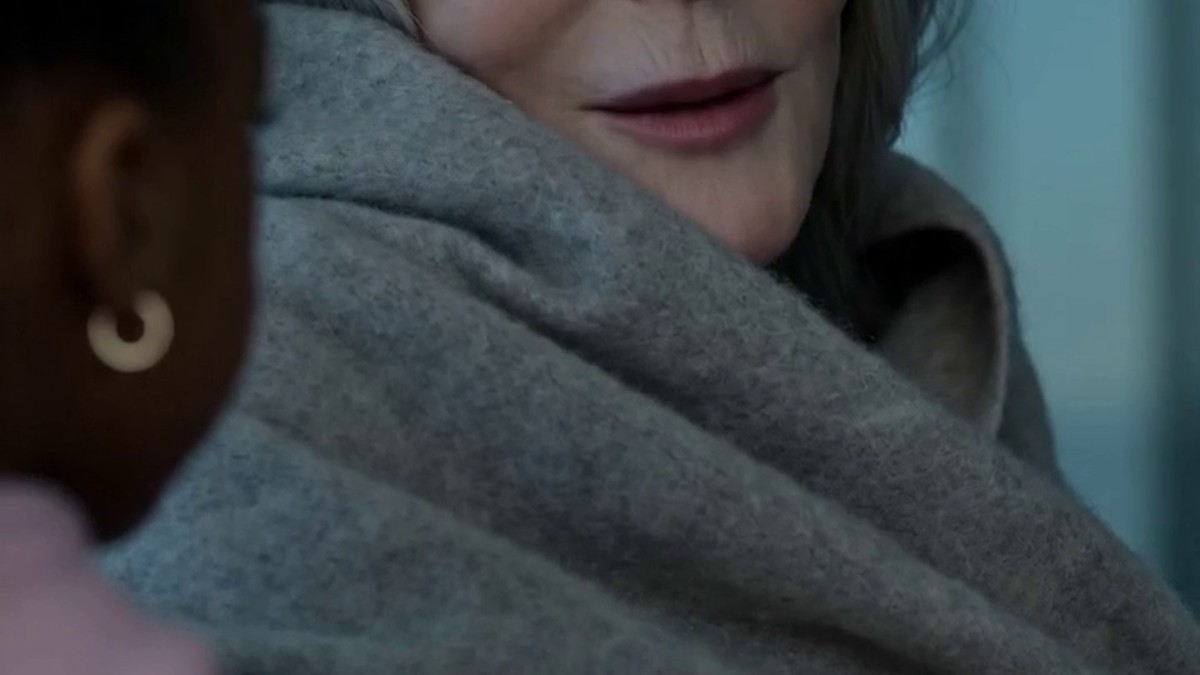
James noticed the wreckage near the windows before he saw the woman in the wheelchair. Yellow yolk streaked the glass. A silver dome lay upside down. Napkins scattered like fallen birds. And then he saw her: Vivian Carrington, half-turned away, one hand gripping the armrest so hard the knuckles were bone-white. Her dark hair spilled over one shoulder, almost violent against the pale blue cashmere wrap draped around her. She was thinner than the magazine profiles from five years ago. Sharper. Beautiful in the way a storm front is beautiful.
The entire room seemed to be held in place by her fury.
Claire lowered her voice. “Ms. Carrington, someone from building maintenance is here to check the airflow.”
Vivian didn’t turn.
Then Emma, who had not yet learned that rich people require a perimeter of silence around their feelings, walked two steps forward and said, “Did you throw your breakfast because it was gross?”
The room froze. James felt his stomach drop straight through the marble.
“Emma—”
Vivian turned.
Her eyes were an unexpected gray, almost silver, paler than the lake. They landed on Emma, then on James, then slid back to the child. It wasn’t anger. It was closer to the bewildered stare of someone who’d just heard a bird speak.
“What,” Vivian said, “is that?”
“My daughter,” James said, already mortified. “I’m so sorry. Her school flooded, I had no childcare, Frank Tremblay signed off—”
“I’m Emma,” she announced, because she believed in giving people multiple chances to understand important information. “I asked if the eggs were gross.”
Claire shut her eyes, a woman praying not to God but to the payroll department.
James crouched beside Emma and dropped his voice to his serious-dad register. “You stay right here while I check the vent. No talking unless someone talks to you first.”
Emma looked offended. “She did talk to me.”
Vivian’s mouth twitched—barely—and James, who had fixed enough broken machinery to recognize the first small click of a gear shifting, thought it might have been the start of something.
He got to work near the ceiling register in the far corner, setting out his tools with the focused speed of a man for whom mistakes meant overdraft fees. He could feel the room breathing behind him: the cautious stillness of the staff, the way they orbited Vivian like moons around a dying planet.
Then Emma wandered exactly three feet past the boundary he’d set and stopped beside the kitchen island.
“There’s a flower,” she reported.
There was. A single pale pink rose in a slim crystal vase, set apart from the breakfast disaster.
“Don’t touch that,” James said without turning.
“I’m not touching it. I’m looking.”
Emma studied the rose, then looked straight at Vivian, whose gray eyes had tracked the child’s every move.
“Who gave you that rose?”
—
Vivian blinked, the question landing somewhere between her ribs. For a moment she didn’t answer. No one had asked her a question that simple in months. Everyone around her asked about logistics, schedules, medication dosages. Not whether she had someone in her life who brought her flowers.
“I bought it for myself,” she said, her voice rougher than she intended. “Yesterday.”
Emma tilted her head. “My dad got me a daisy once from the garden over by the train tracks. He said flowers are for sharing.”
James froze, vent screw halfway out, and felt his throat tighten. He remembered that daisy. He’d picked it from a cracked sidewalk planter when they’d had exactly eleven dollars left until payday and he’d wanted to give her something beautiful.
“That’s very sweet,” Vivian said, and this time the words came out softer, almost fragile.
Emma walked a little closer, not cautious but curious, the way kids approach a cat that’s been hiding under a porch. “Are you sad?”
The question sliced clean through the air, past the tension, past the staff members who suddenly couldn’t look at each other. Vivian’s jaw tightened, and for one horrible second James thought she might explode. Instead, she exhaled.
“I am tired,” Vivian said. “There’s a difference.”
“Not really,” Emma said, completely certain. “When I’m tired, I’m always sad. That’s how it goes.”
Vivian stared at this tiny stranger with her mismatched socks and her ponytail coming undone, and something ancient and locked inside her cracked wide open. She felt it in her sternum, a sharp prickle of heat.
“Do you want me to sit with you?” Emma asked. “I’m good at sitting. My teacher says so.”
Vivian looked at James, who had stopped pretending to fix the vent and was now watching with the expression of a man watching his child wade into deep water. She gave him the smallest nod.
Emma climbed onto the low velvet ottoman beside the wheelchair and folded her hands in her lap like she was at a tea party.
“You didn’t eat your eggs,” Emma observed. “That’s okay. I don’t like eggs either, but my dad says protein is important. I have a granola bar in my backpack. Want some?”
No. Vivian wanted to say no. She wanted to say no and wheel herself back to the window and wait for the light to change and for the day to mercifully end. But there was a five-year-old girl holding out a slightly crushed peanut-free granola bar, and the offer was so startlingly genuine that Vivian felt her eyes sting.
“Okay,” she whispered.
Emma unwrapped it carefully, broke off a small piece, and held it up. Vivian took it with trembling fingers. It tasted like oats and honey and something she couldn’t name—maybe hope, maybe just the ordinary kindness she hadn’t felt in years.
She chewed. She swallowed. She did not die from it.
“Claire,” she said, her voice suddenly steady. “I need the room. You and the nurse and Doris—everyone out. Now.”
Claire’s face went very still. “Ms. Carrington, your vitals need to be—”
“Now.”
The word landed like a gavel. The staff exchanged glances that James didn’t like—tight, strategic, the kind of glances people exchange when an unexpected variable threatens a plan. But they filed out, the door clicking shut behind them with a final, heavy sound.
“James,” Vivian said, and he straightened. “Close your toolbox. Come here.”
He walked over. Emma was now holding Vivian’s hand, the granola bar resting on the blanket between them.
“They’re letting me die,” Vivian said, quietly, matter-of-factly. “Claire and the nurse, Doris. They’re waiting for it. My nephew hired them. He’s my only legal heir. He’s been paying them triple to make sure I don’t recover, don’t eat, don’t call anyone. My phone was taken two weeks ago. I’ve been too weak and too stubborn to admit it, but I’m not dead yet.”
James felt every pipe in his body go cold. “Ms. Carrington, I can call the police right now.”
“First, hand me your phone.” She held out her hand, steady now. “I need to call my lawyer.”
He gave it to her. Emma watched with huge eyes, sensing the shift but not the danger. Vivian dialed from memory—she knew Arthur Mbeki’s number by heart because he’d been her first hire thirty years ago and the only person outside this building she still trusted.
“Arthur. It’s Vivian. I need you at the penthouse in fifteen minutes. Bring security.”
The response was immediate. James could hear the sharp confirmation through the receiver.
While they waited, Vivian looked at Emma. “Thank you for the granola bar.”
“You’re welcome. Are you going to be okay?”
“I think so,” Vivian said, and meant it.
Arthur Mbeki arrived in twelve minutes, two large men in suits flanking him. The staff members, gathered in the hallway, tried to protest when James opened the door. The nurse—Nancy, her name was Nancy—stepped forward, her face a mask of professional concern.
“Ms. Carrington needs rest, this is highly irregular—”
“You’re fired,” Vivian said from her chair, loud enough to carry. “All three of you. Arthur, get them out of my building. I’ll have the full documentation of the payments and the neglect by this afternoon.”
Nancy’s expression shattered. Claire went pale. Doris started stammering about references. Arthur’s security team escorted them out with the kind of unruffled efficiency that costs a fortune and is worth every penny.
When the door closed again, the penthouse felt different. Lighter. The sun had shifted, and the lake outside was a brilliant sheet of hammered silver.
“James Donovan,” Vivian said, turning to him. “You’re no longer a maintenance man in my building. You’re my household operations manager, starting at three times your current salary. You’ll oversee all new staff hires and you’ll make sure no one ever isolates me again.”
James opened his mouth, closed it, opened it again. “I don’t know anything about household management.”
“You know right from wrong, and you know this building. I need someone I can trust. Will you take the job?”
Emma tugged his sleeve. “Daddy, say yes. She’s really nice and her kitchen is huge.”
He looked at his daughter, then at Vivian Carrington, who was still holding a half-eaten granola bar and who had, in the last ten minutes, fought her way back from the edge of a very quiet grave.
“Yes, ma’am,” he said. “I’ll take it.”
—
Three weeks later, Vivian was in an intensive rehab program at Shirley Ryan AbilityLab, pushing against resistance bands with a grim determination that made her physical therapist both terrified and impressed. She could now hold a fork without trembling. She could rotate her wrists enough to turn the pages of a book.
On Saturday afternoons, James brought Emma. They’d sit in the treatment room with the big windows overlooking the lake, and Emma would report on important developments—her new goldfish named Goggles, the fact that she’d learned to tie her shoes, the mystery of why her dad sang off-key in the shower.
One afternoon, after Emma had fallen asleep on the therapy mat, Vivian said to James, “You saved my life. Yours and that little chaos gremlin.”
James shook his head. “She saw someone sad and sat down. That’s just who she is.”
“That’s not nothing,” Vivian said. “That’s everything.”
Outside, the city stretched on, indifferent but not quite as cold. And up in the penthouse—now staffed by people who actually cared—the rose in the crystal vase had been joined by a small, slightly wilted daisy from a sidewalk garden near the train tracks, bottled in a mason jar and placed right where Vivian could see it first thing every morning.