The ballroom seemed to shrink with every hushed voice, every sidelong glance, every sound that ricocheted off the gilded walls. A little girl stood at the center of it all, her small fingers clutching the front of her torn blue dress, holding the frayed edges together like she could somehow make herself whole again. She wasn't crying. Not yet. But her jaw was tight, and her eyes were bright with the kind of pain that comes before tears — the kind a child learns to swallow when the world offers no safe place to let them fall.
The blonde woman lowered her gold scissors slowly, deliberately, savoring the moment the way a cat savors a cornered mouse. Her lips curved into a smile that never reached her eyes.
"Now you look like where you came from."
A few guests laughed — the bright, empty laughter of people who laugh because it's easier than caring. Others found sudden interest in their champagne flutes, in the chandelier, in anything that wasn't a seven-year-old girl being destroyed in front of them. The girl stared at the marble floor. Humiliated. Utterly alone in a room full of people.
Then the main doors opened.
Slowly.
Silently.
An elderly gentleman stepped through the entrance, unhurried, unbothered by the grandeur around him. He carried a small velvet jewelry case in both hands as though it contained something sacred. His suit was old but impeccable. His face was lined with decades of something — grief, perhaps, or the particular exhaustion of a man who has been searching for a very long time.
No one recognized him at first. He was simply an old man who had wandered into the wrong party.
But he recognized her.
The moment his eyes landed on the girl in the center of the room, his entire body went still. He didn't look at the glittering guests. Didn't acknowledge the crystal and the candlelight and the spectacle of wealth arranged around him. He saw only her — this small, disheveled child with tear-bright eyes and a ruined dress — and something in his face cracked open like old wood in winter.
He walked forward. Past the guests who murmured and parted. Past the blonde woman, who stiffened as he moved by her. He stopped directly in front of the child and looked at her for a long moment, saying nothing.
Then he opened the case.
The diamond necklace inside caught the chandelier's light and scattered it across the ceiling like a constellation being born. Every head in the room turned. Someone drew a sharp breath. The piece was extraordinary — not flashy, but deeply, quietly significant in the way that only truly old things can be.
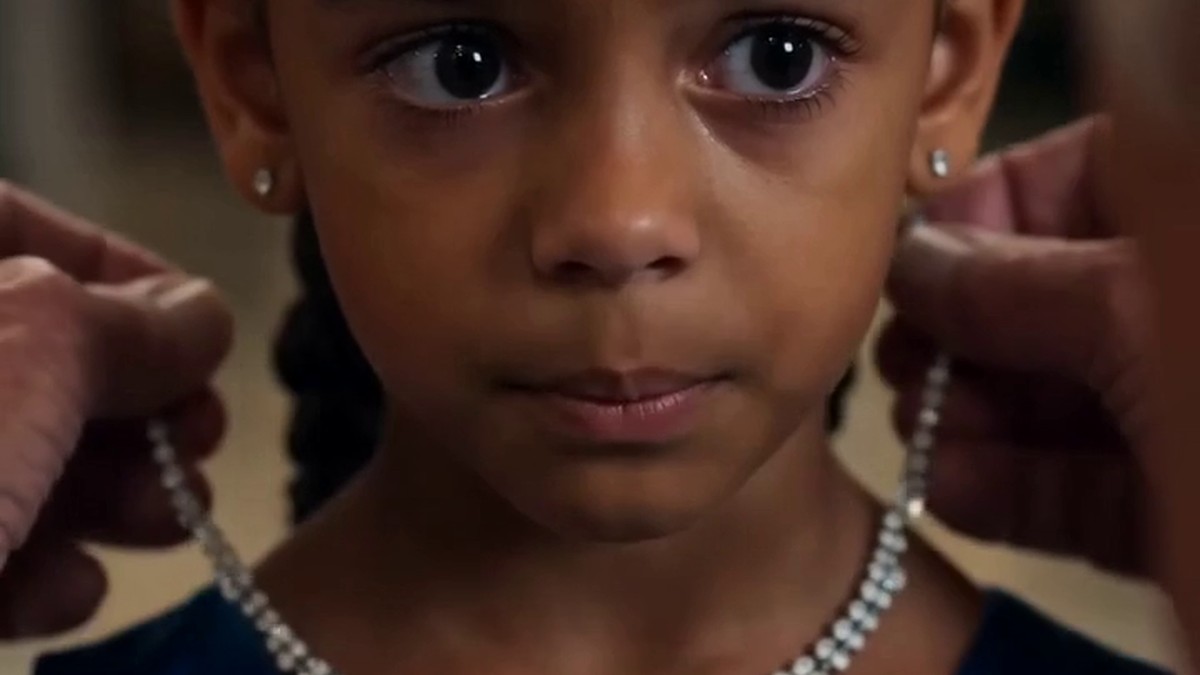
The old man lifted it gently and fastened it around the girl's neck with hands that trembled only slightly.
She looked up at him with wide, confused eyes. "Why are you giving me this?"
He didn't answer right away. His fingers had stilled at the clasp, and his face had changed. He leaned forward almost imperceptibly, his gaze sharpening on something beneath the necklace — a tiny silver emblem, no larger than a thumbnail, etched into the metal just below the clasp. His breath came unevenly now. His lips parted.
"Move away from her." The blonde woman's voice cut across the room. She had stepped forward, her composure cracking at the edges. The color had drained from beneath her powder. "Take it off her. Right now."
The old man didn't move. Didn't look up.
His thumb found a hidden latch along the chain's underside — so small, so precisely placed that no one would ever find it by accident. Only someone who knew it was there. He pressed it.
A tiny compartment clicked open.
A photograph slid out, folded small and faded to the color of old honey. He unfolded it with the care of a man handling something that might dissolve if touched too roughly.
The girl leaned in.
And froze.
The woman in the photograph was young and laughing, caught mid-turn as though someone had called her name just before the shutter clicked. She had dark eyes, a particular way of holding her chin, a familiar shape to her smile that the girl had memorized without ever meaning to.
She had seen that face every night of her life. In a cracked wooden frame on the table beside her bed, in the room at the group home where the radiator knocked in winter and the window wouldn't fully close.
Her hands began to shake.
"That's my mother," she whispered.
The words fell into the room like a stone into still water. The ripples moved outward and touched every person present, and for a moment no one breathed.
The old man's face went white as bone.
The blonde woman's knees buckled visibly. She grabbed the back of a nearby chair and held on. "That's — that's not possible," she said, but her voice had lost every ounce of its earlier authority. It was thin now. Scraped empty. The voice of someone watching a carefully constructed wall come apart brick by brick.
Because she had been the one to make the photograph disappear. Years ago, in a different house, during a different crisis, she had taken everything that connected the girl to her origins and made it vanish. She had been so certain. So thorough.
She had not known about the latch.
The old man straightened. He looked at the blonde woman for the first time since entering the room, and there was nothing cold in his gaze — only the long, flat steadiness of a man who has finally arrived somewhere after an impossible journey.
"Her name was Elara," he said quietly. "My daughter. She disappeared eight years ago." His voice didn't waver, but his hand found the girl's shoulder and rested there. "I have been looking ever since."
The room was completely silent.
The blonde woman — Caroline, whose name the guests all knew, whose charity galas filled the society pages, whose smile appeared on three building plaques downtown — opened her mouth. Closed it. The scissors were still in her hand. She seemed to realize it suddenly and set them on the nearest table with a small, sharp sound.
"I can explain—"
"I don't need you to explain," the old man said. "I need you to step back."
He crouched down in front of the girl, bringing himself to her level, and looked at her fully. She was still trembling. Still holding her dress together with one hand. But she was looking back at him now with something new in her eyes — not understanding yet, not belief exactly, but the dangerous, fragile beginning of hope.
"What's your name?" he asked.
"Mara," she said.
He nodded slowly, and his throat worked. "Your mother called you that. After her grandmother." He reached into his jacket pocket and produced a second photograph — newer, clearer, taken in a garden. A woman and a baby. The same woman as before, older now, holding an infant wrapped in yellow. "She sent me this. Eight years ago. The last letter I ever received from her."
Mara took the photograph with both hands. She looked at it for a long time.
The guests watched in complete silence. No one laughed now. No one studied their champagne.
Caroline made one final attempt. She straightened, lifted her chin, and addressed the room. "This man walked in off the street. We don't know who he is or what he—"
"My name," the old man said, rising to his full height, "is Edmund Voss. I am the founder of the Voss Foundation, which endowed this building." He said it without heat, without drama, as simply as one might give a street address. "And I believe you have a great deal to answer for, Caroline."
Several guests stepped away from her.
She looked around the room and found no allies, no laughter, no one willing to pretend they hadn't heard.
In the end it wasn't the diamonds that unmade her. It wasn't even the photograph. It was the silence of a room full of people who had chosen, finally, to stop looking away.
Edmund Voss took Mara's hand. She let him. The necklace caught the light at her throat, and the torn blue dress didn't matter at all anymore — she stood in the center of the ballroom not as something broken, but as something found.
"Let's go somewhere quieter," he said.
She nodded.
And they walked out through the main doors together — the same doors that had opened slowly, silently, and changed everything — leaving behind the scissors, the whispers, and a woman who was finally, irrevocably, out of places to hide.