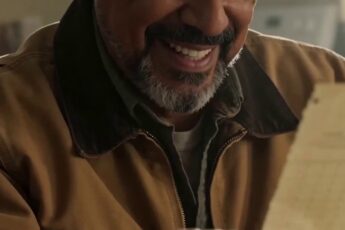
For a moment, no one in Miller’s Diner moved.
The coffee machine hissed behind the counter. A spoon slipped from someone’s hand and tapped against a saucer. Outside, spring rain slid down the windows in thin silver lines, softening the lights of the little town beyond the glass.
But Henry saw none of it.
He saw only Evelyn.
Not the cane in her hand.
Not the gray coat.
Not the years that had gently changed her face.
He saw the girl who had once sat across from him in that very booth, laughing over tomato soup, tearing a napkin in half because she said promises should be shared by two people, not kept by one.
Evelyn took one careful step toward him.
Then another.
Henry held the menu out as if it were something fragile.
Her fingers touched the edge of it, and both of them stopped.
“Your hands are cold,” he said.
“They always were,” she answered, and her voice trembled into a small laugh. “You used to complain about it.”
“I never complained.”
“You absolutely did.”
A few people in the diner smiled, but softly. Nobody wanted to break the spell.
Martha, who had run the diner since her father passed it down to her, came from behind the counter with two cups of tea. She had known Henry for almost thirty years. She had refilled his coffee through snowstorms, power flickers, empty evenings, and Friday nights when his face looked tired enough to make her heart ache.
She placed the cups on the table.
“Soup’s coming,” she said, blinking hard. “And I’m putting extra bread on the side.”
Henry looked up.
“Martha, you don’t have to—”
“Don’t start with me tonight, Henry Cole.”
Evelyn lowered herself into the seat across from him.
The seat that had waited longer than most people would believe.
The second menu lay open in front of her now.
Not like a memory.
Like a beginning.
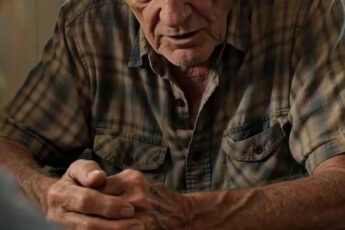
Henry sat down slowly. He reached into his wallet and took out his half of the napkin. Evelyn unfolded hers from a small cloth pouch she carried in her purse.
They laid the two pieces beside each other.
The torn edges fit perfectly.
If they separate us, come back here every Friday.
Evelyn pressed her fingertips to the words.
“I read my half so many times the ink nearly disappeared,” she whispered.
Henry nodded.
“I carried mine until the fold almost broke.”
She looked at him then, and there was so much sorrow in her eyes that Henry felt the years between them rise up like a wall.
“Tell me,” he said gently.
Evelyn took a breath.
“My sister found your letters last winter.”
Henry’s face changed.
“Letters?”
She nodded.
“In a box in the back of my mother’s old cedar chest. Tied with ribbon. All of them addressed to me. All of them unopened.”
Henry’s hand tightened around his cup.
“I wrote for months.”
“I know.”
“I waited for an answer.”
“I never knew there was anything to answer.”
The diner seemed to grow even quieter.
Evelyn looked down at the napkin again.
“They told me you had changed your mind. That you were tired of trouble. That you wanted a quiet life without me in it.”
Henry shook his head slowly.
“And they told me you left because you were ashamed of choosing me.”
Her eyes filled.
“I was never ashamed of you.”
“I was never tired of you.”
A tear slipped down Evelyn’s cheek. She did not wipe it away.
For forty years, both of them had carried a wound that had never belonged to love at all.
It had belonged to fear.
To pride.
To people who believed they had the right to choose another heart’s path.
Henry looked at the two napkin halves.
“All this time,” he said quietly, “I thought maybe I had been foolish.”
Evelyn reached across the table and covered his hand with hers.
“No. You were faithful.”
His lips trembled.
“And you?”
“I was hurt,” she said. “And stubborn. And young enough to think silence meant an answer.”
Henry let out a long, shaking breath.
No anger came.
Not the kind that breaks plates.
Not the kind that raises a voice.
Only a deep sadness that finally had somewhere to go.
Martha returned with two bowls of soup, thick slices of warm bread, and a small plate of butter cut into squares. She set everything down carefully, then touched Evelyn’s shoulder.
“You should know something,” Martha said. “He never let anyone sit there on Fridays.”
Evelyn looked at the empty side of the booth beside her.
“Never?”
“Never,” Martha said. “Even when the place was full. Even when people grumbled. Henry would just say, ‘That chair has a name.’”
Evelyn covered her mouth.
Henry looked embarrassed.
“Well,” he murmured, “it did.”
Martha wiped her eyes with the corner of her apron and walked away before anyone could see too much.
They ate slowly.
The soup was simple and warm, with carrots, onions, herbs, and little noodles that tasted like someone’s kitchen on a rainy evening. Evelyn broke her bread in half and placed one piece on Henry’s plate without thinking.
He stared at it.
“What?” she asked.
“You used to do that.”
“I did?”
“Every time. You said I never took enough bread.”
Evelyn smiled through her tears.
“Maybe some habits wait too.”
That broke something gentle between them.
They began to talk.
At first, their words were careful. Then they came easier.
Evelyn told him about the small house where she lived now, with geraniums in the front window and a porch chair she always meant to repaint. She told him she had spent years working in a little school library, reading stories to children who never knew that the woman turning the pages had once left her own story unfinished.
Henry told her about his quiet mornings, the garden he planted every May, the old radio in his kitchen, and how he had learned to bake biscuits badly but kept making them anyway.
“Badly?” Evelyn asked.
“Very badly.”
“Then you’ll have to let me teach you.”
Henry looked at her for a long moment.
“That sounds like more than one Friday.”
Evelyn’s smile softened.
“I hope so.”
Across the diner, a young couple held hands under the table. An older man at the counter took off his glasses and wiped them slowly. The cook peeked through the kitchen window and pretended he was checking the order slips.
Then the man who had once joked about Henry waiting stood up.
He approached the booth with his cap in his hands.
“Henry,” he said quietly, “I’m sorry. I didn’t understand.”
Henry looked at him.
Then he glanced at Evelyn, at the napkin, at the second menu finally being used.
“Most people don’t,” he said. “Until life gives them something they cannot explain to anyone else.”
The man nodded and stepped away.
There was nothing more to say.
As the evening grew late, the rain stopped. The windows remained fogged at the edges, and the soft yellow light above the booth made the two old faces glow as if time had decided to be kind for once.
Martha began stacking chairs on the far side of the diner, but she left Henry and Evelyn’s booth untouched.
Evelyn folded both napkin halves together and slid them back into her cloth pouch.
Henry noticed.
“You’re taking both?”
She shook her head.
“No. I thought we might keep them together from now on.”
He looked down, smiling.
“Where?”
She glanced at the table between them.
“Here seems right.”
So Martha brought a small frame from the office, the kind that had once held a faded photo of her father beside the diner’s first coffee pot. She placed the napkin inside carefully, smoothing the crease with the back of her finger.
Then she hung it near the corner booth.
Not high.
Not showy.
Just close enough for anyone sitting there to read the words.
If they separate us, come back here every Friday.
When Evelyn stood to leave, Henry reached for her coat. His movements were slower than they had been when he was young, but his hands remembered tenderness.
At the door, Evelyn paused.
“Will you be here next Friday?” she asked.
Henry looked at her, then shook his head.
Her face fell for half a second.
Then he smiled.
“No. Next Friday I’m coming to your porch first.”
Evelyn let out a laugh so small and bright that Martha had to turn away.
“Well then,” Evelyn said, touching the handle of her cane, “don’t be late.”
“Never again,” Henry said.
The next Friday, Henry arrived at Evelyn’s house before six. He wore his best jacket and carried a bunch of wildflowers wrapped in brown paper. Evelyn was waiting by the window, her gray coat already buttoned, her eyes shining like she had seen him coming down the road long before he arrived.
They walked into Miller’s Diner together.
The bell rang softly above the door.
Martha looked up from the counter and smiled.
No one asked why there were two menus.
No one asked if Henry was still waiting.
Because the waiting was over.
From then on, every Friday evening, Henry and Evelyn sat in the last booth. Sometimes they ordered soup. Sometimes pie. Sometimes they barely touched the food because they were too busy remembering, forgiving, and learning each other all over again.
And on rainy nights, when the windows blurred and the little diner glowed like a lantern in the dark, people would glance toward the booth and see two white heads bent close together over the same menu.
Some promises take the long road.
Some hearts need many seasons to find their way back.
But when truth finally knocks, even after forty years, love can still pull out a chair and say:
“You’re not too late. Sit down.”
Dear readers, have you ever discovered the truth about something long after it happened and suddenly understood your own heart differently? What did Henry and Evelyn’s story make you feel? Share your thoughts in the comments — sometimes another person’s memory gives comfort to someone who has been quietly carrying their own.