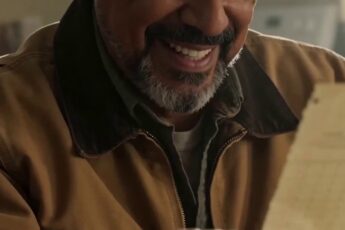
For several seconds, Andrew Whitmore forgot the room existed.
He did not hear the guests whispering.
He did not hear the champagne glass shatter softly against the silver tray.
He did not even hear Vivian saying his name in that careful, polished voice she used whenever something ugly threatened to stain the family image.
He only heard one thing.
The rain song.
A song he had written years ago in a small apartment with a leaking window, when he was younger, poorer in money but richer in feeling, sitting beside a woman named Elise.
Elise, who used to laugh when thunder frightened the old radiator.
Elise, who said rain sounded different when you had someone to miss.
Elise, who vanished from his life before he was told she had moved away, married someone else, and wanted nothing more to do with him.
Now his five-year-old son was clinging to the nanny and saying she knew that song.
Andrew looked at the necklace at Mara’s throat.
It was not fine jewelry.
Just a small silver moon on a worn chain.
But he remembered it.
Not as a necklace.
As a charm sewn into the corner of a baby blanket Elise had once bought from a street market because she said every child deserved something soft before the world became complicated.
Andrew’s voice came out rough.
“Where did you get that?”
Mara’s hand closed around the little moon.
Her eyes filled with tears, but she did not answer.
Vivian stepped forward.
“This is ridiculous. Andrew, Noah is tired. Mara has clearly been filling his head with stories.”
Noah lifted his face from Mara’s dress.
“She didn’t! You said I had to be quiet because Daddy would be sad.”
Vivian’s jaw tightened.
“Noah.”
The child flinched.
Andrew saw it.
That tiny movement did more than any accusation could have done.
His son was afraid of the woman he had trusted to be his mother.
Andrew turned to the butler.
“George. Escort the guests out.”
Vivian spun toward him.
“You cannot be serious.”
Andrew did not look away from Mara.
“I have never been more serious.”
The guests began to move in that awkward, expensive silence only the very rich can manage. Silk brushed against silk. Shoes whispered over carpet. No one wanted to be the last to leave a scandal, but no one wanted to look as if they were rushing to escape one either.
A woman near the piano murmured:
“Poor Vivian.”
Andrew turned.
“No.”
The room froze.
He looked at every guest still lingering near the doorway.
“Do not decide who deserves pity before you know who was hurt.”
No one spoke after that.
Within minutes, the ballroom was empty except for Andrew, Vivian, Mara, Noah, George the butler, and Mrs. Hale, the housekeeper, who stood by the staircase with one hand pressed to her chest.
Noah still clung to Mara.
Andrew crouched a few steps away, careful not to come too close too quickly.
“Noah,” he said softly, “did Mara tell you to call her Mommy?”
Noah shook his head.
“No.”
“Did someone tell you not to?”
Noah’s lower lip trembled.
He looked at Vivian.
Andrew’s chest tightened.
Vivian said sharply:
“He is a child. Children misunderstand.”
Noah cried out:
“I don’t misunderstand! You said if I called her Mommy when Daddy heard, Mara would be sent away forever.”
Mara closed her eyes.
A tear slipped down her face.
Andrew stood slowly.
“Vivian.”
His wife lifted her chin.
“I was protecting him from confusion.”
Mara’s voice finally broke through the silence.
“Were you protecting him when you took him from me?”
The words struck the room so hard that even the candles seemed to flicker lower.
Andrew stared at her.
“What did you say?”
Vivian’s face became white.
“Mara, choose your next words very carefully.”
Mara looked at her, and for the first time since Andrew had known her as the quiet nanny, there was no obedience in her eyes.
“I have chosen every word carefully for five years. I have swallowed my name, my grief, my truth, and my son’s first cries. I have stood outside nursery doors while another woman was called his mother. I have tied his shoes, held him through nightmares, cooled his fevers, and pretended I was only hired to care.”
Noah pressed closer to her.
“You are my mommy.”
Mara bent and kissed his hair.
“Yes,” she whispered. “I am.”
Andrew had to grip the back of a chair to remain standing.
The room tilted.
His life — the polished one, the respectable one, the one built on charity galas and family portraits — began to split open.
Vivian spoke quickly.
“She is lying. She was unstable. That is why she lost any right to—”
Mara turned toward her.
“I lost nothing. You took everything.”
Andrew’s voice was almost unrecognizable.
“Proof.”
Mara reached into the pocket of her plain black dress with trembling fingers.
She pulled out a folded piece of cloth.
Inside were three things.
A faded hospital bracelet.
A tiny square of blue baby blanket with one corner cut away.
And a photograph.
Andrew picked up the bracelet first.
The printed ink was pale, but still readable.
Mother: Elise Marlow.
Infant: Male.
Date: October 9.
Andrew stopped breathing.
Noah’s birthday.
His hand shook as he picked up the photograph.
Elise lay in a hospital bed, pale and exhausted, holding a newborn wrapped in the blue blanket. The silver moon charm was sewn into one corner.
On the back of the picture, written in her handwriting, were six words:
If he forgets, sing the rain.
Andrew looked up.
“Elise.”
Mara closed her eyes.
“My middle name is Mara. I used it because Vivian said if I came here under Elise, you would throw me out before I reached the nursery.”
Andrew turned toward Vivian.
His wife’s polished face had hardened into something cold and cornered.
“You knew.”
Vivian said nothing.
“You knew who she was.”
Vivian’s voice was low.
“I knew she had become a problem.”
Mrs. Hale gasped.
Andrew stepped toward Vivian.
“A problem?”
Vivian’s eyes flashed.
“Yes. A problem. A woman from your past appearing with a baby when your family was already negotiating our marriage, when your father was sick, when your name was tied to half the city’s trust funds. What did you expect everyone to do? Clap?”
Mara’s face twisted.
“I expected him to know he had a son.”
Andrew shut his eyes.
A memory returned with cruel clarity.
His father in the library, coughing into a white handkerchief, saying:
“Elise has left. She sent word. Some people cannot live in our world, Andrew. Let her go with dignity.”
Vivian sitting beside him that same week, soft-voiced, patient, available.
Letters he wrote that never received replies.
Phone calls that never connected.
A funeral for a relationship that had not died naturally.
It had been buried alive.
“What did my father do?” Andrew asked.
Vivian’s silence told him enough.
Mara answered anyway.
“He sent a lawyer to the hospital. Vivian came with him. They told me you had married her already. They said you had denied the child. They said if I tried to make a public claim, they would destroy me.”
Andrew’s face went gray.
“I never knew.”
“I know that now,” Mara said, and her voice cracked. “But I didn’t know it then.”
Noah looked from one adult to another.
His small face was frightened, trying to understand words too big for him.
Mara noticed first.
She knelt.
“Sweetheart, Mrs. Hale is going to take you to the kitchen for warm milk.”
Noah shook his head violently.
“No! If I go, she’ll make you leave.”
Andrew crouched again.
“Noah, listen to me. No one is making Mara leave tonight.”
Vivian snapped:
“You cannot promise—”
“I can,” Andrew said.
His voice was quiet.
Final.
Vivian stopped.
Andrew looked at Noah.
“I promise.”
Noah studied his face.
Children learn quickly when adults are lying.
After a long moment, he whispered:
“Can the door stay open?”
Mara wiped his cheeks.
“Yes. You’ll be able to see me.”
Mrs. Hale came forward, crying openly now.
“I’ll stay with him, sir.”
Noah reached for her hand but looked back twice before leaving.
At the doorway, he turned to Andrew.
“Daddy?”
Andrew’s throat tightened.
“Yes?”
“Don’t be mad at Mommy.”
Andrew looked at Mara.
Then at Vivian.
“I’m not mad at your mommy.”
Noah nodded slowly and disappeared down the hall with Mrs. Hale.
When he was gone, the room felt larger and uglier.
Andrew turned back to Mara.
“How did you end up here?”
Mara held the scrap of blanket in both hands.
“When Noah was born, they told me he had trouble breathing. They took him away. I begged to see him. A nurse finally whispered that he had been moved. Then the lawyer came. He said I had signed documents.”
“Had you?”
“I signed medical papers after they gave me something for pain. I never signed away my baby.”
Vivian said coldly:
“You were poor, alone, and in no condition to care for him.”
Mara’s eyes blazed.
“I was his mother.”
“You were a scandal.”
Andrew hit the table with his palm so hard that a candle toppled.
“Enough.”
Vivian flinched.
He had never spoken to her like that.
Perhaps because until that night, he had never truly seen her.
Mara continued, voice shaking:
“For three years, I didn’t know where he was. I cleaned rooms. I worked night laundry. I followed every rumor about Whitmore House because I had nothing else. Then I saw Noah in a charity photograph.”
Andrew covered his mouth.
Mara’s tears fell freely now.
“He was holding a stuffed rabbit. He had your eyes. And around him, everyone was smiling as if he belonged exactly where he was.”
She swallowed.
“I came to the gate. Three times. George turned me away twice because he had orders not to admit strangers. The third time, Vivian saw me.”
George stepped forward from the doorway, pale.
“Sir, I didn’t know.”
Andrew looked at him.
George’s voice broke.
“I swear, I didn’t know.”
Mara nodded.
“He didn’t. Vivian did.”
Vivian’s mouth tightened.
“I allowed her to work here because Noah was impossible with other nannies. He cried for the rain song. He would not sleep. She was useful.”
Mrs. Hale sobbed from the hall.
Useful.
The word hung in the ballroom like smoke.
Mara whispered:
“You made me apply under another name. You said if I told Andrew or Noah, I would never see him again.”
Andrew looked at Vivian as if she were a portrait that had melted and revealed rot beneath the paint.
“You brought his mother into this house as a servant.”
Vivian’s answer came sharp and proud.
“I gave her access.”
“No,” Mara said. “You gave me a cage with a nursery view.”
That broke something in Andrew.
Not loudly.
Not dramatically.
But completely.
He walked to the fireplace and pulled the old bell cord.
George stepped in at once.
“Call Mr. Ellison. Now. Tell him to bring every family file, every hospital document, every legal record tied to Noah’s birth. And call Dr. Patel for Noah. Not because he is physically ill. Because my son has been made to carry secrets.”
George bowed, tears in his eyes.
“Yes, sir.”
Vivian stepped forward.
“You are not thinking clearly.”
Andrew looked at her.
“For the first time in years, I believe I am.”
That frightened her more than anger.
By midnight, the mansion had changed.
The roses were removed.
The champagne was cleared.
The ballroom, which had been arranged to impress strangers, stood half-empty and cold.
Mr. Ellison, the family lawyer, arrived pale and silent. He had worked for Andrew’s father. He knew too much. His hands shook when Andrew ordered him to open the archived files.
By three in the morning, the first box was found.
Letters.
Mara’s letters to Andrew, unopened.
Andrew’s letters to Elise, returned before they reached her.
Hospital forms with signatures that did not match.
A payment record to a clinic administrator.
A handwritten note from Andrew’s father:
The matter is contained. Vivian understands what must be protected.
Andrew read that sentence again and again.
Contained.
As if Mara were not a woman.
As if Noah were not a child.
As if love were a spill on the carpet.
Mara sat beside the nursery door all night.
Noah slept only when her hand rested on his back.
Andrew did not ask her to move.
He sat in the hallway, on the floor, his suit wrinkled, his tie loosened, holding the scrap of blue blanket with the missing moon charm.
Near dawn, Mara came out.
“You should sleep,” she said.
“So should you.”
She almost smiled, but it did not reach her eyes.
For a moment, they were simply two exhausted people standing outside the room of the child they both loved.
“I wrote to you,” Andrew said.
Mara leaned against the wall.
“I know now.”
His head lifted.
She explained:
“I found one letter last winter. Hidden in Vivian’s locked desk. It was yours. From before Noah was born.”
Andrew closed his eyes.
“I thought you left.”
“I thought you chose them.”
He nodded.
The words were knives, but they were clean knives.
They cut toward truth.
“I failed you,” he said.
“You didn’t know.”
“I should have looked harder.”
Mara was silent.
Then she said:
“Yes.”
He accepted it.
That mattered more than any defense.
By morning, Vivian was removed from Whitmore House under legal supervision.
She did not go quietly in spirit, even if her voice stayed controlled.
At the staircase, she turned toward Mara.
“You think this makes you one of them?”
Mara looked exhausted.
Pale.
Shaken.
But when she answered, her voice did not bend.
“No. It makes me Noah’s mother. That was true before this house knew it.”
Andrew stepped between them.
“And this house will remember it now.”
The scandal did not stay private.
Too many guests had heard Noah.
Too many staff had witnessed the aftermath.
Too many documents existed.
The newspapers wrote about the Whitmore heir, the hidden mother, the nanny who sang a song only she should have known.
Some stories were cruel.
Some were sentimental.
Some cared more about Vivian’s wardrobe than Mara’s years of grief.
Andrew refused every interview.
But he released one statement:
My son was taught to hide the truth inside his own home. His mother was forced to care for him without the dignity of her name. I believed lies because those lies protected my comfort. That comfort is over.
The Whitmore Foundation changed within weeks.
No more charity dinners built around polished speeches and photographed generosity.
No more families turned into decorations for donors.
Mara insisted on the first new rule:
“Help should never require humiliation.”
Andrew placed it at the top of the foundation charter.
The mansion changed too.
Not quickly.
Not magically.
But room by room.
The ballroom stayed closed for months.
The nursery door was never locked.
Mara moved from the staff corridor to the blue suite beside Noah’s room.
Not as a guest.
Not as staff.
As his mother.
Noah did not heal just because the truth had been spoken.
For weeks, he woke crying.
Sometimes he refused to let Mara leave the room.
Sometimes he pushed Andrew away.
Sometimes he asked whether Vivian had lied because he had done something wrong.
Every time, Mara held him.
Every time, Andrew sat nearby and learned that being a father was not demanding trust from a wounded child.
It was showing up until the child’s fear got tired of expecting abandonment.
They told Noah the truth carefully.
Mara was the mother who gave birth to him.
Andrew was his father and loved him.
Vivian had hidden the truth and hurt people.
None of it was Noah’s fault.
They repeated that last part so often that one day Noah shouted:
“I know!”
Then cried because children can know something in their minds long before their hearts believe it.
Andrew learned that too.
He learned Mara liked tea with lemon but hated when servants treated her as if she had become fragile.
He learned Noah counted stairs when anxious.
He learned Mrs. Hale had suspected pieces of the truth but had been taught all her life that servants survived by not knowing too much.
He learned apologies were meaningless when they arrived alone.
So he attached them to action.
Legal petitions.
Therapy appointments.
Public corrections.
Documents amended.
Staff protections rewritten.
And, most difficult of all, silence when Mara was not ready to hear him speak.
For months, he did not touch her hand.
Not because he did not want to.
Because she had spent years with people taking what they wanted from her life.
He would not add tenderness to that list.
One rainy evening, Andrew heard the song again.
He stood outside the nursery door.
Mara sat beside Noah’s bed, singing softly.
Not the full song.
Just the middle part.
The part Elise used to say sounded like rain tapping at a window, asking to be let in.
Andrew leaned against the wall.
His eyes burned.
When Mara came out, she found him there.
“I’m sorry,” he said.
“For listening?”
“For needing a child to tell me what I should have seen.”
Mara looked down the hallway.
“Power teaches people not to see what would inconvenience them.”
He flinched.
She did not apologize for it.
He was glad she didn’t.
A year passed.
Then another.
Vivian faced court.
The investigation found forged documents, coerced signatures, intercepted letters, and payments made through accounts tied to Andrew’s father’s former legal office.
Vivian confessed only when denial became impossible.
In court, she said:
“I wanted to be his mother.”
Mara, seated beside Andrew, whispered:
“You wanted to be called that.”
Andrew reached for her hand.
This time, she let him hold it.
Not because everything was healed.
Because in that moment, she chose not to sit alone.
That was enough.
Noah grew.
He still kept the silver moon necklace in a small box by his bed, though Mara wore it most days. He called it “the proof moon.”
When he was eight, he asked:
“Did you love Daddy before?”
Mara looked across the family room at Andrew, who was helping Mrs. Hale rescue burned biscuits from the oven.
“Yes,” she said.
Noah frowned.
“Do you love him now?”
Mara did not answer quickly.
Children deserved truth, but not the weight of adult confusion.
“I am learning what love looks like after truth,” she said.
Noah considered that.
“That sounds hard.”
“It is.”
“Harder than math?”
“Much harder.”
He sighed.
“Then good luck.”
Mara laughed for the first time that day.
Andrew heard it from the kitchen and turned.
For a second, he looked like the young man Elise had loved before fear, money, and family lies turned his life into polished marble.
Mara saw him.
She did not run from the feeling.
But she did not rush toward it either.
Healing deserved time.
So did she.
Eventually, years later, Mara told Noah the full story of the rain song.
How Andrew had written it badly in a tiny apartment.
How the first line made no sense.
How she changed one word and he pretended to be offended for two days.
How he sang it once during a storm, off-key, and made her laugh so hard she spilled tea on the blanket that later became Noah’s.
Noah listened with his chin in his hands.
“So the song is mine?”
Mara touched his hair.
“It became yours.”
Andrew, sitting across from them, said:
“It was always waiting for you.”
Noah rolled his eyes.
“That’s very dramatic.”
Mara smiled.
“Your father has always had a weakness for dramatic sentences.”
Andrew placed a hand over his heart.
“I am wounded.”
“You survived worse,” Noah said.
And they laughed.
Not because the past had become light.
But because they were finally allowed to live beyond it.
Mara and Andrew did marry one day.
Not soon.
Not for appearances.
Not because the world liked tidy endings.
They married in the garden on a quiet morning after Noah insisted that “if everyone keeps asking when we are a family, we should tell them we already are and just have cake.”
So they had cake.
No grand ballroom.
No photographers.
No champagne tower.
Mrs. Hale cried through the whole ceremony and blamed the flowers.
George walked Mara halfway down the path, then Noah took her hand and walked the rest.
At the front, Andrew did not look like a man receiving something.
He looked like a man being trusted with something he knew he had not earned quickly.
When Mara reached him, she said quietly:
“If you ever stop telling the truth, I will leave.”
Andrew nodded.
“I would expect you to.”
Then Noah whispered:
“Can we do the nice part now?”
Everyone laughed.
At the reception, Andrew tried to sing the rain song.
Badly.
Mara covered her face.
Noah shouted:
“Stop. This is why Mommy had to sing it.”
Andrew bowed dramatically.
“I accept this family judgment.”
Years later, the Whitmore mansion was still large.
Still beautiful.
Still filled with history.
But it no longer felt like a museum where everyone spoke carefully around lies.
There were muddy shoes by the back door.
Noah’s books on expensive tables.
Mara’s tea cups in rooms Vivian once controlled like stage sets.
Andrew’s piano notes drifting badly through the halls.
Mrs. Hale scolding everyone equally.
The house became loud.
Messy.
Human.
In the family room, near the window where rain sounded loudest, Andrew framed the old piece of blue blanket, the hospital bracelet, and a handwritten copy of the rain song.
Underneath, Mara wrote:
A mother’s love does not stop being true because someone hides her name.
Noah added, in crooked handwriting:
And kids hear more than adults think.
Andrew added one final line:
Thank God they do.
People still talked about that night at the Whitmore mansion.
Some remembered the scandal.
The nanny.
The wife exposed in front of the wealthy.
The little boy crying beneath chandeliers.
But those who understood remembered something else.
They remembered a child brave enough to defend the person who made him feel safe.
They remembered a mother who loved quietly because loud love had been made dangerous.
They remembered a father learning that comfort can be built from lies if no one asks who paid for the silence.
And they remembered the rain song.
The song Andrew wrote for Elise.
The song Mara carried through years of fear.
The song Noah knew before he knew the whole truth.
It had survived locked drawers, forged papers, intercepted letters, and a mansion full of people trained not to ask.
And in the end, it did what songs sometimes do when words are too frightened to stand alone.
It opened the door.
❤️ Do you believe children sometimes recognize the truth before adults are ready to face it? Can a family heal after years of lies if the truth is finally protected? Share what this story made you feel — because sometimes the smallest voice in the room carries the song that saves everyone.