Rosie did not move for several seconds.
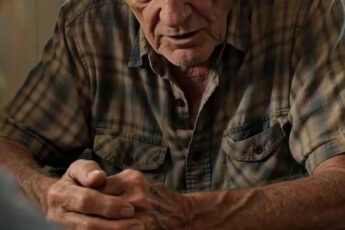
She had seen Walter Hayes sit in that booth through summer heat, winter sleet, birthdays, holidays, quiet Fridays, and crowded ones. She had watched him grow older under the same red diner light, always with his coat folded beside him and two menus on the table.
But she had never seen his face like that.
Not sad.
Not lonely.
Almost afraid to believe.
Margaret stood by the booth with the old red scarf pressed to her chest. Rain clung to the shoulders of her coat. Her silver hair had loosened in the storm, and one hand trembled around the folded letter.
Walter looked at the scarf first.
He remembered it.
Of course he remembered it.
She had worn it the last night they sat together in that booth, young and stubborn and sure that love could outlast every door someone tried to close between them.
“You still have it,” he said.
Margaret touched the frayed edge.
“I kept it in a hatbox for forty years,” she whispered. “Wrapped in tissue paper. Every time I opened that box, I told myself I was only checking if moths had gotten to it.”
She gave a small laugh, but it broke before it became a laugh at all.
“The truth is, I just wanted to remember your hands tying it around my neck.”
Walter sat slowly, as if his knees had forgotten how to hold him.
Margaret sat across from him.
For the first time, the second menu was not waiting.
It had arrived.
Rosie came over with two fresh cups of coffee. She set one in front of Walter, one in front of Margaret, then slid a small plate of warm apple pie between them.
“On the house,” she said softly.
Walter looked up.
“Rosie…”
She shook her head.
“Don’t you dare argue with me tonight.”
A few people smiled through wet eyes.
The young waiter who had once joked about the empty seat stood behind the counter with both hands on a stack of napkins, staring like someone who had just learned that an old man’s silence can carry a whole lifetime.
Margaret unfolded the letter.
The paper was yellowed at the creases. The ink had faded, but Walter knew his own handwriting before he read a single word.
He reached for it, then stopped.
“I wrote that the morning after I waited here,” he said.
Margaret nodded.
“I found it three months ago.”
“Where?”
“In my brother’s old desk.”
Walter closed his eyes.
The bell above the door swung gently in the draft, making one tiny sound, then stillness again.
Margaret swallowed.
“My brother never wanted me to meet you that night. He thought he was protecting me. He said you would break my heart. When I wouldn’t listen, he decided for both of us.”
Walter’s face tightened, but he said nothing.
Margaret laid the letter flat between them.
“He hid this. And when I cried because you never came to the house, he told me you had changed your mind. He said he had seen you with someone else. I believed him because I was hurt, and because everyone around me kept repeating the same story until it sounded like the truth.”
Walter stared at the letter.
“I came here every Friday after that.”
“I know now.”
“I thought maybe, one day, you’d walk in and tell me they’d lied.”
Margaret covered her mouth.
“And I thought maybe, one day, you’d knock on my door and tell me the same.”
Neither of them spoke for a while.
The rain softened against the windows. The neon sign outside flickered red and blue across the tabletop. Somewhere in the kitchen, a spoon tapped the side of a pot, then stopped.
Rosie wiped her eyes with the corner of her apron and pretended to check the pie case.
Walter finally picked up the letter.
He did not read it aloud. He did not need to.
He remembered every word.
He had written that he would wait. That if she was scared, he would understand. That if her family was angry, they would face it slowly, one day at a time. That he would be at Rosie’s every Friday at 6:30 until she could come.
His fingers shook as he folded the paper again.
“So you never chose to leave me behind,” he said.
Margaret shook her head.
“No.”
“And I never chose to stop waiting.”
“I can see that.”
Her eyes moved to the two menus. The second coffee cup. The extra fork. The booth that had held her place longer than any person had the right to expect.
“Walter,” she whispered, “can you forgive me for not searching harder?”
He looked at her then.
Not at the scarf.
Not at the letter.
At her.
The girl he had loved was still there, hidden inside the lines around her eyes, inside the careful way she held herself, inside the little tremble in her smile.
“Only if you forgive me for believing even part of what they said,” he answered.
Margaret reached across the table.
Their hands met beside the old letter.
Her fingers were cold from the rain. His were warm from the coffee cup.
For a moment, they simply held on.
The whole diner seemed to exhale.
A man at the counter removed his cap. An older woman in a green cardigan dabbed her eyes with a paper napkin. The young waiter turned away quickly, but not before Rosie saw his face.
Then one of the boys who had whispered earlier walked over with his head lowered.
“Sir,” he said to Walter, “I’m sorry. For laughing.”
Walter looked at him for a long moment.
Then he nodded toward the booth.
“Remember this,” he said quietly. “When you see someone sitting alone, you don’t always know who they’re keeping a place for.”
The boy nodded, unable to speak.
Margaret squeezed Walter’s hand.
Rosie cleared her throat.
“All right,” she said, trying to sound normal and failing. “Are we eating dinner or just watering my floors with tears?”
That brought a gentle laugh through the room.
Walter looked at Margaret.
“Meatloaf?”
She smiled.
“With mashed potatoes?”
“And gravy.”
“And green beans if they still make them the way Rosie’s mother did.”
Rosie pointed at her.
“Now that is a woman with memory.”
Dinner came on two heavy plates, the kind with blue flowers around the edge. The meatloaf was tender, the mashed potatoes had little lumps in them the way homemade food should, and the gravy steamed under the diner lights. Margaret took one bite and closed her eyes.
“I haven’t tasted this in years.”
Walter smiled.
“I ordered it for you the first Friday.”
“And the second?”
“And the third.”
Her eyes filled again.
“All forty years?”
“Most Fridays,” he admitted. “Sometimes I got the chicken pot pie. A man has to live a little.”
Margaret laughed then.
Really laughed.
And the sound changed the whole booth.
It no longer felt like a shrine to something lost. It felt like a kitchen table after a long day, with rain outside and someone finally home.
They talked until the plates were empty and the coffee went cold.
They spoke of the years that had passed, but not like people counting wounds. They spoke like people carefully unpacking boxes from an attic, finding what could still be kept and gently setting aside what no longer needed to be carried.
Margaret told him she had worked in a little library for many years, that she had grown roses badly but kept trying anyway, that she still made cinnamon toast when she couldn’t sleep.
Walter told her about the small white house he lived in, the porch light he left on every Friday evening, the worn armchair by the window, the radio he kept low, and the drawer full of napkins from Rosie’s Diner.
“You kept napkins?” she asked.
He looked embarrassed.
“Only the ones from Fridays when I almost stopped coming.”
Margaret’s face softened.
“What made you come back?”
He looked around the diner.
Rosie at the counter.
The rain on the glass.
The red scarf beside Margaret’s hand.
“Something in me refused to let the last word be a lie.”
Margaret bowed her head.
That sentence stayed with everyone who heard it.
Near closing time, Rosie began turning chairs upside down on the tables. But she did not touch the corner booth.
Walter helped Margaret into her coat. His hands were slower now, but careful. When he lifted the red scarf, she turned her back to him, and he tied it around her neck just as he had done when they were young.
Neither of them said anything.
They didn’t have to.
Outside, the storm had passed. The street shone under the diner sign, and puddles reflected the red and blue lights like ribbons laid across the pavement.
Margaret stood beneath the awning.
“Will you be here next Friday?” she asked.
Walter looked at her, then shook his head.
For one terrible second, her smile faded.
Then he said, “No.”
She blinked.
He reached into his coat pocket and took out the second menu.
“I’m coming to pick you up first.”
Margaret pressed both hands to her heart.
Rosie, standing in the doorway with her arms folded, sniffed loudly.
“Well,” she called, “don’t be late. I’m not reheating gravy twice.”
The next Friday, Walter arrived at Margaret’s little house at six sharp.
He wore his best jacket and carried a small bunch of grocery-store daisies wrapped in brown paper. Margaret opened the door before he could knock a second time. She had on the red scarf.
They drove to Rosie’s together.
When the bell above the diner door rang, every regular looked up.
Rosie did not ask if the seat was taken.
She simply placed two menus on the table and smiled.
From then on, every Friday at 6:30, Walter and Margaret sat in the corner booth by the window. Sometimes they talked for hours. Sometimes they sat quietly, sharing pie, passing the cream, watching rain slide down the glass.
But nobody called the booth empty again.
Because some promises do not die just because people are kept apart.
Some hearts keep a chair open.
Some love waits without making noise.
And sometimes, even after forty years, the truth walks in wearing silver hair, holding an old red scarf, and asks for the dinner that should have happened long ago.
Dear friends, have you ever learned the truth about something from the past and suddenly understood everything differently? What did Walter and Margaret’s story make you feel? Share your thoughts in the comments — your words may touch someone who has been carrying an old unanswered question of their own.