—The Man Who Came Back After His Place Was Gone
“You’re late again,” Hannah said quietly.
She didn’t turn around. She stood by the kitchen window, watching the rain slide down the glass and blur the lights of Manchester outside. Behind her, Daniel closed the front door with exaggerated care, as if silence could soften the truth.
“I had a meeting,” he said.
“You always do.”
On the table sat dinner: roast chicken, vegetables, two plates, one untouched. It had gone cold an hour ago. Hannah had stopped reheating meals for him months before. There was something humiliating about warming food again and again for a man who no longer seemed hungry for home.
Daniel took off his coat.
“Don’t start.”
Hannah turned then.
“I’m not starting, Daniel. I’m just the only one still standing in the middle of what you left unfinished.”
He looked tired. He always looked tired. Tired from work, tired from responsibility, tired from the family he claimed to be sacrificing for.
Years earlier, they had lived in a tiny flat with damp around the bedroom window and a boiler that made frightening noises at night. They had second-hand furniture, cheap mugs, and a mattress that dipped in the middle. But they had laughter. They had evenings on the floor with takeaway chips and dreams too big for their bank account.
“One day,” Daniel used to say, pulling her close, “I’ll give you everything. A proper house. Holidays. Security. The kids will never have to worry the way we did.”
“I don’t need everything,” Hannah would answer. “I need you.”
He had smiled, certain those two things were the same.
They weren’t.
“Dad?” Their daughter, Emily, appeared in the doorway with her school jumper folded over her arm. “My choir concert is tomorrow. Are you coming?”
Daniel glanced at his phone before answering.
“I’ll try, sweetheart.”
Emily nodded.
“You always try.”
She didn’t cry. That was what broke Hannah’s heart. Tears meant there was still hope. Emily’s calm voice meant she had already learned how to expect disappointment.
When she left, Hannah looked at him.
“It starts at five. One hour. That’s all she’s asking.”
“I have clients coming in from London.”
“Your daughter has one childhood.”
“And I’m working to give her a good one!” Daniel snapped. “For her, for Ben, for this family.”
“No,” Hannah said. “You’re working for an idea of this family that doesn’t require you to actually be in it.”
He laughed bitterly.
“You’ve no idea what kind of pressure I’m under.”
“I know exactly what pressure feels like. I carry this house, the children’s feelings, your excuses, and my own loneliness. The difference is I don’t get to leave it at the office.”
Money came, just as Daniel had promised. Promotions, bonuses, a bigger house, a better car, holidays in places Hannah had once only seen in magazines. Emily had piano lessons. Ben had football boots that cost more than Hannah’s first winter coat. The fridge was full. The bills were paid.
And yet, every year, the house felt emptier.
Daniel came home later. He smiled at messages and turned his phone face down when Hannah entered the room. Some evenings he smelled of wine and perfume that didn’t belong to her. He called it networking. Long dinners. Business.
Hannah did not search his pockets. She did not read his phone. The truth did not need her help.
She found it on an ordinary Thursday, in a café near St Peter’s Square. She had stopped in after meeting Ben’s teacher. Daniel was sitting by the window with a younger woman in a camel coat. She was laughing, and Daniel was looking at her with a warmth Hannah had not seen in years.
Then he reached across the table and touched her hand.
Hannah stood there with her umbrella dripping onto the floor. Nobody noticed her. Not even her husband.
That night, after the children were asleep, she said:
“How long?”
Daniel froze.
“Hannah…”
“Don’t. Please don’t insult me with a lie.”
He sat down slowly.
“I never meant for it to happen.”
“But you made room for it.”
He rubbed his face.
“With her, it’s easier. There’s no pressure. No accusations. I don’t feel like I’m failing all the time.”
Hannah’s voice shook, but it did not break.
“Of course it’s easier. She didn’t know you when you were terrified of missing rent. She didn’t sit up with Ben when his fever wouldn’t come down. She didn’t stretch one salary across a month so you could take risks. She met the finished version. I loved the man still under construction.”
Daniel looked away.
“You changed.”
“Yes,” she said. “Waiting changes people.”
The divorce was quiet. Painfully civil. There were forms, boxes, arrangements, polite emails. Daniel promised support.
“I’ll make sure you and the kids are looked after,” he said.
Hannah looked at him for a long time.
“You still think care is something you can transfer on the first of the month.”
At first, he visited. Then he cancelled sometimes. Then often. Then he became a man the children heard from on birthdays and holidays. Emily stopped telling him about school. Ben stopped asking if he was coming to matches.
Hannah never spoke badly of him. She didn’t have to. Empty chairs speak for themselves.
Years passed.
Emily became a strong young woman who trusted actions more than promises. Ben grew tall and quiet, answering his father’s messages with short, polite replies. Hannah rebuilt her life in small ways. She painted the kitchen blue. She went back to work full time. She learned to sleep without listening for keys in the door.
Then, one winter afternoon, Daniel called.
“Hannah… could we meet?”
His voice sounded smaller than she remembered.
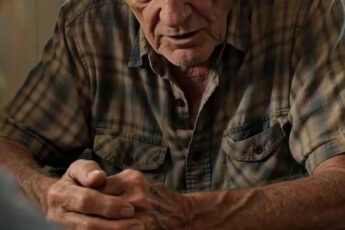
They met in a modest café not far from the station. Daniel arrived wearing a dark coat, his hair grey at the temples, his shoulders slightly bent. Success had once made him look taller. Regret made him look old.
“She left,” he said.
Hannah wrapped both hands around her cup.
“For someone younger?”
He gave a bitter smile.
“Yes.”
“I’m sorry,” she said, and meant it in the quiet, human way one can feel sorry for someone without wanting them back.
“I’ve lost everything,” Daniel whispered. “Her. The house. The children. You. I don’t know what I have left.”
Hannah looked at him. For years she had imagined this moment and thought she might feel satisfaction. She didn’t. She felt the deep sadness of watching someone finally understand the cost after the price had already been paid.
“You didn’t lose everything, Daniel. You gave it away. Every time you said, ‘I’ll try,’ and didn’t come. Every time you thought a gift could replace an evening. Every time you chose to be admired somewhere else instead of needed at home.”
His eyes filled.
“Do they hate me?”
“No.”
Hope flickered across his face.
“And that’s the worst part,” Hannah continued. “They don’t hate you. They learned to live without waiting for you.”
He lowered his head. For once, he had no defence.
“And you?” he asked. “Could you ever forgive me?”
Hannah watched the steam rise from her tea.
“I don’t live inside the pain anymore. But peace is not the same as permission to come back.”
When she returned home, Emily was in the kitchen, making tea. She was grown now, but for a moment Hannah saw the little girl in the doorway, holding her school jumper, asking for one hour of her father’s life.
“Was it Dad?” Emily asked.
“Yes.”
“What did he want?”
“To return to a place he left too many times.”
Emily came over and hugged her mother.
“You’re not alone, Mum.”
Hannah closed her eyes. Those words loosened something she had carried for years.
That Sunday, Ben came over with cake, Emily made dinner, and the kitchen filled with noise. They argued about music, laughed over burnt potatoes, and sat around the table until late. There was an empty chair, but it no longer felt like a wound.
Daniel had spent his life trying to buy his family a better future. He never understood that love is not proven by what you provide from a distance. Love is the person who shows up, tired or not. Love is the familiar face in the crowd. Love is the chair that is never empty when a child turns to look.
And sometimes, by the time a person finally comes home, the home has learned how to be whole without them.