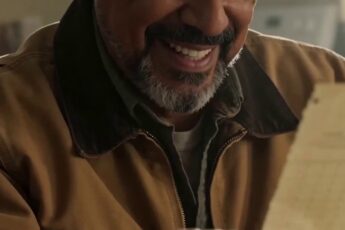
Daniel did not take the leaf from Noah right away.
He only stared at the boy’s hand.
Small fingers.
Water shining on the knuckles.
A green leaf folded slightly at the edges, floating with one drop of fountain water caught in its center.
It should have been nothing.
A child’s game.
A quiet afternoon in a garden.
But Daniel felt as if someone had placed eight missing years into his palm before he had even touched it.
Noah waited.
He did not smile.
He did not step back either.
He had the steady, cautious look of a child who had been told something important was about to happen, but not promised that it would be easy.
Daniel crouched slowly.
“Hi, Noah.”
The boy looked at him carefully.
“Hi.”
His voice was small, but not afraid.
Claire stood beside the fountain with the gift bag still in her hand. Her fingers gripped the paper handles tightly enough to crease them.
Daniel glanced at her.
Then back at the boy.
“I’m Daniel.”
Noah nodded.
“I know.”
That hurt more than Daniel expected.
Not because the boy knew his name.
Because Daniel had not known his.
Noah held out the leaf again.
“It floats better if you don’t touch the middle.”
Daniel took it carefully.
Their fingers brushed.
A strange, unbearable tenderness moved through him.
He placed the leaf back on the fountain water. It wobbled, spun once, then steadied and drifted toward the stone edge.
Noah watched it seriously.
“Mom says you used to make boats from receipts.”
Daniel looked at Claire.
“She remembered that?”
Claire’s mouth trembled.
“She remembered a lot of things she wished she didn’t.”
The sentence landed softly.
Too softly.
Daniel stood.
His phone buzzed in his hand.
He looked down automatically.
Three missed messages.
Two from the board.
One from his mother.
He turned the phone face down and slipped it into his pocket.
For the first time that day, the merger could wait.
Everything could wait.
“Claire,” he said, “what happened?”
She looked toward the townhouse windows.
“Can we talk out here?”
“Yes.”
“I don’t want to go inside yet.”
Daniel understood that before she explained.
The house was too polished.
Too tall.
Too full of his life now.
Claire had arrived carrying a past that had never been allowed through the front door.
Noah sat on the fountain ledge, watching the leaf boat.
Claire opened the gift bag.
Inside was a small wooden object wrapped in tissue paper.
She unfolded it and placed it in Daniel’s hands.
A tiny sailboat.
Roughly carved.
Uneven.
One side sanded smoother than the other.
Daniel stopped breathing.
“I made this.”
Claire nodded.
“Outside your first office. The day the rain came through the ceiling.”
He almost laughed.
The memory rose with brutal clarity.
A tiny rented office above a dry cleaner. A crooked sign he had painted himself because he could not afford a proper one. A bucket under the leak. Claire sitting cross-legged on the floor, laughing while he tried to convince her that every great company began with water damage.
He had carved the little boat from a broken drawer handle while waiting for the landlord.
“I gave it to you,” he whispered.
“You said every sinking room deserved a boat.”
Daniel closed his fingers around it.
“Why did you bring it?”
Claire looked at Noah.
“Because he asked where he came from.”
Daniel’s eyes stung.
Noah lifted his head.
“Mom says people come from stories before they come from places.”
Daniel swallowed.
“She’s right.”
Noah looked at him for a moment.
“Are you in my story?”
The question broke him open.
Daniel did not answer quickly.
He had spent his whole adult life learning to speak in boardrooms, to respond under pressure, to negotiate when millions depended on the right sentence.
None of that helped.
He crouched again.
“I should have been,” he said. “And I want to understand why I wasn’t.”
Noah looked at Claire.
She nodded once.
Then Daniel heard the side door open behind him.
“Daniel?”
His mother’s voice crossed the garden.
Eleanor Ashmore stood on the terrace steps.
She was dressed in pale grey, elegant as ever, one hand on the railing. Even at seventy, she carried herself like a woman who had never entered a room without deciding what everyone in it should think.
Her eyes moved from Daniel to Claire.
Then to Noah.
The color left her face.
Claire saw it.
Daniel saw Claire see it.
Something cold passed through him.
“Mother,” he said slowly. “You know Claire is here.”
Eleanor stepped down one stair.
“I remember Claire.”
Claire’s voice was steady.
“You should. You answered the door when I came with the first letter.”
Daniel turned.
“The first letter?”
Eleanor’s expression tightened.
“Daniel, this is not the time.”
He laughed once.
A hollow, dangerous sound.
“I just found a child in my garden who looks like me, holding a photograph of my first office. I think this is exactly the time.”
Noah’s shoulders hunched.
Claire noticed and immediately moved closer to him.
Daniel saw that too.
He saw how naturally she protected the boy from adult storms.
And he hated himself for not having been there to do the same.
He lowered his voice.
“Noah, this is my mother. Eleanor.”
Noah looked at her politely.
“Hello.”
Eleanor’s lips parted.
For one strange second, she looked almost human.
Then she recovered.
“Hello.”
Claire took a letter from the gift bag.
“I came here when I found out I was pregnant,” she said. “You were in Chicago, Daniel. At least that’s what I was told.”
Daniel looked at his mother.
“I was in Chicago for three days.”
Claire nodded.
“She said you knew. She said you had chosen the company. She said if I cared about you at all, I would not drag you backward when you were finally becoming what your father wanted.”
Daniel’s face hardened.
“My father had been dead six months.”
Eleanor lifted her chin.
“And you were barely holding the company together.”
“I asked what happened. Not for a speech.”
The wind moved through the garden.
A leaf fell into the fountain beside Noah’s boat.
Eleanor clasped her hands.
“I did what I thought was necessary.”
Claire closed her eyes for a moment.
There it was.
The sentence powerful people used when they wanted cruelty to sound responsible.
Daniel’s voice dropped.
“What did you do?”
Eleanor looked at Noah, then away.
“I told her you could not see her.”
Daniel stared.
Claire continued quietly:
“She told me you had received my calls. That you had read my note. That you had said a child would ruin everything you were building.”
Noah looked up sharply.
Daniel crouched in front of him at once.
“No,” he said. “Noah, I never said that.”
The boy studied his face.
“Mom didn’t say you did for sure.”
Daniel looked at Claire.
She gave a small, sad shrug.
“I could never make myself tell him you had rejected him. Not completely. I didn’t know what was true. I only knew every door closed.”
Daniel stood.
His hands shook.
“What else?”
Claire opened the box and took out three envelopes.
All old.
All marked.
Returned.
Forwarding unavailable.
Recipient declined contact.
Daniel took one.
He recognized the firm’s old letterhead on the return label.
He recognized his mother’s handwriting on a sticky note still attached to the back:
No response. Handle through Hale.
“Hale,” he said.
Eleanor’s eyes flickered.
Daniel turned toward the house.
As if summoned by guilt, Gregory Hale appeared in the doorway.
His company counsel.
His father’s old friend.
The man Daniel had trusted through every acquisition, every estate matter, every family crisis.
Gregory stopped when he saw the envelopes.
Daniel held one up.
“Did you handle this?”
Gregory’s silence answered before his words did.
“Daniel, your mother believed—”
“My mother lied. What did you do?”
Gregory adjusted his glasses with a trembling hand.
“I sent standard correspondence indicating you did not wish further contact.”
Claire’s face tightened.
Daniel stared at him.
“You wrote as me.”
“I wrote on behalf of the family.”
“No. You wrote away my child.”
Noah’s leaf boat bumped against the fountain wall and stopped.
No one moved to free it.
Daniel looked at the folder still under his arm — the merger papers he had brought home from the boardroom. The biggest deal of his career. Gregory’s deal. His mother’s dream of expanding the Ashmore name into something untouchable.
Suddenly it looked obscene.
Daniel handed the folder to Gregory.
“The merger is suspended.”
Eleanor stepped forward.
“Daniel, don’t be rash.”
He did not look at her.
“Gregory, by tomorrow morning, every record related to Claire, Noah, these letters, payments, internal notes, and correspondence will be delivered to an independent solicitor.”
Gregory swallowed.
“Daniel—”
“You are no longer my counsel.”
The old man lowered his eyes.
“Yes.”
Eleanor’s composure cracked.
“You are throwing away years of work because a woman arrived with old paper and a boy who may or may not be—”
“Stop.”
Daniel’s voice was quiet.
But it cut through the garden.
He looked at his mother.
“Do not finish that sentence.”
Claire put a hand on Noah’s shoulder.
Noah whispered:
“Mom, is he angry at us?”
Daniel heard.
He turned immediately.
“No.”
The force in his answer startled even him.
He crouched again.
“Noah, I am angry that I didn’t know you. I am angry at the people who made sure I didn’t know you. I am not angry at you. I could never be angry at you for being here.”
Noah looked at the fountain.
“My boat got stuck.”
Daniel followed his gaze.
The leaf was caught against a stone ridge.
He gently lifted it free and placed it back in the current.
It drifted again.
Noah watched.
Then said:
“Mom says some things need help getting unstuck.”
Daniel almost broke.
“She’s very wise.”
“She says that too.”
For the first time, Claire laughed.
Small.
Tired.
But real.
Eleanor stood rigid on the terrace.
Daniel turned to her.
“You will leave tonight.”
Her face went pale.
“This is my home.”
“It became yours because you kept Claire and Noah from ever knowing whether it could be theirs.”
“I protected you.”
“No,” he said. “You protected your idea of me.”
Eleanor’s eyes filled.
“I lost your father. I could not lose you too.”
Daniel’s expression softened for one second.
Then steadied.
“You lost me when you decided I was too weak for the truth.”
She flinched.
But he did not take it back.
Claire spoke for the first time to Eleanor directly.
“I was twenty-four. I had no money, no family in Boston, and a baby coming. You looked me in the eye and told me Daniel had called me a complication.”
Eleanor did not answer.
Claire’s voice trembled, but held.
“I spent years wondering whether I should have waited longer outside the building. Written more letters. Fought harder. Then Noah got sick at five months and I stopped performing courage for a locked door. I chose medicine. Rent. Food. Bedtime stories. I chose the child in front of me.”
Daniel looked at her with tears in his eyes.
“You shouldn’t have had to choose alone.”
“No,” she said. “I shouldn’t.”
That was the first truth between them that did not bend to protect anyone.
Eleanor left an hour later.
Gregory followed, pale and silent, carrying the folder that no longer mattered.
Daniel did not watch the car go.
He stayed by the fountain with Claire and Noah.
The garden slowly recovered its sounds.
Water.
Leaves.
A distant car on the street.
A dog barking somewhere beyond the wall.
Noah sat on the bench between them, still folding the edge of his leaf boat with wet fingers.
Daniel looked at him.
“What do you like besides boats?”
Noah considered this carefully.
“Dinosaurs. Maps. Toast with too much butter. And drawing buildings that don’t fall down.”
Daniel looked at Claire.
She was watching Noah with that expression parents have when their child gives away a secret piece of home.
“I like buildings too,” Daniel said.
Noah glanced at him.
“Mom said you started with one crooked office.”
“That is generous. It was more like a closet with ambition.”
Noah smiled.
Just a little.
Daniel knew he would remember that smile for the rest of his life.
Claire looked at the photograph in her lap.
“I didn’t come for money.”
“I know.”
“You don’t know. Not yet.”
He nodded.
“Then I will learn.”
“I didn’t come to restart what we were.”
That sentence hurt.
But Daniel had no right to protest.
“I understand.”
“I came because Noah started asking why he had your eyes.”
Daniel looked at the boy.
Noah was trying to balance the leaf boat on the fountain edge now, tongue pressed slightly against his lip.
Daniel recognized the expression.
He had made that face in childhood when concentrating.
His chest tightened.
“May I see him again?” Daniel asked.
Claire was silent.
“No promises,” she said finally.
“No promises.”
“One afternoon. Public place. Park by the river. Saturday.”
“I’ll be there.”
“No expensive gifts.”
Daniel glanced at Noah.
“What counts as expensive?”
Noah looked up.
“A castle.”
Despite herself, Claire smiled.
“No castles.”
Daniel nodded solemnly.
“No castles.”
Saturday came.
Daniel arrived early at the river park with a paper bag, two coffees, and a stack of plain paper.
No driver.
No assistant.
No grand gesture.
Claire noticed.
“Plain paper?”
“For boats. Or airplanes. I wasn’t sure.”
Noah ran toward the picnic table.
“Boats,” he said. “Airplanes later.”
So they built boats.
Most sank.
One turned in circles until Noah declared it dramatic.
Another floated beautifully until a duck bit the corner.
Noah laughed so hard he leaned against Claire.
Daniel laughed too.
Then looked away because the sight of them together — his son and the woman he had lost — was almost too much.
The visits continued.
Slowly.
At parks.
At the library.
At a diner where Noah ordered toast with too much butter and Daniel admitted he did the same.
Daniel learned that Noah hated peas, loved thunderstorms, slept with three books beside his bed, and asked questions that had no easy answers.
Noah learned that Daniel could sketch buildings quickly, fold terrible boats, and burn scrambled eggs.
Claire learned something too.
Daniel did not push.
He did not ask Noah to call him Dad.
He did not ask Claire to trust him faster than she could.
He did not turn his grief into a debt she owed him.
That mattered.
Three months later, Claire requested a DNA test.
Daniel agreed without hesitation.
“I don’t need it to know what I feel,” he said.
Claire nodded.
“But Noah may need it later, when someone else tries to make truth negotiable.”
He understood.
They opened the results at Claire’s kitchen table.
Probability of paternity: 99.999%.
Noah stared at the paper.
“So science says yes?”
Claire smiled through tears.
“Yes.”
Daniel nodded.
“Yes.”
Noah looked at him.
“Can I still call you Daniel?”
Daniel’s eyes filled.
“You can call me Daniel for as long as you want.”
Noah thought about that.
“Okay. Daniel.”
It hurt.
It was also perfect.
Because it was honest.
The next year changed Daniel’s life more than any merger could have.
He removed Gregory from the company entirely. He hired independent oversight. He created policies that separated family control from personal correspondence and legal decisions. He funded legal aid for parents whose letters, custody rights, or financial independence had been manipulated by powerful families.
At the opening, he stood at a small podium and said:
“Silence is not always an accident. Sometimes it is managed. Sometimes it is paid for. Sometimes it is filed neatly by people who call cruelty protection. I know because I benefited from that silence without knowing it. Ignorance does not erase responsibility.”
Claire stood in the back with Noah.
She did not clap loudly.
But she stayed.
That was enough.
Eleanor wrote letters.
At first, Daniel did not answer.
Then Claire surprised him.
“You should read one.”
He looked at her.
“Why?”
“Because refusing letters is how this began.”
So he read them.
The first letters were full of defense.
The company.
His father.
His youth.
Her fear.
Daniel answered one sentence:
Love that cannot trust the truth is control.
Months later, Eleanor wrote differently.
To Claire, she wrote:
I wronged you. I called my fear wisdom and my pride protection. I cannot ask you to repair what I broke. I am sorry.
Claire read it twice.
Then folded it.
Daniel asked:
“Do you forgive her?”
“No.”
He nodded.
“But I believe that apology more than the others.”
“That is something.”
“Yes,” Claire said. “It is something.”
Noah met Eleanor much later.
Not at the townhouse.
Not at a formal table.
At the river park, with Claire close enough to leave if she wanted.
Eleanor brought no gift.
Only a sheet of paper.
“I was told you know how to make boats,” she said.
Noah looked at her carefully.
“I do.”
“I don’t.”
He studied her for a long moment.
Then said:
“You have to fold carefully or it sinks.”
Eleanor’s eyes filled.
“I am beginning to understand that.”
The boat she made sank almost immediately.
Noah sighed.
“That was bad.”
Eleanor gave a small, broken laugh.
“Yes.”
“But you can try again.”
She looked at Claire.
Then at Daniel.
Then at the boy.
“May I?”
Noah handed her another sheet.
Years passed.
The photograph from the first office eventually hung in Daniel’s study, not as decoration, but as evidence. Beside it was the tiny wooden sailboat from Claire’s gift bag, and below them a brass plaque read:
This was before everything was taken apart by silence.
And this is after truth began putting it back together.
The day Noah first called Daniel “Dad,” it happened without planning.
They were in Claire’s kitchen, building a model bridge for a school project. Daniel had glued the wrong piece to the wrong side.
“Dad, that’s not where it goes,” Noah said.
Everyone froze.
Noah looked annoyed.
“Don’t make it weird.”
Daniel laughed through tears.
“I’m trying very hard not to.”
“You’re crying.”
“I’m failing.”
Claire turned toward the sink, but not before Daniel saw her wiping her eyes.
That night, after Noah slept, Daniel and Claire sat at the kitchen table with the old photograph between them.
“I can’t give back the years,” Daniel said.
“No.”
“I can’t become the man I would have been if I had known.”
“No.”
“I still love you.”
Claire looked down.
“I know.”
He did not reach for her.
He had learned that truth was not a claim.
It was an offering.
She looked at him after a long silence.
“I don’t know what we become.”
“Neither do I.”
“But Noah gets both of us now. Honestly.”
Daniel nodded.
“That is enough to build from.”
And slowly, it was.
Not perfectly.
Not like stories pretend.
There were hard days. Claire sometimes hated him for believing the lie. Daniel sometimes hated himself for not questioning it. Noah sometimes asked questions that left both adults quiet.
But silence was different now.
It was no longer a locked door.
It was a bench where they could sit until words came.
The Boston townhouse changed too.
Daniel no longer thought of it as the center of his life.
Home became the river park.
The diner with too much buttered toast.
Claire’s kitchen table.
The fountain where a leaf boat had once waited for someone to notice it was stuck.
One afternoon, years after that first day, Noah found the wooden box in Daniel’s study.
Inside were the photograph, the returned letters, the DNA result, and the small wooden sailboat.
Noah turned the photograph over and read the faded sentence again:
This was before everything was taken apart by silence.
Below it, in Daniel’s handwriting, another line had been added:
And before a boy by the fountain taught me what was missing.
Noah carried the wooden boat outside.
Daniel and Claire were in the garden beneath the maple tree, older now, quieter, no longer separated by a door someone else had closed.
Noah placed the boat on the fountain water.
It wobbled.
Drifted.
Caught the current.
And this time, when it reached the stone edge, three hands moved at once to guide it back.
Daniel’s.
Claire’s.
Noah’s.
They looked at one another.
And laughed.
Not because the past no longer hurt.
Because the boat kept moving anyway.
People later told the story as the day Daniel came home and found a boy by the fountain.
But Claire always corrected it.
“He didn’t find us,” she would say. “The truth did.”
And perhaps that was the real miracle.
Not the photograph.
Not the leaf boat.
Not even the DNA test.
But the fact that, after years of managed silence, one child stood by a fountain with his father’s face and gave three people a chance to begin again.
❤️ Do you believe truth can still rebuild a family after years of silence? Have you ever seen people kept apart not by distance, but by someone else’s lie? Share what this story made you feel — because sometimes the smallest boat in a child’s hand can carry an entire past back home.