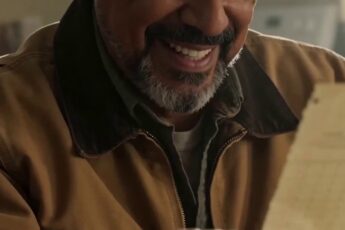
For a moment, even the rain seemed to hold its breath.
Hank Mercer sat frozen in the corner booth with the silver bracelet resting in his palm.
For Rosie.
The letters were worn, scratched by years, but he knew every curve of them. He had paid a jeweler in Tulsa to engrave those words the week Rosie turned seventeen. Back then she had rolled her eyes, kissed his cheek, and said:
“Dad, you act like I’m going off to war.”
Hank had laughed and told her:
“No. I’m just making sure you remember where home is.”
Two years later, she was gone.
Not dead.
Not officially missing.
Just gone from his life after one final fight neither of them ever got to take back.
Rosie had wanted freedom.
Hank had wanted control dressed up as protection.
She slammed the door.
He waited for her to apologize.
She never did.
Then pride turned into silence.
Silence turned into years.
And years turned into the kind of regret a man carries in his bones.
Now a little girl under his table held his pant leg like a lifeline and looked at him with Rosie’s eyes.
The man near the door took another step.
“She’s confused,” he said. “Her mother’s sick. She ran off.”
Hank slowly closed his fingers around the bracelet.
“What’s your name, sweetheart?” he asked without taking his eyes off the man.
The little girl whispered:
“June.”
The name hit him softly.
Rosie had loved June storms when she was young. She used to sit on the porch and say rain sounded kinder in June.
Hank swallowed.
“June what?”
“June Carter.”
The man snapped:
“That’s enough.”
Hank looked up.
“No. It isn’t.”
The biker closest to the door, a heavy man named Red, folded his arms across his chest.
The bartender, Marlene, quietly reached for the phone behind the counter.
Another biker slid his chair aside so the aisle to the door disappeared.
No one shouted.
No one threatened.
That was what made the man nervous.
Hank leaned down enough to see the girl beneath the table.
“June, did your mama give you that bracelet?”
She nodded.
“She said if he got mad again, I should run to the road bar with the motorcycles. She said ask for Hank Mercer.”
The old biker’s face tightened.
“And him?”
June glanced at the man and shrank back.
“That’s Troy.”
Troy forced a laugh.
“She’s dramatic. Kids make things up.”
June whispered:
“He hurt Mommy.”
The room changed.
Not loudly.
Not visibly to anyone who did not understand men like the ones standing around those tables.
But Troy understood enough to go pale.
Hank stood.
He was older than he used to be. His knees ached in the rain. His back hated mornings. His hands had scars that never fully closed right.
But when he rose, every man in the room remembered that age is not the same as weakness.
“Where is Rosie?” Hank asked.
Troy looked toward the door.
Wrong move.
Red shifted half a step, blocking it completely.
Troy wet his lips.
“She’s at home.”
June shook her head hard.
“No. The ambulance came.”
Hank’s breath left him.
Marlene spoke from behind the bar.
“Police are on the way.”
Troy turned sharply.
“You people have no right to keep me here.”
Red’s voice was low.
“We’re not keeping you. We’re just standing.”
Another biker, Eli, added:
“Real inconvenient place for all of us to stand, though.”
Troy’s eyes flicked around the room.
For the first time, he looked like what he was: not a powerful man, not a guardian, not someone in control.
Just a frightened bully in a wet shirt who had chased a child into the wrong bar.
Hank crouched beside the booth.
“June, do you have anything else from your mama?”
The girl reached into the front pocket of her red hoodie and pulled out a folded plastic sandwich bag. Inside was a letter, damp at the edges but protected.
“She said only you could read it.”
Hank took it like it might break.
The handwriting inside made the years collapse.
Dad,
if June gives you this, it means I waited too long again. I’m sorry. I have been sorry for years, but sorry becomes harder to carry the longer you keep it hidden.
I didn’t stay away because I stopped loving you. I stayed away because I was ashamed. First because I left. Then because I was stubborn. Then because I met Troy and let him make my world smaller until I didn’t know how to walk back into yours.
He wasn’t like this at first. They never are. First he helped. Then he corrected. Then he decided who I could call. Then he made me believe nobody would open the door if I ran.
But I told June about you. I told her you looked scary and loved harder than you knew how to say. I told her if she ever had to run, she should look for the old biker with gray in his beard and thunder in his voice.
Please protect her. She is my daughter. She is your granddaughter.
I gave her the bracelet because you gave it to me when I still believed home could wait for me.
Maybe it did.
Rosie.
Hank read the letter once.
Then again.
By the end, his hand was shaking so badly that Eli stepped closer, not to take the letter, only to stand near him.
June peeked out from under the table.
“Are you mad at Mommy?”
Hank closed his eyes.
That question nearly undid him.
“No, little one.”
His voice was rough.
“I’m mad at a lot of things. But not at your mama for sending you to me.”
June crawled out slowly.
Her sleeves were soaked. One sneaker was untied. There was a bruise on her wrist shaped too much like fingers.
Hank saw it.
So did half the room.
Troy saw them see it.
“You don’t know what happened,” he said quickly.
Hank turned to him.
“I know enough to wait for the police.”
Troy stepped forward.
“She belongs with me.”
Hank’s face went still.
“Children don’t belong to people. They’re trusted to people. You never learned the difference.”
When the police arrived, Troy tried to talk first.
Men like him always do.
He spoke about misunderstandings. About a hysterical mother. About a child who ran off in a storm. About good intentions.
But he had walked into a room full of witnesses.
And for once, the loudest man did not get to write the first version of the story.
June sat beside Hank in the booth with a towel around her shoulders and hot chocolate Marlene had made too sweet on purpose.
An officer tried to ask her questions.
Hank placed one scarred hand flat on the table.
“She gets a child advocate first.”
The officer looked at him, then at June, then nodded.
“Fair.”
Rosie was at Hillcrest Medical Center.
That was all Hank learned at first.
He drove there behind the ambulance that had taken June for a checkup, his motorcycle left at the bar because his hands were not steady enough for the road.
Marlene drove.
Red sat in the back seat, saying nothing.
At the hospital, June refused to let go of Hank’s sleeve.
So he walked through the bright hallway with a little girl attached to him and a silver bracelet in his pocket, wondering how a man can lose twenty-two years and still be asked to arrive in time.
When he saw Rosie, he stopped in the doorway.
She lay in the hospital bed with a split lip, bruises along one side of her face, and an arm wrapped in a sling.
She looked older.
Of course she did.
He did too.
But beneath the swelling, beneath the pain, beneath the years, she was still his daughter.
The girl who once climbed onto his motorcycle when she was six and declared herself queen of the road.
The teenager who sang off-key in the garage.
The young woman who slammed the door because neither of them knew how to say “please don’t leave” without making it sound like an order.
Rosie opened her eyes.
For a second she looked confused.
Then she saw him.
“Dad?”
It was barely a sound.
Hank walked to the bed and sat down.
He had imagined this moment a thousand times.
In some versions he scolded her.
In some he demanded answers.
In some he turned away to make her feel what he had felt.
But those were the fantasies of a lonely man polishing his hurt.
The real moment was smaller.
Holier.
He took her hand carefully.
“I’m here.”
Rosie began to cry.
“June?”
“Safe.”
“With you?”
“With me.”
Her eyes closed.
“Thank God.”
Hank swallowed hard.
“She gave me the bracelet.”
Rosie looked at him.
“And the letter?”
He nodded.
Shame crossed her face.
“I wanted to come back sooner.”
“I know.”
“No, you don’t.”
Hank’s eyes filled.
“I do now.”
She looked away.
“I thought you hated me.”
“I thought you hated me too.”
A broken laugh escaped her, then turned into a wince.
Hank leaned closer.
“I was proud. And stupid. That’s a dangerous mix in a father.”
Rosie shook her head weakly.
“I should have called.”
“Yes.”
His answer surprised her.
He continued:
“And I should have kept looking after my anger got tired.”
Tears slid into her hair.
“I was scared.”
Hank nodded.
“I believe you.”
Those three words did what apologies alone could not.
They gave her back a piece of ground.
Troy was arrested that night.
At first he denied everything.
Then the police found Rosie’s phone.
Photos.
Voice messages.
Threats.
A note saved under the title: If I don’t wake up.
There were medical records too.
Neighbors who had heard shouting.
A teacher who remembered June flinching when a man raised his hand to point at a bulletin board.
This time, people listened.
Not everyone at once.
The world rarely does that right.
But enough.
Rosie and June did not move straight into Hank’s house.
He wanted them to.
He had already imagined cleaning out the spare room, fixing the back porch, buying June a bed with a pink quilt if she wanted pink and a blue one if she hated pink.
But a social worker explained gently:
“Safety is not just a locked door with a strong man behind it. Sometimes safety is letting them choose the next room they enter.”
Hank wanted to argue.
Then he saw June jump when a nurse dropped a clipboard.
He saw Rosie apologize for asking for water.
He saw how both of them watched every doorway as if peace could turn dangerous without warning.
So he nodded.
“Then we do it right.”
That became the first new rule.
Right.
Not fast.
Not proud.
Not dramatic.
Right.
Rosie and June spent the first weeks in a protected apartment arranged through a shelter.
Hank visited when invited.
At first, only for thirty minutes.
He brought soup. Clean socks. A stuffed bear from the gas station that June named Captain Thunder. He brought old photos of Rosie, but only after asking if she wanted them.
The first time Rosie saw herself at sixteen, sitting on Hank’s motorcycle with her hair flying wild, she cried for ten minutes.
“I forgot I looked happy,” she said.
Hank set the photo on the table.
“You were.”
“Was I easy to love?”
The question broke him.
“No,” he said, because he had promised himself never to lie to her again. “You were stubborn, loud, impossible, and full of opinions.”
Rosie blinked.
Then he added:
“And I loved you so much it scared me. That’s where I went wrong. I tried to make love sound like control.”
Rosie looked at him for a long time.
“That’s the truest thing you’ve ever said to me.”
He nodded.
“Don’t get used to it. I’m still learning.”
June slowly came to trust the bar.
Not as a place for beer or bikes or loud men.
As the place where nobody handed her back.
Marlene kept coloring books behind the counter.
Red taught her to play checkers and always pretended to lose badly.
Eli fixed the squeaky wheel on her little backpack.
Hank let her sit in his booth, but never under the table unless she wanted to.
One afternoon, she asked:
“Is this your house?”
Hank looked around at the old wood, the faded signs, the coffee stains, the helmets near the door.
“No. But it’s a kind of home.”
June thought about that.
“Can a home be a place where people believe you?”
Marlene stopped wiping the counter.
Hank looked at his granddaughter.
“Yes,” he said. “That may be the best kind.”
A month later, a small sign appeared near the bar entrance.
IF YOU NEED HELP, ASK FOR ROSIE.
Marlene made it.
Hank said it was too sentimental.
The next morning, under it, someone had taped another sign in Hank’s handwriting:
KIDS DON’T RUN FOR NO REASON.
No one admitted crying when they saw it.
The bar changed after that.
At first, quietly.
A woman came in one Tuesday afternoon with sunglasses on though the sky was cloudy.
Then a teenage boy who said his stepdad had locked him out.
Then a mother with two children who asked if she could use the phone.
Marlene kept numbers for shelters and advocates in a drawer.
Red became very good at standing near doors without looking like he was standing guard.
Hank learned to ask:
“What do you need right now?”
instead of:
“What happened?”
That was harder for him.
He liked facts.
He liked problems he could grip with both hands.
But fear does not always tell its story in order.
Sometimes it only sits in a booth and shakes.
So he learned to wait.
Rosie healed slowly.
Not like in movies.
There was no single morning where she woke up free.
Some days she laughed.
Some days she could not answer the phone.
Some days she snapped at Hank for hovering, then cried because he stepped back too quickly.
They both learned.
She learned he was not leaving if she got angry.
He learned love did not mean pushing into every locked room.
June started school.
She chose a yellow backpack because red, she said, was “for running,” and yellow was “for staying.”
Hank bought it without arguing.
On her first day, she asked if he would come.
Rosie looked nervous.
Hank said:
“Only if you want me there.”
June nodded.
“But don’t bring the motorcycle. It’s too loud.”
Hank looked offended.
“My bike is a classic.”
“It’s a thunder machine.”
Rosie laughed.
It was the first laugh that sounded like the girl he remembered.
So Hank drove the truck.
Years passed.
Troy went to prison.
Not long enough, Hank thought.
But long enough for Rosie to learn how to sleep without a chair pressed under the doorknob.
Long enough for June to stop hiding snacks in her pillowcase.
Long enough for ordinary days to start feeling ordinary.
The first time June called Hank “Grandpa,” she was eight.
It happened at the bar.
She was doing homework in the corner booth while Hank pretended not to watch her spell every word.
“Grandpa,” she said, “how do you spell motorcycle?”
Hank froze.
Marlene dropped a spoon.
Red turned sharply toward the window.
June looked up.
“What?”
Hank cleared his throat.
“Nothing.”
“You’re crying.”
“No, I’m not.”
“You are.”
“Old bikers don’t cry.”
Marlene muttered:
“They do. They just blame smoke, rain, dust, onions, pollen, and the government.”
June slid her worksheet toward him.
“Can you cry after you spell it?”
Hank laughed then.
A real laugh.
The kind that cracked open something long sealed.
“M-O-T-O-R-C-Y-C-L-E.”
June wrote it down carefully.
Then added:
“My grandpa has one, but it sounds like the sky breaking.”
Hank kept that paper in his wallet for years.
Rosie eventually began volunteering at the shelter that had helped them. Later, she worked there part time.
When a woman whispered, “I should have left sooner,” Rosie would say:
“You left when you could. That counts.”
When someone said, “I feel stupid,” she would answer:
“Fear is not stupidity. It is what your body learns when love becomes unsafe.”
Hank heard her say that once and had to step outside.
Not because he was ashamed of her.
Because he was proud in a way too large for the room.
On Rosie’s fortieth birthday, Hank gave her the bracelet back.
She stared at it.
“I don’t know if I deserve this.”
Hank sat across from her at the kitchen table.
“I gave it to my daughter. That part hasn’t changed.”
Rosie touched the engraving.
“For Rosie.”
“That’s you.”
“I’m not the same Rosie.”
“No.”
He smiled faintly.
“You’re still mine.”
She cried.
He did too.
Neither of them denied it that time.
Many years after the rainy night, the bar outside Tulsa was renovated.
Marlene said it was because the roof leaked.
Everyone knew it was because June had said the bathroom looked “like a crime documentary with plumbing.”
They painted the walls, fixed the lights, cleaned the old floor, and built a small shelf near the entrance filled with cards for shelters, hotlines, legal aid, youth services, and counseling centers.
Above the corner booth, Hank hung a framed photo.
Not of June.
Not of Rosie.
Not of himself.
Just a red hoodie folded beside a silver bracelet.
Under it were the words:
THE SAFE BOOTH
For anyone who comes in from the rain needing to be believed.
June, now sixteen, stood in front of it and groaned.
“Grandpa, that is so dramatic.”
Red called from the bar:
“I voted for ‘June’s Booth,’ but somebody said that was embarrassing.”
“It is embarrassing!”
Hank sat in his usual place, older now, slower, his beard nearly white.
“Kids don’t get a vote once they become legends.”
“I’m not a kid.”
He looked at her.
“You are to me.”
She rolled her eyes.
But she sat beside him and leaned her shoulder against his.
Rosie arrived with three coffees and one hot chocolate.
June stared.
“Mom, I’m sixteen.”
“Hot chocolate.”
“I have a driver’s permit.”
“Hot chocolate.”
“Fair.”
They sat together.
Not perfect.
Not untouched.
But together.
Later that evening, the door opened.
Rain blew in.
A young woman stood at the entrance holding a baby against her chest. Her lip was split. Her eyes were terrified. She looked like she had spent the whole walk convincing herself not to turn around.
“Someone told me,” she said quietly, “that if I needed help, I should ask for Rosie.”
Rosie set down her cup.
Hank looked at June.
June was already standing.
“Come in,” she said. “It’s raining.”
And it was.
Not as hard as that first night.
But enough.
Marlene brought coffee. Red moved near the door. Rosie spoke softly. June held the baby with awkward teenage care that grew steadier by the minute.
Hank remained at the corner booth.
He looked at the rain on the windows and thought about the night a little girl crawled under his table with a bracelet in her fist and fear in her throat.
Troy had said she needed to come with him.
As if children were luggage.
As if women were property.
As if fear made him the owner of anyone.
He had been wrong.
June belonged to no one.
Rosie belonged to no one.
No child, no woman, no person belongs to someone else.
But sometimes people are entrusted to us.
For a night.
For a phone call.
For a ride to the hospital.
For a lifetime.
And when that happens, the door must open.
Not because we are heroes.
Because we are human.
People later told the story of the girl under the corner booth in many ways.
Some made it about tough bikers protecting a child.
Some made it about Hank Mercer finding his daughter’s daughter.
Some made it about Troy getting what was coming.
But Hank told it differently.
“A child came in,” he would say, “because adults had been silent too long.”
And when people asked if he had saved June, he always shook his head.
“She got herself to the door. We just opened it.”
On June’s eighteenth birthday, Rosie placed the bracelet around her daughter’s wrist.
Hank watched, quiet.
June touched the engraving.
“For Rosie.”
Rosie smiled through tears.
“And for you now.”
June looked at Hank.
“And for him.”
Hank shook his head.
“I only bought it.”
June hugged him before he could step back.
“You waited.”
“Not always well.”
“You were there when I came.”
That ended the argument.
Because sometimes love is not proven by a perfect past.
Sometimes it is proven by the door that opens when everything else is closed.
Outside the bar, rain began again, soft at first.
Inside, June’s silver bracelet caught the light.
The room smelled of coffee, leather, old wood, and something Hank had not recognized for years.
Peace.
The biker bar went quiet the moment the little girl ran inside.
Not because she was loud.
Because everyone saw a child asking for the one thing no child should ever have to beg for.
Safety.
And that night, beneath a corner booth outside Tulsa, safety answered.
💬 Do you think Hank should have kept searching for Rosie longer, or was June the one who finally brought the family home? Can a broken bond heal after twenty-two years of silence? Share what this story made you feel — because sometimes a child running in from the rain carries not only fear, but the road back home.