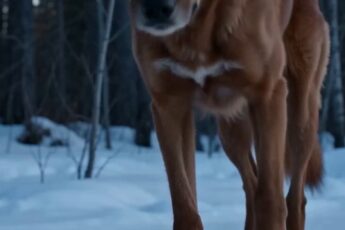
Laura set her suitcase in the weeds and froze at the gate. Rex sat by the porch steps—big, rust-colored, his muzzle now almost white. He stared at her with no flicker of recognition. No wag. No whine.
“Rex, baby,” she tried, her voice cracking. “It’s us.”
The dog didn’t move. His ears twitched once, then stilled.
Mark put down the heavy duffel beside her. “He doesn’t know us anymore.” He called the dog’s name again, but Rex turned his head toward the house as if guarding a secret they couldn’t see.
Five years earlier, Mark’s brother-in-law had lined up a job in Frankfurt. The money was euros, the kids would learn German, and it felt like the chance of a lifetime. Rex was already eight, with arthritic back legs and a gray-flecked chin. Mark stared at the dog and did the math: vet certificates, quarantine, a long-haul flight in cargo. An old dog in a metal crate, alone in the dark with strange noises.
“He won’t survive the trip,” Mark told Laura, even though part of him was bargaining.
“Probably not,” she whispered, looking away.
They struck a deal with a distant cousin, Aunt Carol, who lived two towns over. They left cash for food, a key to the gate, and a phone number. Carol nodded, promised to stop by every other day. “We won’t be gone long,” Mark said, scratching Rex behind the ears for the last time. “A year, two at most.”
The dog licked his hand. He didn’t know it was goodbye for half a decade.
Germany chewed them up. The job was only temporary, the apartment cramped, and the kids cried through language lessons while Mark and Laura sank into exhaustion. For the first few months, Laura called Carol. The woman always sounded rushed but reassured her: *Everything’s fine, the dog’s eating well.* Then the calls got shorter. After six months, Carol’s number stopped working altogether.
“Maybe she got a new phone,” Mark said.
Laura nodded, but that night she stared at the ceiling until dawn.
The years stretched. Mark’s contract ended, their visas expired, and there was no money to extend them. They packed what they could and bought tickets back to the U.S. “Rex is probably gone,” Laura murmured on the plane. Mark didn’t answer. He believed the same.
That’s why, when they finally bounced down the dirt road to their cabin in the Vermont woods, the first thing that hit them was shock. Rex was alive. He was thinner, his face almost fully white, but he was there. And the place around him was transformed.
The fence stood straight, freshly stained. The gate hinge didn’t sag. The gravel path was raked, and garden beds overflowed with tomatoes and peppers, the soil dark and damp from watering. The apple tree had been pruned by someone who knew exactly what they were doing. A sturdy new doghouse sat in the shade, insulated, with a sloped shingle roof. Beside it lay a metal bowl of what smelled like chicken and rice.
“Who’s been living here?” Laura breathed.
Mark pushed open the gate. It moved without a whisper. They walked to the cabin. The front door was unlocked. Inside, the place was tidy. A pot of cold soup sat on the stove. In one corner, a sleeping pad with a folded blanket. On the table, jars of raspberry jam, a loaf of bread. Under a chipped mug, a note in careful handwriting:
*Rex is yours, but he deserves better people. — Hank*
Laura’s hand went to her mouth. Mark sank onto a chair, the note crumpled in his fingers. “Who the hell is Hank?” he muttered.
That evening, Rex wouldn’t come inside. He slept in the doghouse Hank had built. When Laura tried to call him, he got up and walked to the farthest corner of the yard.
The next morning, Mark trudged to the neighbor’s place. Mrs. Patterson was in her seventies and knew everyone within five miles. “Hank?” she said, tilting her head. “Lives out by the old logging trail. Keeps to himself. Strange fellow, but harmless. Spent years with your dog. Every single day. Wouldn’t even visit if I paid him, but that dog? He’d come rain or snow.”
“Where can we find him?” Mark asked.
“Past the beaver pond, where the trail forks toward the spring. There’s a run-down shack. You can’t miss it.”
That evening, Mark and Laura followed the narrow footpath through the woods. It was overgrown but clearly walked often. They came to a weathered cabin with a swept dirt yard. A man in his fifties stepped into the doorway. He had a salt-and-pepper beard, tired gray eyes, and hands scarred from hard work.
“You found the note,” Hank said. It wasn’t a question.
“We want to thank you,” Laura started. “And ask… why you did all this.”
Hank motioned them inside and put a kettle on a propane burner. He poured tea into mismatched mugs and stared out the small window.
“I used to live in the city,” he began quietly. “Had an engineering job, a wife, a little house. Then the divorce hit. She got the house. All I had left was this shack—my grandfather’s hunting camp. I moved here to disappear. That was five years ago.”
He paused, took a sip. “I found Rex by accident, maybe two months after you left. I was out gathering morels and heard something whimpering. He was at your gate, ribs showing, his water bowl bone dry. I asked around. Neighbors said you’d gone overseas and some relative was supposed to feed him. That stopped fast.”
Laura’s jaw tightened.
“So I started bringing him scraps,” Hank continued. “Then I thought, winter’s coming. He’ll freeze. I built him the doghouse. Spring came, and I figured the land shouldn’t go to waste. I planted a garden. Rex walked beside me, day after day, guarding the rows. With him, I felt… less alone.”
“Five years. You did this every day for five years?” Mark’s voice was hoarse.
“Almost every day,” Hank said. “He needed someone. So did I.”
Laura’s throat ached. “Let us pay you,” she insisted. “Name any amount.”
Hank shook his head slowly. “I didn’t do it for money. And honestly, looking at you two, it seems you’ve come back with nothing yourselves.”
Mark’s eyes dropped.
“At least come for dinner,” Laura tried. “Please. Let us thank you properly.”
Hank’s mouth twisted into a sad half-smile. “Rex might not let me. I brought you back to him. And he wanted me, not you. To him, I’m the one who broke his trust.”
Silence filled the shack. Laura made a small, wet sound.
“We thought we were being merciful,” Mark said, barely audible. “We thought he wouldn’t survive the trip.”
“Wouldn’t survive the trip,” Hank echoed flatly. “But five years of waiting by a locked gate, that he could survive just fine?”
No one spoke. Finally, Laura whispered, “What do we do?”
“You don’t abandon him again. That’s all. Whether he forgives you—that’s his choice. Dogs have long memories.”
For weeks, Rex kept his distance. He’d eat from the bowl they set out but refused to cross the threshold. He slept in Hank’s doghouse. When they took walks, he’d vanish into the woods and come back after dark.
Every morning, Mark sat in the grass beside the doghouse. He talked about Germany—the stress, the shame, the way he’d think of a rusty-colored dog every single night. Rex lay with his back turned, but he didn’t leave. Laura cooked the meals Rex used to beg for: beef knuckles, chicken livers, little patties of ground meat and egg. She’d set the bowl down and walk away so he wouldn’t feel crowded.
A month passed. One morning, Rex didn’t turn away. He held Mark’s gaze and let out a single, low bark.
“Rex?”
The dog stood. Took a step. Paused. Another step. He closed the gap and pressed his cold nose into Mark’s palm.
“Did you forgive us, boy?”
Rex didn’t answer. He lay down at Mark’s feet and rested his gray chin on his paws. His tail gave a single, tired thump—not joyful, not yet, but a beginning.
Hank started visiting. First just for coffee, then for dinner. Rex greeted him with frantic leaps and whines, licking his hands like a puppy. With Mark and Laura, he was slower, more careful. But he was thawing.
One evening, Hank looked around the cabin and said, “My shack’s drafty. Winter’s going to be rough. Maybe I could put up a small shed on your property—just for the cold months. I’d help with the garden, the firewood.”
Mark and Laura exchanged a glance.
“Hank,” Laura said gently, “what if you just moved in? We have an extra room.”
He blinked. “Why would you want that?”
“Because you took care of our dog for five years,” Mark said. “Because Rex loves you. And because we’re ashamed. Truly ashamed. And we need to make it right.”
Hank stood silent, then gave a slow nod. “I’ll try. If it doesn’t work, I’ll go.”
Rex lifted his head and looked at the three of them. Then, for the first time since they’d returned, his tail wagged—really wagged—and the old dog sighed and closed his eyes.
Mornings now, Mark wakes up to a heavy muzzle resting on his chest. Rex sleeps inside, on a braided rug by the woodstove. Hank lives in the spare room, and in the evenings the three of them sit on the porch with mugs of tea, Rex sprawled across their feet, his legs twitching in some dream.
Forgiveness is a strange thing. It doesn’t come with trumpets. It comes quietly, late at night or early in the morning, when an old dog lays his head in your lap and shuts his eyes. Trust, rebuilt one patient day at a time, by people who decided to stay.