Victoria's diamond-laden fingers tightened around her champagne flute as she leaned close to Sophie, whose slate-blue dress felt suddenly like a costume she hadn't chosen.
The Beverly Hills ballroom hummed around them — crystal chandeliers, polished laughter, the easy cruelty of people who had never wanted for anything. Sophie stood in the middle of it all, holding herself together with the quiet discipline of someone who had been doing so for years.
Adrian glanced at his gold watch and exhaled through his nose.
"You ought to be grateful," he said. "Women like you don't get opportunities like this."
Sophie said nothing.
She had learned silence the year her mother died. Since then, Victoria had chosen her dresses, corrected her posture, offered small precise criticisms about her apartment, and reminded her — often, gently, ruthlessly — that admission into a wealthy family was not a right. It was a gift.
"I understand," Sophie said.
Victoria smiled the way people smile when they've already won.
"Good. Remember that."
Then the ballroom doors opened.
The music stopped mid-phrase.
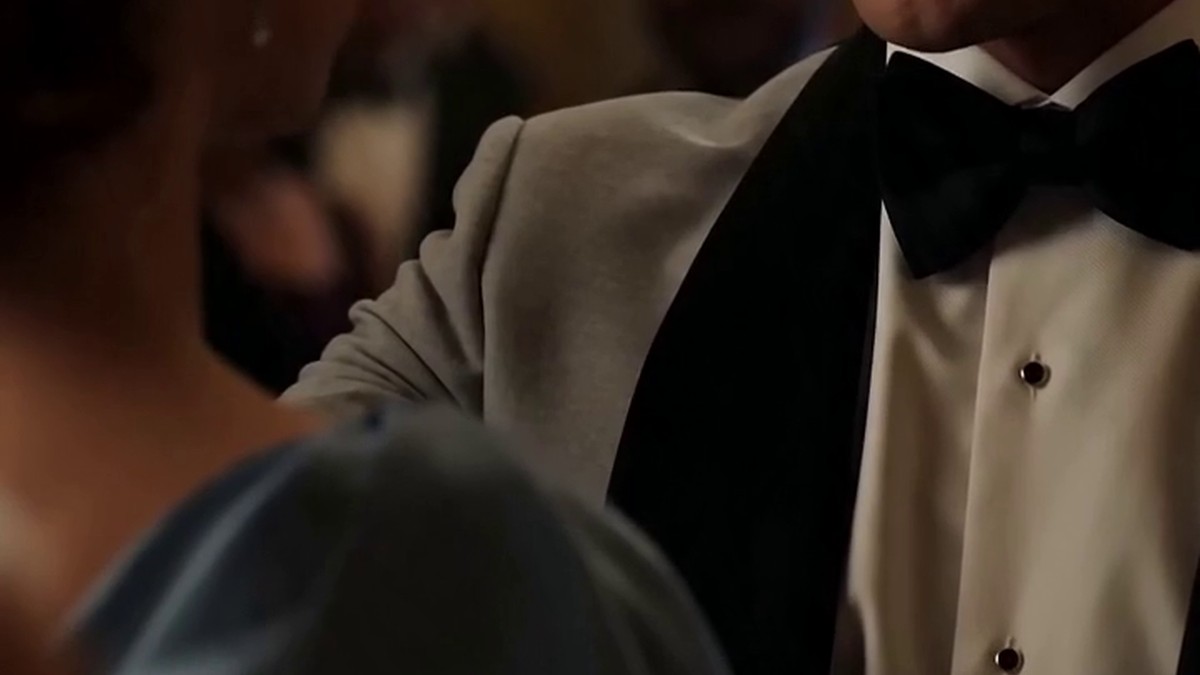
A man walked in — gray-and-black tuxedo, unhurried stride, a composed woman on his arm. The room didn't just notice him. It *turned* toward him, the way a compass needle swings north. Adrian straightened his spine without realizing it.
Victoria moved first, crossing the floor with a bright, rehearsed smile stretched wide across her face.
"Sir, what an absolute honor. We're so delighted you came."
The man didn't slow down for her.
He didn't take Adrian's extended hand.
He moved through the crowd as though the only person in the room worth reaching was standing near the far wall in a slate-blue dress with wet eyes.
He stopped in front of Sophie.
His hand came to rest on her shoulder — careful, as though something fragile had been returned to him.
Sophie looked up. Confused. Searching his face.
Something shifted in his expression. An old grief, or the end of one.
"Hello, my daughter," he said quietly. "It's time to come home."
The champagne glass tilted in Victoria's grip.
"Daughter?" The word came out barely formed.
The man reached inside his jacket and produced a birth certificate — worn at the folds, soft with age. He placed it in Sophie's hands without ceremony.
She looked down.
Her name.
Her birthdate.
And a father's signature she recognized from newspaper covers, from boardroom profiles, from the very name Adrian's family had spent years trying to impress.
The chandeliers kept burning.
The room held its breath.
And Sophie, for the first time in as long as she could remember, did not lower her eyes.
The paper trembled in her hands — not from weakness, but from the particular shock of something long-buried suddenly breaking the surface.
She read her name again. Then his name beside it. Then again, as though repetition might complete the circuit that had shorted somewhere deep inside her chest.
"I don't understand," she said.
"No." His voice was measured, careful with itself. "You wouldn't. I made sure of it, for a long time. That was my mistake."
His name was Elliot Crane. She knew it the way everyone in that room knew it — from headlines, from skylines, from the kind of quiet power that doesn't need to announce itself. Three hospitals bore his family name. Two universities. A foundation that had kept the arts alive in this city when the city had tried to let them die.
And now he was standing in front of her in a Beverly Hills ballroom, watching her hold the proof of who she was.
"How long have you known where I was?" Sophie asked.
"Too long," he said.
Behind her, Victoria's voice found its shape again — clipped, controlled, dangerous in the way of small animals cornered against something larger than themselves.
"There must be some misunderstanding." She stepped forward, positioning herself into the conversation like a piece moved on a board. "Sophie has been part of our family for three years. We've given her everything—"
"You've given her a very specific kind of nothing," Elliot said. He didn't look at Victoria when he said it. He kept his eyes on Sophie.
Adrian stepped up beside his mother, the practiced authority of inherited money squaring his shoulders. "I don't know who you think you are, walking in here and—"
"I know exactly who I am." Now Elliot looked at him. The sentence landed without anger, without theatre. Just the flat certainty of a man who had stopped needing to explain himself decades ago. "The question you should be asking is whether you understand who she is."
The room was very still.
Sophie thought of small things. The dress Victoria had chosen. The posture corrections at Sunday dinners. The phrase *women like you* hanging in the air five minutes ago like smoke that hadn't cleared. She thought of the apartment she'd been subtly discouraged from decorating, the job offer she'd been guided away from, the grief after her mother that had been managed and shaped and directed like a river into a narrow channel.
She thought of how much space she had learned to not take up.
Her fingers pressed flat against the birth certificate.
"Who was my mother?" she said. Not to the room. To him.
Something moved through Elliot Crane's face — a weather system passing, brief and total. The composed woman on his arm, who had been silent through all of it, reached out and touched his elbow gently.
"Her name was Lena," he said. "She was extraordinary in ways that had nothing to do with money. We were young and afraid of different things, and we made a terrible decision together. I made it worse by letting it stand." He paused. "I looked for you, when I finally understood what I'd walked away from. It took me longer than it should have."
"You found me."
"Yes."
"And you came here. Tonight."
"You weren't answering your phone. Your address had changed twice." He glanced, briefly, at Victoria. "I began to understand why."
Victoria lifted her chin. The diamonds at her throat caught the light. "Whatever story you've constructed—"
"There's no story." Sophie's voice surprised her. It came out level and clear and it didn't ask permission. "There's a document. And a question. And an answer I've been standing in this room not knowing I was waiting for."
She folded the birth certificate along its worn lines, carefully, and held it against her sternum.
Adrian took a step toward her. His face had the expression of a man recalculating a set of numbers that had stopped adding up. "Sophie, think about what you're doing. Everything we've built together—"
"Adrian." She looked at him. Really looked at him, maybe for the first time in months — past the jawline and the easy smile and the gold watch and all the architecture of a life she had almost agreed to inhabit. "You told me tonight that women like me don't get opportunities like this."
A muscle moved in his jaw.
"I've been trying to decide for a long time what that meant," she said. "I think I finally know."
She stepped away from him.
She stepped away from Victoria, who had gone very quiet in the way of people watching control slip through their fingers and finding no surface to grip. The bright, rehearsed smile had dissolved entirely, and what was left underneath was smaller, and less certain, and somehow more honest for that — though honesty had come too late and meant nothing now.
Sophie crossed the floor.
The crowd parted without ceremony, as crowds do when the momentum of a moment becomes undeniable. Crystal chandeliers burned above. Someone's champagne sat untouched on a white linen table.
She stopped in front of Elliot Crane.
He was watching her with the expression of a man who understood he had no right to ask for anything, and was not asking.
"I have questions," she said.
"I know."
"A lot of them."
"I know that too."
"I'm not—" She stopped. Started again. "I'm not ready to call you anything yet."
"You don't have to." He said it simply, without deflection. "There's time. That's what I came to tell you, more than anything. There is time. You don't have to decide anything in this room tonight."
She thought about her mother. About a woman named Lena who had been extraordinary in ways that had nothing to do with money. About a girl who had learned silence like a second language and worn it so long she'd almost forgotten what the first one sounded like.
She thought about the slate-blue dress she hadn't chosen.
"I'd like to leave," Sophie said.
"Then let's go," he said.
They walked out through the ballroom doors, the composed woman half a step behind, and the music did not resume, and no one stopped them. The night air outside was cool against Sophie's bare arms — the kind of cool that clarifies rather than chills, that makes the lungs expand properly after too long in a room made of other people's expectations.
She stood on the steps and breathed.
Elliot Crane stood beside her, not touching, not pressing. Just present in the particular way of someone who knew the value of space, having once failed catastrophically to understand it.
The valet brought a car around. Dark, understated. Nothing that needed to perform.
Sophie looked at the birth certificate in her hands one more time.
Her name. Her date. His signature.
The simplest kind of proof. The kind that didn't argue, didn't posture, didn't smile with a face full of careful cruelties. It just sat there, soft with age, and told the truth.
She got in the car.
The city slid past the windows in long amber streaks as they drove — lights and motion and the vast, indifferent beauty of Los Angeles at night. Elliot didn't speak. He seemed to understand that silence, for once, belonged to her. That she was the one who got to fill it or leave it empty, who got to choose the shape of what came next.
Sophie watched the lights.
She thought of a hundred things she didn't yet have words for. She thought of a conversation she would have to have with herself, alone, about who she had been in that ballroom and who she was now, stepping out of it. She thought of her mother — her real mother, Lena — and felt the grief of not having known her story, and then, underneath the grief, something else. Something that had the texture of beginning.
For three years, she had been grateful on command. Polished and positioned and guided toward someone else's vision of what her life should look like. She had learned to stand at the centre of rooms and take up the least amount of space possible.
She pressed her back against the seat.
She breathed.
The city kept burning, gorgeous and indifferent, full of a thousand stories with no idea they were being lived.
And Sophie, for the first time in as long as she could remember, felt the quiet and specific dignity of a woman who no longer had to earn her place in her own life.
She didn't lower her eyes.
She looked straight ahead.