I heard the splash before I saw it—a thick, ugly *thump* of water, wrong for a Phoenix afternoon in April. I’d only stepped away for twenty minutes to grab groceries, and now my daughter’s scream split the air.
“No! Mom, no!”
I dropped the bags on the driveway and ran toward the backyard. The gate was already open. That’s when I saw it: Hailey’s little Janome sewing machine, the one she’d saved up for all through eighth grade, sinking fast under the glittering blue surface of my ex-husband’s pool. The pale pink plastic shell caught the sun for one long second, then vanished.
Hailey was on her knees at the edge, sobbing, her hands stretched out uselessly over the water. She was still in her school hoodie, and her fingers were shaking.
I looked up and found them. Mark, my ex, stood near the barbecue with his arms crossed, staring at the deck like the screws in the wood had suddenly become fascinating. Beside him, his new wife Tiffany tilted her head and smiled. She was holding a half-empty glass of white wine, wearing a spotless white sundress, and she looked like a woman who’d just solved a mildly annoying problem.
“She needed a lesson,” Tiffany said, her voice cool and almost amused. “Maybe next time she’ll listen when I tell her to clear the table the *first* time.”
Hailey kept crying, and I knelt behind her, wrapping my arms around her thin shoulders. Her whole body was trembling. I thought about how she’d earned that machine—selling handmade scrunchies at the weekend market, pet-sitting the neighbor’s ancient bulldog, saving every birthday twenty from Grandma. Six months of small, tired hands and quiet persistence. And Mark… Mark just stood there, letting his new wife drown it.
“You destroyed her property,” I said, my voice way steadier than I felt, “because she didn’t clear a plate fast enough?”
Tiffany shrugged. “It’s just a sewing machine. She’ll get over it.”
Hailey choked out a sound that cracked me in half. Mark finally opened his mouth. “Tiff, maybe we should—”
“No,” she snapped. “You agreed she was spoiled. I’m not raising a brat on my weekends.”
I looked at Mark. He didn’t look at me. Didn’t look at Hailey either. A grown man, and he was afraid of a woman in sandals.
I helped Hailey up, grabbed her backpack, and led her to the car. She didn’t speak the whole ride home, just pressed her wet face against the window. That night, she cried herself to sleep in my bed, a tiny ball of grief with calloused fingertips.
I sat in the dark and watched the ceiling fan go around, slow and steady. Every time I closed my eyes, I saw that smile on Tiffany’s face. The smugness of someone who had never lost anything that mattered.
The next morning, I called Mark.
“Jenna, I know it got out of hand—”
“You stood there,” I cut him off. “Don’t tell me it got out of hand. You watched her break your daughter, and you said nothing.”
Silence. I could hear his jaw working. “What do you want me to do?”
“I’ll handle it. You’ll see.”
“Jenna, don’t turn this into a big thing.”
I laughed, low and humorless. “It’s already a big thing.” I hung up.
I waited until Saturday. I knew they did brunch by the pool every weekend—Tiffany posted it all over Instagram, the perfect #poolsidevibes with her fancy iced lattes and her Peloton glowing in the background. So when I pulled up to their Chino Valley house a little past noon, I wasn’t surprised to find them right where I expected.
Tiffany was reclined on a lounge chair in giant sunglasses, a venti cold brew sweating in her hand. Mark saw me first. His face went tight, but before he could say anything, I smiled.
“I’m not here for drama. Just a demonstration.”
Tiffany lifted her sunglasses just enough to glare. “You need to leave. We’re not doing this.”
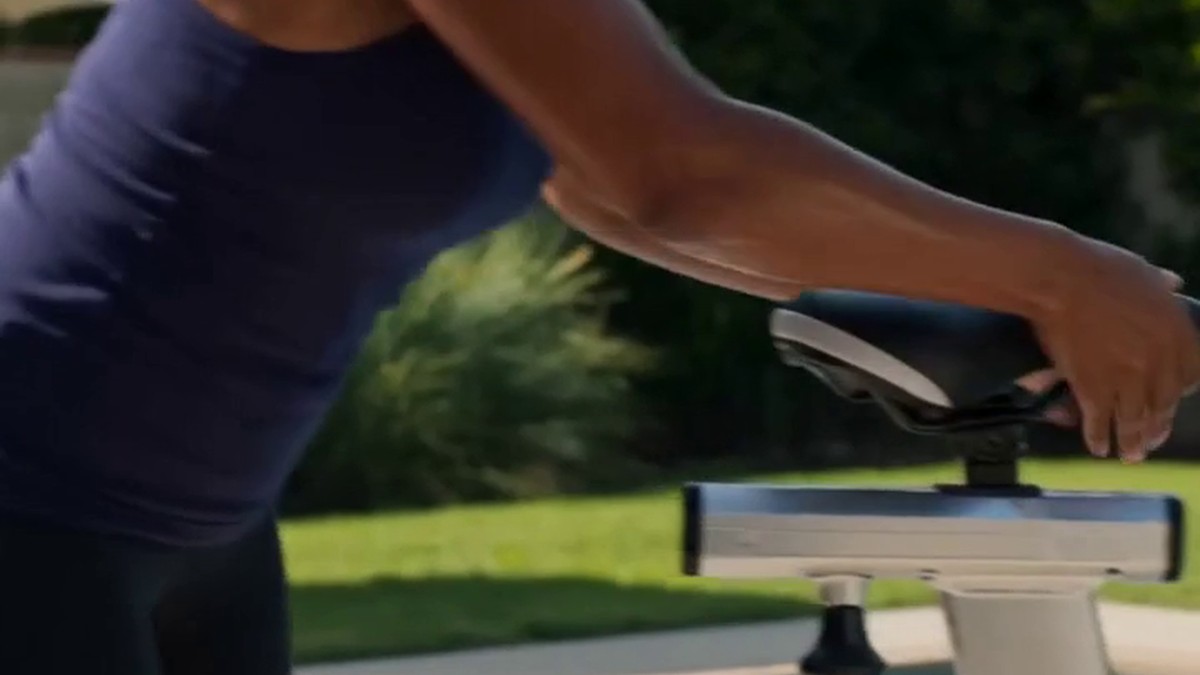
I walked right past her into the living room. I knew every corner of that house—Mark and I had bought it together, back when we were still pretending things worked. In the middle of the room, facing the sliding glass doors, sat Tiffany’s pride and joy: a top-of-the-line Peloton Bike+, the $2,500 kind with the big screen and the custom shoes she bragged about in every morning story.
I unplugged it.
“What the hell are you doing?” Mark’s voice spiked, and I heard him scrambling behind me.
I started rolling the bike toward the pool. It was heavier than I expected, and the wheels scraped over the tile, but the sound was satisfying as hell. “You said Hailey needed to learn what it feels like to lose something she loved,” I said, not even turning around. “So here we are. A lesson.”
Tiffany shrieked. “Don’t you dare. That’s a three-thousand-dollar bike! Mark, do something!”
Mark lunged, but I’d already muscled the bike past the doorframe, onto the deck. “Mark, you can either grab me, or you can step back and think about what you let happen to your daughter.”
He froze. That one sentence did more than any push ever could. His face crumpled up, and he looked away.
I gave the Peloton one final shove. It tilted, wobbled on the edge—and crashed into the pool with a spectacular splash. Water erupted up, drenched the lounge chairs, soaked Tiffany’s perfect sundress and sent her cold brew flying. The silence after was so complete I could hear the water settling.
I turned and walked out. Water dripped from my forearms, and my heart punched against my ribs. Behind me, Tiffany’s screeching faded, swallowed by the garden wall. I got into my car and sat there a full minute, just breathing, my wet clothes sticking to the seat. I noticed a small tear in my thumbnail where I’d caught it on the bike’s frame. It stung a little, but I didn’t mind.
That night, Hailey looked up from her untouched dinner. “Mom… you did something, didn’t you?”
I gave her a small smile. “Yeah. I broke her bike.”
Hailey stared at me, her forehead creased. “You what?” Then, slowly, a small laugh escaped her, like she couldn’t help it. “Mom, you’re crazy.”
I reached over and tucked a strand of hair behind her ear. “We’ll figure out a new machine, okay? One way or another.”
She just nodded, still looking half-worried. That was enough for now.
The next morning, a knock on the door. Two officers. Mark had actually called. They took my statement, asked about the sewing machine, nodded a lot. In the end, they called it a civil matter and left, but gave me a warning about “future actions.” I stood in the doorway after they drove off, my coffee going cold in my hand, a strange mix of anger and relief stiffening my neck.
Word got around. Tiffany’s tearful post about “toxic ex-wives” appeared, but someone in the comments asked about the sewing machine, and the story leaked. A few people left angry comments, then the whole thing just fizzled out. No great vindication, just a slow fade.
But something else happened. Hailey’s art teacher heard the story and reached out to a local nonprofit called Stitching Futures. Three days later, a woman named Julie showed up at our door with a box. Inside was a refurbished Brother machine, basic but clean, with a note that said “Keep creating.”
Hailey opened the box and her eyes lit up. She ran her fingers over the stitch dial, then hugged me so tight I felt the cool metal press into my ribs. Neither of us said much. I just kept my hand on her back, feeling the sharp little bumps of her spine.
A month later, Hailey entered a junior fashion showcase up in Scottsdale. She worked every night after school—sketching, cutting, sewing—rebuilding her confidence seam by seam. I’d catch her at two in the morning, headphones on, lips pressed together in concentration, those calloused hands moving like magic. I’d leave a glass of water on her desk and say nothing.
The night of the showcase, the community center was packed. I sat in the third row, my program already creased from my thumb rubbing the same spot. When Hailey’s designs came out, the second outfit’s zipper stuck; I saw her duck backstage, jaw clenched, and I didn’t breathe until a minute later the model reappeared, smooth. The applause was warm and long, and I could see Hailey’s chest still heaving when she finally walked out. I stood and clapped until my palms stung, my eyes blurry.
Out of the corner of my eye, I saw him. Mark stood at the back, near the exit, looking smaller than I remembered. After the show, he came up to us, hands shoved deep in his pockets.
“She’s… amazing,” he said. His voice cracked a little, but the words sounded rehearsed, like something he’d practiced in the car.
I just looked at him. Hailey’s face was unreadable, her chin tipped up. “Okay,” she said. Then she turned and walked toward the double doors.
Mark opened his mouth as if to add something, then closed it again. I followed my daughter, not looking back.
Outside, the parking lot smelled of cooling asphalt and desert sage. Hailey slipped her hand into mine; her grip was sticky from sweat and the leftover candy from the concession stand. She said, “Mom, are we getting tacos on the way home?”
I laughed, a short, surprised sound. “Yeah, baby. We’re getting tacos.”
And we walked to the car, the world just ordinary again.