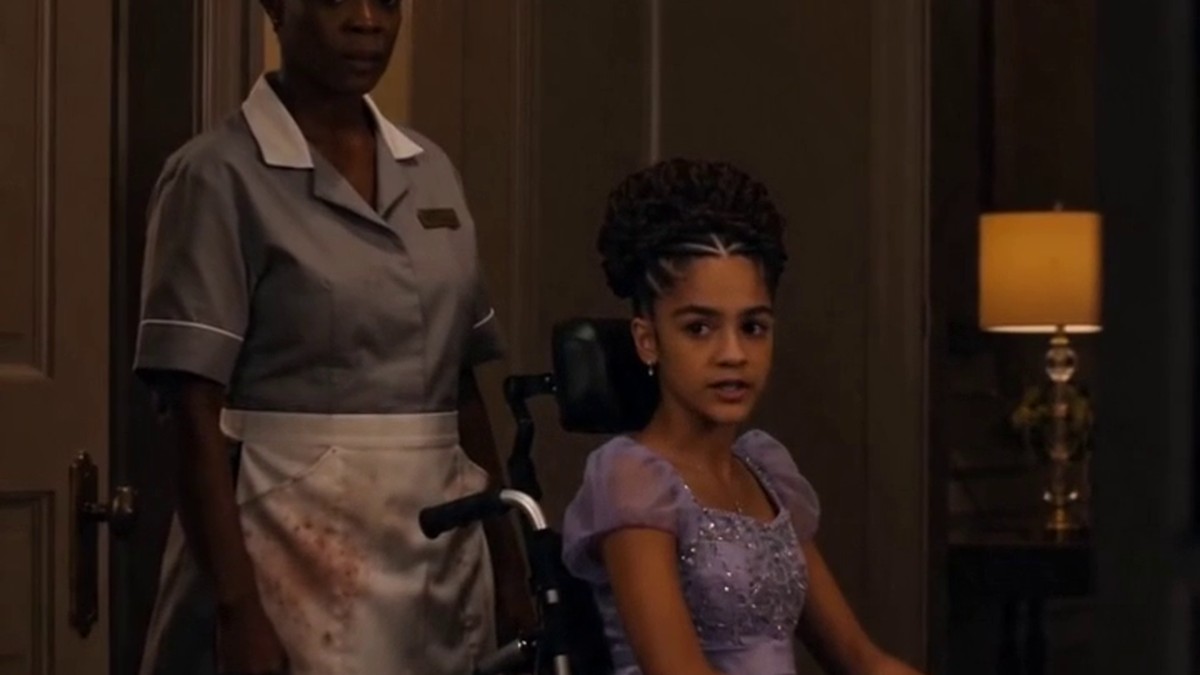
The Harrington estate blazed like a diamond under the Connecticut night. Every window of the colonial mansion spilled golden light across manicured lawns, and the circular driveway was a slow parade of Escalades, Teslas, and polished town cars. Photographers fired bursts of white, valets sprinted, and guests in silk gowns and tailored tuxedos followed a crimson runner lined with pale gardenias.
This was the Richard Harrington Inclusive Futures Gala — an annual event that raised millions for children with disabilities. Richard himself, a self-made magnate with a hotel chain, a regional airline, and a private foundation, stood at the podium beneath a canopy of fairy lights. His teeth were impossibly white.
“Inclusion,” he said, lifting a crystal glass, “is not a marketing slogan. It’s a moral obligation. Every child deserves to be seen. Every child deserves a seat at the table.”
The applause was a wave of polite adoration.
Two floors above, in a room locked with a brass key, was his daughter Emily. She was fifteen, with dark hair braided in a crown and a dress the color of lilacs that she’d chosen online and ordered with her own card. Her wheelchair was a sleek, custom-fit titanium model. She’d been in it since a spinal injury at age five, before her mother’s cancer took the only adult in this house who had ever looked at her without flinching.
From her window, Emily could see the whole party. She could see her father working the crowd, shaking hands, touching his chest with practiced sincerity. She could hear the muffled sound bite about “every child being seen.” And she knew, with a cold and perfect clarity, that tonight — just like every year — she was not to be one of them.
“It’s for your own protection,” Richard had told her that afternoon, fastening his cufflinks while standing in her doorway. “The press can turn a sob story ugly. I don’t want them making you a headline.”
Emily had said nothing. She’d just nodded, the way she’d learned to do years ago, so he’d leave faster.
Beside her, in the darkened room, sat Maya, one of the younger housekeepers. She was twenty-two, with a quiet smile and the tired eyes of someone who’d been making her own way since she was a kid. Her uniform was creased at the elbows, and her comfortable shoes were held together with discreet stitches. Maya had grown up in a cramped apartment in Newark, sharing a bedroom with her little brother, who also used a wheelchair. She knew the difference between keeping someone safe and keeping someone invisible.
“He’s giving the speech,” Emily whispered, her voice flat. “Right on schedule.”
Maya didn’t answer. She just rested her palm lightly on Emily’s shoulder. The gesture was small, but it said everything Richard’s foundation never could.
—
Maya had worked in the Harrington mansion for eleven months, and in that time she’d catalogued every exit, every ghost of a plan that Emily had sketched in the margins of her notebooks. Most days, Emily accepted her father’s rule — the locked room during publicity events, the private tutors who doubled as wardens, the estate’s unspoken code that her face belonged anywhere but in front of a camera.
But tonight the lie felt heavier. The foundation was named for Emily’s late mother, a woman who had started a small charity for adaptive sports. Richard had taken the name, the mission, and the shine, then surgically removed anything that might remind potential donors that his own daughter lived the very story he profited from telling.
“What if I went down?” Emily asked, the words raw in her throat.
Maya’s hand stilled. “He’d lock you out of more than a room. You know what he said about the trust.”
Emily did know. The trust her mother left was controlled by her father until she turned eighteen — or until she proved “emancipated or in clear need of independent protection,” a clause her mother’s lawyer had buried so deep that Richard had never noticed. Emily had discovered it herself last spring, scrolling through digitized documents on a library database. She hadn’t told a soul. Not yet.
“I’m not asking permission,” Emily said. She swung her chair toward the old service elevator at the end of the hall — the one the caterers used. “I’m asking if you’ll hold the cables steady.”
Maya didn’t hesitate. “I’ll do better. I’ll get the key.”
Ten minutes later, the kitchen staff was too frantic with champagne trays to notice a slim housekeeper guiding a girl in lavender through the butler’s pantry. Emily’s heart slammed against her ribs. The music grew louder — a string quartet playing something achingly elegant. She smelled hothouse flowers and expensive perfume. The air changed temperature, warm and crowded, as she emerged into the garden through the same side door that the servers used.
At first, no one spotted her. The guests were too busy laughing, posing, networking. Emily navigated around a towering ice sculpture of the foundation’s logo and angled herself toward the main lawn where her father stood, clinking glasses with a senator. Her wheels left faint tracks in the dewy grass.
Then, one of the photographers noticed. The popping of his shutter was a tiny, mechanical heartbeat. Then another noticed. And another. A murmur rippled outward. Heads turned.
Richard Harrington saw his daughter when the crowd parted. The glass in his hand dipped, and his practiced smile shivered like a broken marquee.
“Emily.” It wasn’t a greeting. It was a warning.
But Maya was already there, five steps ahead of Emily, her phone held low at her side — recording. She pressed the red button with the calm of someone who had spent years waiting for one honest moment.
Emily didn’t shout. She didn’t cry. She just rolled forward until she was directly under the fairy lights, the same lights that framed her father’s grand speeches.
“You forgot to introduce me,” she said, her voice steady enough to carry. “I’m Emily Harrington. I’m the reason this foundation was supposed to exist. But my father thinks I’m better kept in a locked room during the good parts.”
The silence was a vacuum. A reporter’s camera light blinked like an unblinking star.
Richard’s expression cycled through shock, fury, and the instinct to manage. “Sweetheart, you’re confused. You were resting. The heat—”
“I wasn’t resting,” Emily cut in. “I’m never resting. I’m just not convenient. But I’m here now, and I’ve got something to say: Inclusion isn’t a set of camera-ready talking points. It’s letting the kids you claim to help stand next to you and speak for themselves.”
She didn’t need to add that she had copies of the trust documents, that she’d filed a petition for financial independence that very afternoon with the help of a pro bono legal clinic Maya had found, or that the video on Maya’s phone was already being streamed to a local journalist who’d been tipped off ten minutes ago. All of that could come later.
What came next was a blur. Richard lunged forward, his voice cracking into a stage whisper about hysteria, about privacy, about security. Two of his assistants tried to form a human wall between Emily and the cameras. But the reporters were already swarming, asking questions that had no easy answers. A board member with a tight smile told Richard he’d better step inside. The senator slipped away into the crowd.
And Emily, still under the lights, reached out and squeezed Maya’s hand.
A month later, the news cycle had done its work. Richard Harrington resigned from the foundation’s board. The gala funds were frozen pending an audit. Emily’s petition was granted — a tiny, brutal triumph that put her mother’s trust under the control of an impartial custodian until her eighteenth birthday, with immediate allowance for her living expenses. She used a chunk of that allowance to rent a small, accessible bungalow on the outskirts of Hartford and to hire Maya as her official care assistant, with a real salary and enough hours to let Maya finally go back to school.
The first night in their new place, Emily sat on the porch watching fireflies stitch patterns in the dark. She had traded the gilded cage for a house with a squeaky ramp and a mailbox that said Harrington-Ruiz, because Maya had earned a name on it too.
A few reporters still called, but mostly the world had moved on. Emily didn’t mind. She was done being a headline. She was learning, finally, what it felt like to be a person who didn’t have to hide, and the silence tonight was not the silence of a locked door. It was the quiet of a life she had chosen, with someone who had never seen her chair as anything but a seat at the table.