The wedding had all the suffocating polish of old Louisiana money—candles dripping onto magnolia garlands, the clink of silver against Limoges china, a string quartet sawing through something mournful.
Julian’s mother, Adeline, rose from her seat with the weight of a woman who believed her blood pumped stronger than anyone else’s in the room.
She tapped a flute of Cristal with a butter knife. The chatter died.
“Before we get too drunk to remember who we are,” she said, smiling the way a viper smiles before it strikes, “I want to welcome Claire into our family properly.”
Claire felt Julian’s hand tighten over hers under the table. He knew his mother. He knew that tone. But he didn’t move to stop her.
Adeline reached into her clutch and pulled out a velvet box the color of dried blood.
“This ring,” she said, turning so all two hundred guests could see it, “has been in the Beaumont family for six generations. It sat on the finger of a Confederate widow. It crossed the Atlantic twice. It survived a fire that took half of Baton Rouge.”
She paused. The air in the tent felt heavy.
“I’m giving it to Claire tonight,” Adeline continued, her voice dripping honey laced with arsenic, “even though she will never truly belong to this family—because that is the gracious thing to do.”
Gasps. Someone’s champagne glass tipped over.
Claire didn’t flinch. She watched Adeline slide the ring from its box—a thick gold band with a ruby the size of a hazelnut, flanked by tiny diamonds that caught the chandelier light and scattered it in red shards across the tablecloth.
“Stand up, dear,” Adeline said. “Let everyone see you try to wear it.”
Claire stood. She was tall. Taller than Julian. Taller than Adeline. She’d worn a simple ivory sheath from a boutique in the Quarter. No lace. No train. Just fabric that moved when she breathed.
Adeline took Claire’s left hand and shoved the ring onto her fourth finger. It fit perfectly.
The older woman’s smile flickered. She’d expected a struggle. Maybe even tears. Instead, Claire lifted her hand and examined the ring the way a jeweler examines a stone.
That’s when she laughed.
Not a nervous giggle. Not a hysterical shriek. A low, genuine laugh that made several people at the head table lean back in their chairs.
“Oh, Adeline,” Claire said, loud enough for the whole tent. “You really shouldn’t have.”
“I know it’s overwhelming,” Adeline purred. “To finally touch something with actual history.”
Claire twisted the ring off her finger and held it up between her thumb and forefinger. The ruby caught the light again, but something was different now. The stone’s interior looked cloudy. Almost hollow.
“This isn’t a ruby,” Claire said.
A flush crept up Adeline’s neck. “Don’t be absurd. That ring has been appraised by—”
“By a man in Metairie who went out of business in 2014,” Claire finished. “A man your husband hired to confirm what you already wanted to believe.”
Silence fell over the tent like a sheet.
Claire turned the ring over in her palm. “This is a synthetic corundum grown in a lab in the 1960s. The diamonds on the band? Cubic zirconia. I’d guess the whole thing is worth about four hundred dollars—and that’s generous, accounting for the gold weight.”
Julian’s aunt let out a strangled sound. His uncle knocked over his bourbon.
Adeline’s perfectly powdered face had gone the color of old bone. “How dare you—”
“You want to know how I know?” Claire set the ring down in the center of the table, next to the butter dish. “Because my mother used to design jewelry in New York. I grew up with a loupe in my hand. I’ve been sorting real stones from paste since I was twelve.”
She wasn’t shouting. Her voice stayed level. Calm. Almost gentle.
“And also,” Claire added, “because the real Beaumont ruby wasn’t destroyed. It was sold.”
The tent went so quiet that Claire could hear the ice melting in the water glasses.
“The original ring,” she said, turning now to face the guests, “was a pigeon-blood Burmese ruby set in platinum. It was insured for two point seven million dollars. And twenty years ago, Julian’s father sold it to cover the debts from a failed hotel development in Gulf Shores.”
Adeline grabbed the edge of the table. Her knuckles went white. “You lying little—”
“The replacement was your idea,” Claire said, still calm. Still smiling that small, sad smile. “You couldn’t let anyone know the family was bleeding money. So you had a replica made. And you’ve been passing it off as the real thing ever since.”
Julian pushed back his chair and stood up. “Dad sold the ring?”
“Your father sold half the things in that house,” Claire said. “The Degas sketch in the upstairs hallway? A print. The silver in the dining room? Electroplated nickel. The land the stables sit on? The bank repossessed it three years ago. Your mother’s been keeping the whole thing upright with sheer force of will and a line of credit your uncle doesn’t know about.”
Adeline’s younger brother, Thomas, who had flown in from Houston that morning, was already pulling out his phone. “I’m calling the accountant.”
“The accountant’s been cooking the books since 2018,” Claire said. “You’ll want to call a forensic auditor instead.”
Adeline lunged.
Actually lunged across the table, sending butter knives and champagne flutes flying, her fingers hooked like claws. Julian caught her around the waist, and she sagged against him, her breath coming in ragged gasps.
“You’ve been in my house,” she hissed at Claire. “You’ve been going through my things.”
“I didn’t have to go through anything,” Claire said. “Your husband kept a safety deposit box at a bank in Lafayette. He left the original insurance documents inside. Along with the receipt for the replica. And a letter.”
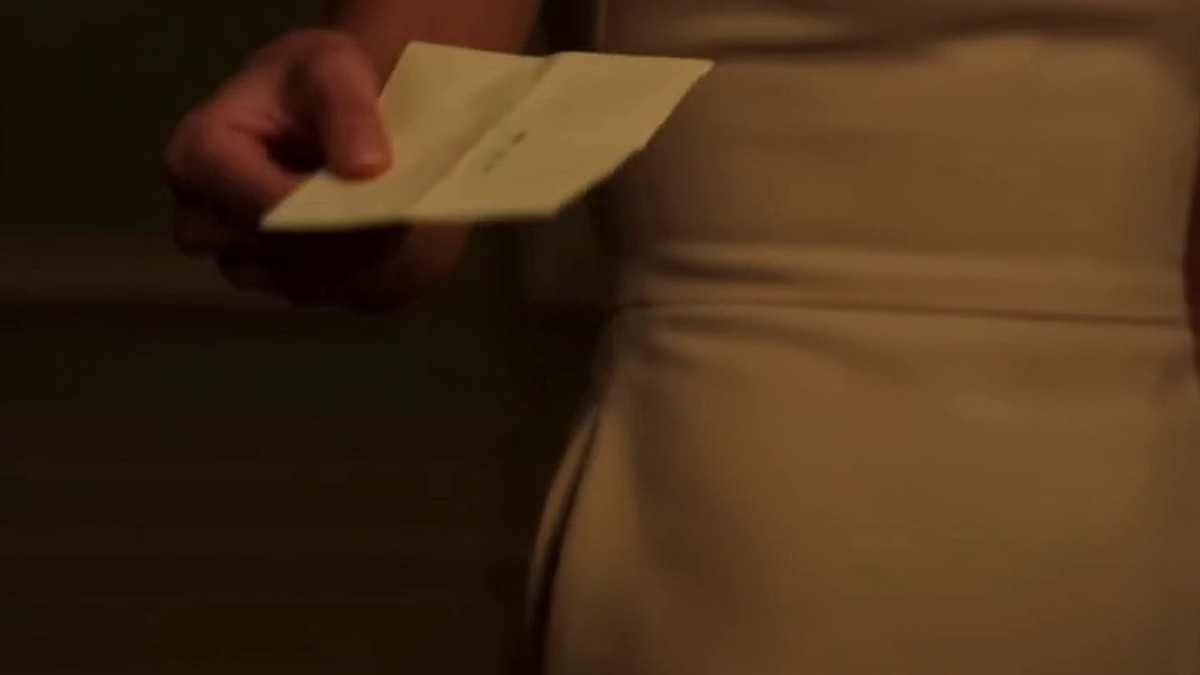
She reached into the pocket of her dress and pulled out a folded piece of paper, yellowed and fragile.
“He wrote it two weeks before his heart attack,” she said. “He wanted to tell you. He was afraid to. So he wrote it down instead, locked it in a box, and put the key in a drawer you never open.”
Adeline’s face crumpled. Her mascara had started to run, leaving gray tracks through her blush. She looked, suddenly, like an old woman. Like a woman who’d spent thirty years shouting at the tide to stop coming in.
“Why,” she whispered. “Why would you do this here? Tonight?”
Claire set the letter down beside the fake ring.
“Because you tried to humiliate me in front of everyone I love,” she said. “Because you spent two years trying to make your son choose between us. Because you just stood up at my wedding and told two hundred people I wasn’t good enough to wear your family’s history.”
She stepped closer to Adeline, close enough to smell the Chanel and the fear.
“And because it’s the truth,” Claire said. “You’ve been drowning for two decades, and you’re too proud to ask for a life raft. So I’m throwing you one anyway. That letter isn’t just a confession. It’s instructions. The real Beaumont fortune—the one the old man’s grandfather hid from the IRS in 1952—is sitting in a trust in the Caymans. Julian’s father wanted you to access it. He just couldn’t bring himself to tell you how to find it.”
Adeline stared at the letter. Her hand shook as she picked it up.
“The ring was the key,” Claire said. “The real one. It had an account number engraved inside the band. But the replica doesn’t. So you’ve been locked out of your own money for twenty years, and you never even knew it.”
Thomas was already on his feet, loosening his tie. “I’m calling the family attorney. Right now.”
“Call him,” Claire said. “He’s been waiting for this phone call since 2004.”
Adeline unfolded the letter. Her eyes moved across the words her dead husband had written two decades ago. Her lips parted. Her shoulders dropped.
She looked up at Claire, and for the first time that evening, there was no venom in her expression. Just exhaustion. And something that might have been the beginning of a question.
Julian stepped between them. He looked at his mother, then at his wife, then at the ring sitting on the table like a grenade with the pin pulled.
“You knew all this,” he said to Claire. “The whole time.”
“I found out six months ago,” she said. “I wanted to tell you. But I also wanted your mother to hear it from me, not from you. She needed to know I wasn’t going anywhere.”
Adeline folded the letter carefully, reverently, back into its original creases. She tucked it into her clutch beside the empty velvet box.
Then she did something no one in that tent had ever seen before.
She apologized.
“I misjudged you,” she said, her voice cracking. “I have been… I have been horrible. To you. To my son. To everyone in this room who has been waiting for me to fall.”
She turned to the guests, who sat frozen in their chairs like mannequins in mothballed silk.
“The wedding,” Adeline announced, “is still a wedding. And this woman—” She gestured at Claire, still breathing hard, still holding on to the table for support. “—this woman just saved my family. So if anyone has a problem with her, you can take it up with me.”
No one spoke.
Adeline turned back to Claire. “The account number. Do you know it?”
Claire shook her head. “But I know someone in the Quarter who can extract the engraving pattern from old photographs of the original ring. It’ll take a few days. The money’s not going anywhere.”
Adeline nodded. She reached down, picked up the fake ruby ring from beside the butter dish, and slipped it onto her own finger.
“Then I’ll wear this one,” she said. “To remind me.”
The string quartet, uncertain whether to keep playing, launched tentatively into a waltz.
And under a tent in Louisiana, with cicadas buzzing in the live oaks and a half-melted wedding cake sweating on its stand, a family that had spent two decades pretending to be rich finally admitted it was broke—and realized, for the first time, that it might actually survive.
Claire reached for Julian’s hand. He was still staring at the letter in his mother’s clutch, processing, recalibrating every memory he’d ever had of his father.
“You okay?” she asked.
“I don’t know,” he said. “Ask me in the morning.”
But his fingers interlaced with hers and stayed there, and when the waltz ended and the cicadas took over, neither of them let go.