"Do not draw attention to yourself tonight."
Victoria's jewelled fingers tightened around her champagne glass as she leaned in close to Sophie, who stood near the edge of the ballroom in a slate-blue dress she hadn't chosen for herself.
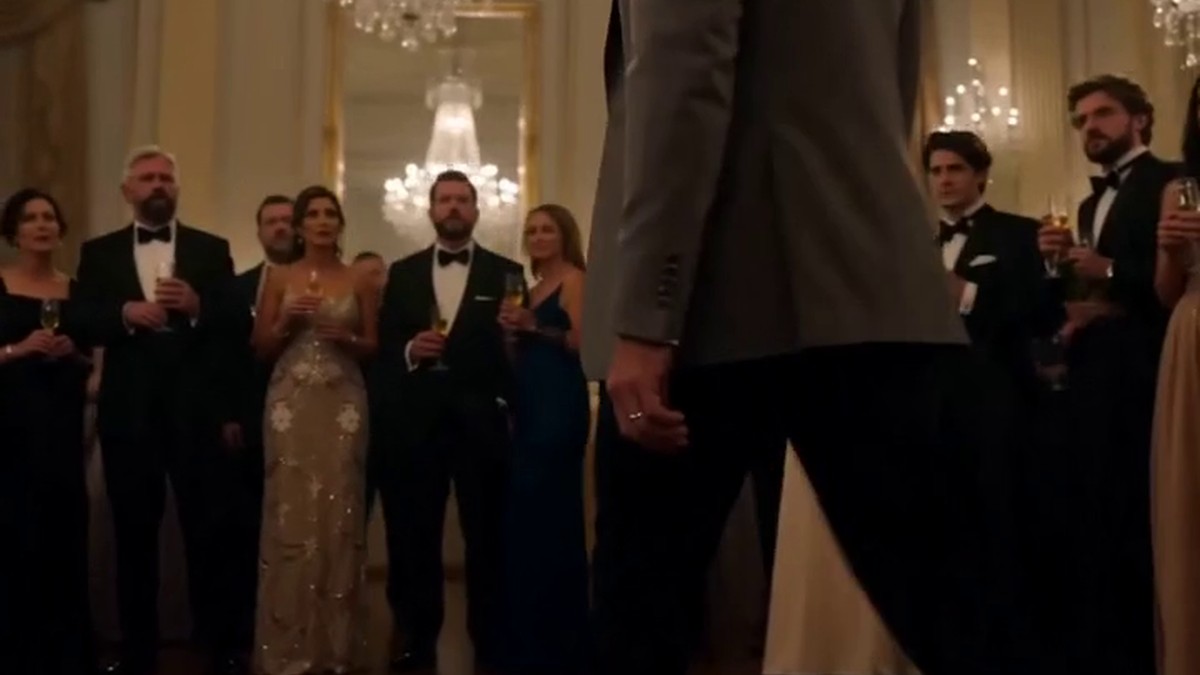
The private mansion outside Chicago blazed with light. Crystal chandeliers threw gold across laughing faces. No one noticed the young woman near the wall, working very hard to hold herself together.
Adrian glanced at his watch. Exhaled through his nose.
"My family is giving you a life you could never have built on your own," he said. "Try not to forget that."
Sophie's lips pressed together. The trembling was small. She had learned to keep it small.
After her mother died, silence had become her survival. Victoria chose her clothes and corrected her posture. Victoria commented on her apartment — the size of it, the smell of it — and returned again and again to the same essential point: Sophie should be grateful. Sophie should remember where she came from and where she would have stayed.
"I'll try," Sophie whispered.
Victoria's smile didn't reach her eyes.
"You'll do considerably more than try."
Then the ballroom doors swung open.
The music died mid-phrase.
He entered in a grey-and-black tuxedo, unhurried, a poised woman on his arm. The laughter went out of the room like a candle. Every head turned. Adrian's spine straightened visibly. Victoria pivoted on her heel, her voice flooding with rehearsed warmth before she had even closed half the distance.
"What an extraordinary honour — truly, we are so thrilled—"
The man moved past her without a syllable.
He didn't stop at Adrian.
He crossed the ballroom floor in a straight line, directly to Sophie.
She looked up at him, blinking, tears still catching the chandelier light.
He placed one hand gently on her shoulder.
His eyes held something heavy. Something old.
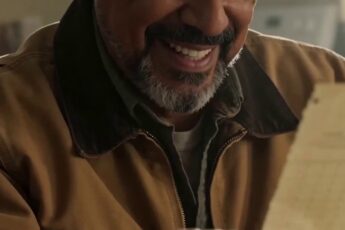
"Hello, Sophie." His voice was barely above a whisper. "I'm your father. Let's go home."
The glass in Victoria's hand dropped an inch.
"Her — father?" The word came out hollowed.
The man reached into his jacket and produced a birth certificate, worn at the folds, handled many times over many years.
Sophie looked down.
Her name was printed there, clear and certain.
And then she found the signature at the bottom.
The same signature she had watched Victoria invoke in conversation for years — admired, chased across charity galas and business dinners and every carefully orchestrated evening exactly like this one.
The signature of the man now standing at her side.
The room held its breath.
Sophie's fingers traced the edge of the paper. The ink was old, but the letters were unmistakable, pressed deep the way people used to sign their names when they meant it. When it mattered.
She looked up at him.
He didn't look away.
"That's — " Victoria's voice had changed. The rehearsed warmth was gone, stripped clean. What remained was something rawer and considerably less elegant. "That document is — there must be some mistake."
"There isn't." His name was Elliot Crane, and he said it without raising his voice. He didn't need to. The room had already decided to listen. "Twenty-eight years ago I signed that certificate in a hospital in Oak Park. I didn't know where Sophie went after that. I've spent a significant portion of my life finding out."
Adrian stepped forward. He had arranged his face into the expression he used in boardrooms, the one that made assistants apologize before they'd done anything wrong.
"This is a private event," he said. "And whatever you think you're establishing here — "
"Sit down, Adrian."
It wasn't a request. Adrian sat down. Several people pretended not to notice.
Sophie's hand still held the birth certificate. She kept expecting her fingers to shake, the way they always shook in this house, in this dress, in every room she hadn't been allowed to feel comfortable in. But the shaking had stopped. She couldn't quite account for it.
"Why now?" she asked Elliot. Her voice was steady, and it surprised her.
He looked at her the way someone looks at a thing they have been searching for so long that finding it doesn't quite feel real yet.
"Because I didn't know you existed until fourteen months ago," he said. "Your mother — " He paused. Not from evasion. From something more careful. "She was protecting you from a legal situation I was in the middle of. She thought distance was safer. She made a decision I wouldn't have made, and I have spent fourteen months trying not to be angry at a woman I can't argue with anymore."
Sophie felt the grief move through her the way it always did — sudden and sideways, arriving without permission.
"She never told me."
"No." He breathed out slowly. "I don't think she knew how."
Victoria had recovered enough to find her voice again, though it had taken on a different quality — higher, more careful, picking its way through unfamiliar terrain.
"Sophie." She moved toward her. "Whatever this man has told you, you need to consider the context. You need to consider — "
"Don't." Sophie turned and looked at her directly.
It was the first time she had looked at Victoria directly in longer than she could remember. She had learned to look slightly past her, the way you look past a very bright light to avoid the burn. But now she looked, and what she saw was someone smaller than she had remembered. Someone whose power had always been borrowed, and who was only now beginning to understand that the loan had been called.
"Don't tell me what I need to consider," Sophie said. "You told me where I came from every chance you had. You said it like it was a wound I should be ashamed of."
Victoria's jaw tightened. "I gave you — "
"You gave me exactly as much as you had to, and you charged me for every bit of it." Sophie folded the birth certificate with the same care with which it had been kept. "I was a project, Victoria. A useful kind of charity case. Don't mistake that for kindness now."
The room had gone absolutely still.
The crystal chandeliers still threw their gold across the walls, indifferent and brilliant. The champagne still sat in its glasses. Somewhere in the corner a small string quartet held their instruments and had no idea what to do with them.
Adrian had found his voice again. It was thinner than usual.
"If you walk out of here, the apartment — "
"Is yours." Sophie handed him the key from her clutch without looking at him. She had been carrying it all evening, the small brass weight of it, not yet knowing she was already leaving. "You can have it. You've been paying for it long enough to feel you own it anyway."
He stared at the key in his palm.
She turned to Elliot Crane.
He was watching her with that same expression, the one she hadn't found a name for yet. Recognition, maybe. The specific variety that comes from seeing someone you love in a stranger's face.
"You said home," she said. "Where is that?"
"Right now?" He almost smiled. Almost. "A car outside. And then wherever makes sense after that." He paused. "I have a house in Vermont. It has too many rooms and not enough furniture and a dog that doesn't obey anyone. I thought you might want to see it."
She stood there for a moment in the middle of the blazing ballroom. In the slate-blue dress she hadn't chosen. Surrounded by all the careful architecture of someone else's life.
Then she walked.
Not quickly. She didn't run. Running would have looked like escape, and this was something else entirely. This was a woman crossing a room on her own terms, and the difference was visible in every step.
Elliot fell into pace beside her.
The woman on his arm — she had been introduced to no one and seemed unbothered by it — gave Sophie a look of quiet warmth and asked nothing at all.
The ballroom doors opened.
The cold outside was a relief, sharp and honest. The city glittered beyond the gates. A black car waited on the long drive, engine running, patient as a promise kept late.
Sophie stopped on the steps and looked up.
The sky above Chicago was that particular shade of dark blue that happens right at the edge of real night, where the light hasn't quite surrendered yet.
She breathed it in.
Behind her, through the tall windows, she could see the shapes of the party rearranging themselves. Victoria moving through the room with the tight efficiency of damage control. Adrian staring at the key. The string quartet starting up again, because what else could they do.
It looked, from the outside, like a photograph of a life she had almost believed in.
It looked very far away.
"She used to tell me I was lucky," Sophie said. "Your mother. She said it often enough that I started to believe it."
Elliot stood beside her. He didn't rush her.
"Were you? Lucky?"
Sophie considered this with the seriousness it deserved.
"I'm still here," she said finally. "That's something."
He nodded. "It is."
She looked at him again — the way you look at someone when you're just beginning to understand the shape of what they might mean to you. The way you look at a door you've never walked through.
"I have a lot of questions," she said.
"I know." He opened the car door for her. "I have a lot of answers. I've been rehearsing them for fourteen months."
She got in.
The car moved down the drive and through the iron gate, and the mansion fell away behind them, brilliant and receding, growing smaller in the rear window until the road curved and it vanished entirely.
Sophie leaned back against the seat.
The trembling was still gone.
She didn't know yet what Vermont looked like, or the dog that didn't obey anyone, or what it felt like to sit in a room where no one was keeping score. She didn't know what her father's laugh sounded like, or whether she had inherited anything from him beyond the name on a worn document in her lap.
But she was on her way to find out.
And that, after everything, was the beginning.