Rain had been falling in thin, cold ropes since dawn. The cemetery smelled like wet earth and old lilies, and Michael Aldridge sat on the stone bench beside plot 247 with a bouquet of white roses going limp in his hand. Five years to the day. He still couldn’t say her name without his chest locking up.
Rachel.
The headstone was simple — just her name, the dates, and *Beloved Wife*. No body had ever been found, only an overturned kayak and a scribbled note about clearing her head. The ocean had swallowed her, and a closed casket had swallowed the hope he’d clung to for two weeks.
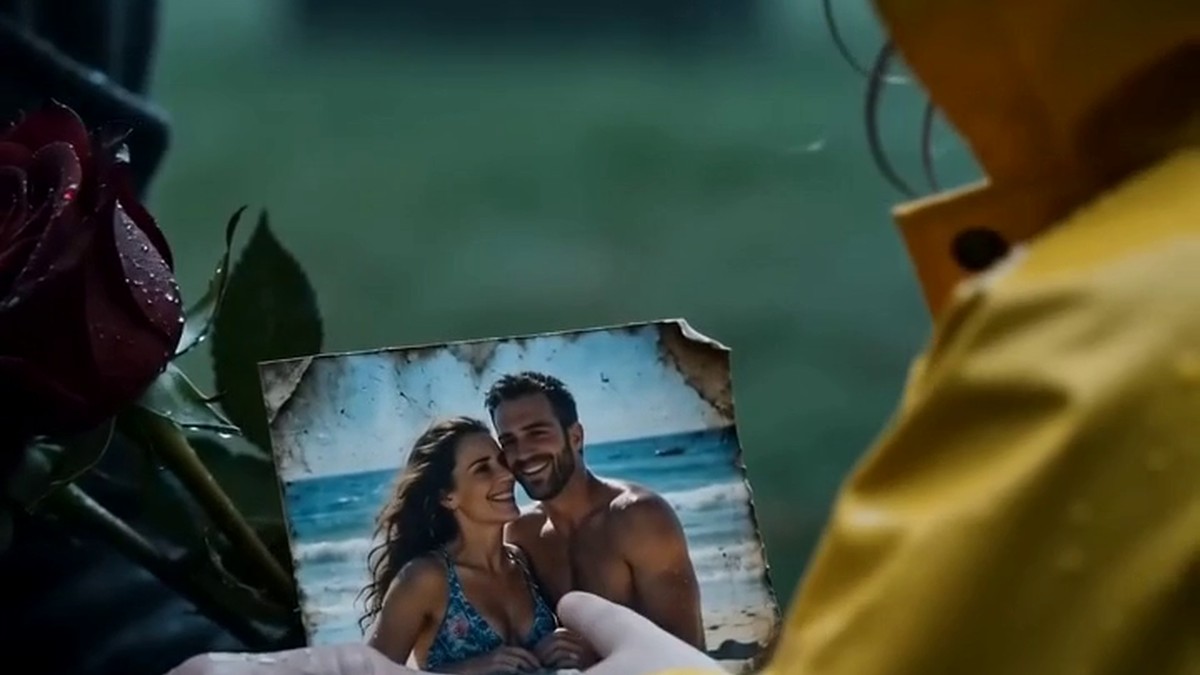
He pulled his wallet from his coat and slipped out the old photograph he never traveled without. Him and Rachel on their Maui honeymoon, both sunburnt and laughing, his arm slung around her shoulders. He’d stared at it so many times that the corners had gone soft.
A scuff of tiny footsteps made him look up.
A little girl in a yellow rain slicker and polka-dot boots stood three feet away, holding something out with a chubby hand. She couldn’t have been more than seven, with two neat pigtails clipped with butterfly barrettes.
“Sir? You dropped your picture.”
Michael blinked. The photo — he must have let it slip. He took it from her damp fingers, ready to thank her and send her back to whatever parent was lurking among the graves. Then she spoke again.
“That’s my mommy.”
The roses slid an inch in his grip. “What?”
“That lady,” the girl said, jabbing a finger at Rachel’s face. “That’s my mommy.”
Michael let out a breath that was half a laugh, half a broken thing. “No, sweetheart. That’s my wife. She passed away a long time ago.”
The girl tilted her head, rain dripping off the hood of her slicker. “My mommy says some people think that.”
A chill that had nothing to do with the weather crawled up his back. People think that. People. He dropped onto his heels so he could look her in the eye. “What’s your mommy’s name?”
“Rachel,” she said, like it was the easiest thing in the world. “I’m Sophie.”
Michael’s vision swam. Rachel hadn’t been able to have children — years of tests, of specialists shaking their heads. He’d buried that dream along with her. Now a child with Rachel’s exact shade of green eyes was blinking at him in a North Carolina cemetery, promising the impossible.
He gripped her shoulders, trying to keep his voice steady. “Sophie, is your mommy… alive?”
Sophie nodded so hard her pigtails bounced. “Uh-huh. She’s in the car. She was too scared to come in by herself. But she said if I ever found you here, to tell you…” She scrunched up her nose, concentrating. “‘I never stopped looking for you.’ That’s what she said.”
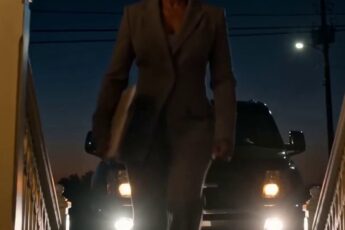
The roses thudded into a puddle. Michael didn’t remember standing up, didn’t remember the walk down the gravel path or the iron gate he shouldered through. He only registered the parking lot, the drizzle, and a blue Honda CR-V idling by the curb.
The driver’s door opened.
A woman stepped out. She was thinner, her hair cropped short and dark instead of the long honey-blonde waves he remembered, but the shape of her mouth and the way she cupped her elbow as she stood — it was Rachel. It had to be. She pressed a hand to her face, and even from twenty feet he could see the way her shoulders heaved.
He didn’t walk. He ran.
She met him halfway, and his arms wrapped around a body that was solid and warm and trembling with sobs. She smelled of lavender and something sharp like coffee, and he buried his face in her neck because if this was a hallucination, he wasn’t giving it up.
“Michael,” she choked out. “Oh God, Michael.”
He pulled back just enough to touch her face, her jaw, her wet cheeks. “You died. I watched them lower the casket.”
She shook her head, tears mixing with the rain. “They never found a body. The kayak capsized, I hit my head on a rock. A fishing trawler picked me up two days later off the Oregon coast. I didn’t know my name. No wallet, no phone, nothing.” She sucked in a breath. “They called me Jane at the hospital. I didn’t remember you until three years later.”
Three years. He couldn’t let go of her. “You could have called. You could have come back.”
“By the time my memory returned, I had a new life, a new identity. The state had declared me dead. I didn’t even know if you’d still want me, or if you’d moved on. I was so scared, Michael.” Her voice broke. “But I never stopped looking. I hired an investigator who tracked you to this cemetery. And when I saw you sitting at my grave every Sunday, I knew I had to try.”
Sophie had walked up beside them, the photograph clutched against her chest. Michael looked at the girl, then back at Rachel. “She called you Mommy. But we couldn’t—”
“I hadn’t remembered who I was when Sophie was conceived,” Rachel said, her voice barely audible. “It was a brief relationship during the lost years. He left before I even knew. By the time my memory came back, Sophie was already two.” She met his eyes, raw and terrified. “She’s my daughter. I won’t ever apologize for loving her. But you — I never stopped loving you. I just didn’t know how to come home.”
The rain had lessened to a mist. Michael could hear Sophie humming a tune from some cartoon inside the open car. Five years of grief and a child with Rachel’s stubborn chin. He didn’t know what the right emotion was — betrayal, relief, jealousy — so he just reached out and took Sophie’s free hand.
“You get breakfast?” he asked her.
Sophie’s face lit up. “Pancakes?”
“Mountains of pancakes.” He glanced at Rachel, who was watching him with a hope so fragile it hurt. “Both of you are coming home. We’ve got five years of catching up to do, and I’m not wasting another second in this rain.”
Rachel let out a sob that was half a laugh, and then her hand was in his and Sophie was skipping ahead through the puddles, the photograph carefully tucked into her coat.
At the diner, Sophie drew a picture on the placemat with crayons: a tall stick man, a smiling stick woman, and a tiny girl holding a flower. She wrote MOM, DAD, and ME in crooked kindergarten letters.
Rachel squeezed Michael’s hand under the table, and he didn’t let go until the waitress came to refill their coffee. The headstone on plot 247 could wait. For the first time in five years, he had a living reason to leave it behind.