The Rottweiler stopped barking.
Buddy stood frozen in the high grass, his massive head aimed at the tree line like a loaded gun. No growl. No hackles, even. Just that awful stillness that makes a man’s mouth go dry.
I couldn’t breathe.
Behind me, in the rotting planks of the abandoned cabin, the letters were still there — C H L O E — scratched deep into the wood with something sharp, maybe a nail, maybe a stone. The dust on the floor told the rest of the story: a single bare footprint, small, the arch pressed hard into the floorboard as if she’d bolted from the corner. The edges of the print were still crumbling. Minutes, maybe less.
“She’s alive,” I whispered, and the words scraped my throat raw. “Chloe…”
That was when Buddy’s ears swiveled forward.
Someone stood between the pines. No, not someone — a shape, thin and dark, just beyond the first slant of morning light. It didn’t move. Didn’t run. Just watched.
My hand found the doorframe. I couldn’t tell if I was holding myself up or holding myself back.
Buddy took one step toward the tree line. Then another.
I didn’t call him off. Couldn’t. The dog hadn’t made a sound, but his whole body was talking in a language I’d forgotten I knew. His tail lifted. Swung once. Twice. A greeting.
My heart stopped because I understood. There was only one person on earth Buddy greeted like that.
She stepped into the pale morning.
First I saw her eyes, the same winter-sky blue I’d stared into the day she was born. Then the tangled rope of dark hair, too long now, unwashed but undefeated. And finally, the thing that made the world tilt under my boots — a tiny white scar cutting through the edge of her left eyebrow. The scar she got at seven years old when she crashed her bike into Mrs. Kerr’s mailbox on Oak Street and came up laughing through the blood.
I’d kissed that scar a thousand times. I’d dreamed it. I’d begged God to let me see it one more time.
The girl in the clearing opened her cracked lips, and the word that came out of her shook the trees.
“Dad…”
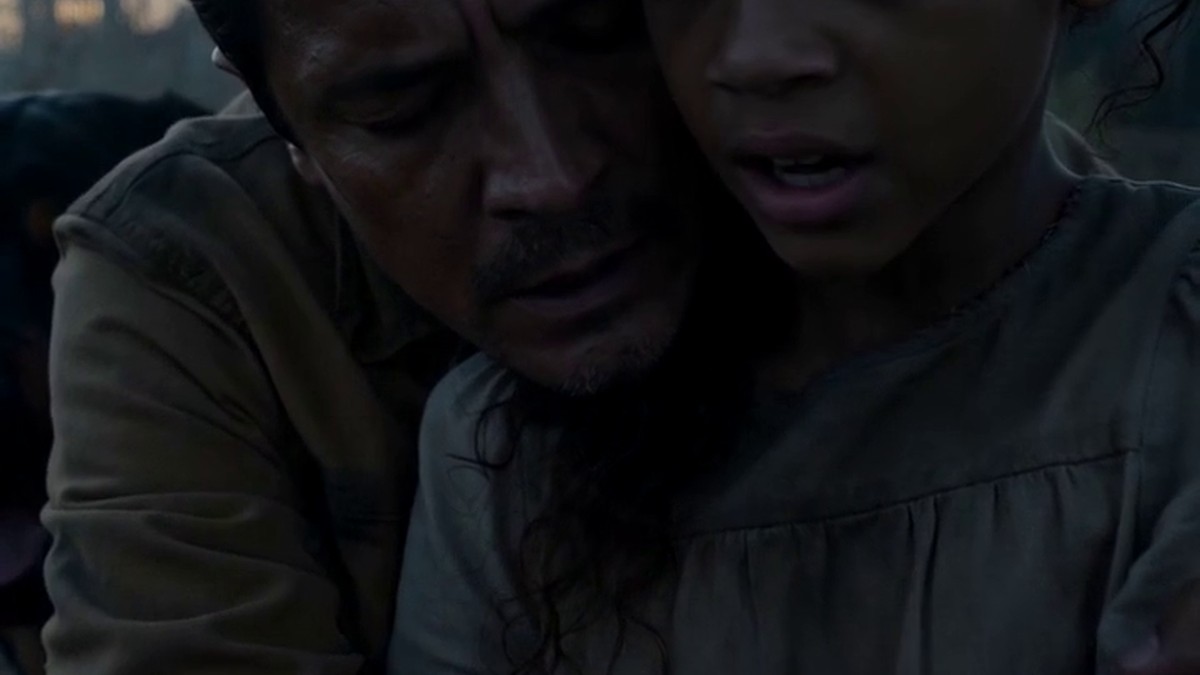
I don’t remember crossing the distance. I just remember the impact of her in my arms, all sharp angles and trembling bones, the sound she made against my chest that was half sob and half animal. She smelled like pine sap and smoke and fear, and she was real, so real I thought my ribs might break from holding her.
“I knew you’d come,” she choked into my jacket. “I knew you’d find the word.”
Buddy pressed against her hip, whining, licking her knuckles.
But Chloe pulled back. Her fingers clutched my wrist so hard her nails drew blood, and her face, already too thin, went pale as bone ash.
“He’s still here, Dad.” She didn’t blink. “He’s coming back. We have to go. *Now.*”
That was when the snap of a branch cracked through the clearing from behind me, from the cabin side, and Buddy’s whine curdled into a snarl.
I pushed Chloe behind my body and turned.
He stepped out from the far corner of the cabin. Six-four, maybe six-five. A slab of a man in a canvas coat smeared with old dirt, a hunting knife strapped to his thigh. The kind of man who doesn’t look insane until you find his eyes — flat, patient, and utterly unbothered by the sight of me standing between him and the girl he’d kept.
“I knew you’d track her here,” he said, and his voice was almost friendly. “That’s the thing about strays. They always run back where they marked their name.”
I didn’t answer. My mind was already doing the terrible math: him between us and the trailhead. No phone signal. Chloe barefoot, shivering, weeks without proper food. And Buddy — ninety pounds of aging muscle and the only weapon I had.
“You’re not taking her,” I said, and my voice didn’t shake.
The man smiled. It sat wrong on his face. “I already did. You just don’t understand the rules out here.”
He reached for the knife handle.
Everything after that happened in ten seconds that felt like ten years.
I grabbed the rusted length of rebar leaning against the cabin wall — a piece of debris I’d noticed earlier without knowing why — and threw it like a javelin. It didn’t hit him, but it bought me three steps, and three steps was enough to put my body between Chloe and the blade. The man lunged. I took the hit low in the shoulder, a hot gash that went numb before the pain even registered, and then Buddy hit him from the side.
A Rottweiler doesn’t need to be young when he’s got purpose. Buddy clamped onto the man’s forearm and pulled him off balance. The knife skittered into the ferns. I tackled him. We went down in a storm of pine needles and blood, his fists finding my ribs, my knees pinning his chest, Chloe screaming my name somewhere behind me. I remember the weight of a rock in my left hand, and then I don’t remember swinging it — only the sound it made, a wet, hollow crack that ended the struggle like a slammed door.
He went still.
Buddy released his grip, panting, his muzzle smeared red.
Chloe crawled to me, pulling off her ragged sweatshirt to press it against my shoulder. Her hands were shaking so badly she could barely hold pressure, but her voice, when she found it, was iron.
“He had a truck a mile down the logging road. A silver pickup. There’s probably a phone inside.”
We limped through the woods together — me, bleeding and dizzy; Chloe, her bare feet cut to ribbons but her spine straight for the first time in two years; Buddy, trotting ahead with a limp and his head high. The pickup was there, keys still in the ignition, a mobile phone on the dash with a single bar of signal.
I called the sheriff. Then I sat on the running board with my daughter pressed against my good shoulder, and I didn’t try to speak. I just watched the light shift through the pines and listened to her breathe.
Two years. She’d been taken from a bus stop in Reno on a Tuesday afternoon. The man had kept her moving between national forests, cabins like this one, places so remote the world forgot they existed. She’d found a broken nail file in a drawer and carved her name into the wall three weeks ago, hoping, hoping like only a thirteen-year-old stolen child can hope, that I was still looking.
I was. I never stopped.
Buddy laid his heavy head on her knee and closed his eyes. The old dog had done his job. The search dogs, the flyers, the years of waking up at 3 a.m. to my own useless anger — all of it ended right there in the dirt, with my girl’s hand in mine and the sound of sirens building far down the mountain.
When the deputies cuffed the man in the clearing, he was still alive. He’ll walk with a limp for the rest of his life, inside a cell. Chloe testified once, via video link, in a courtroom two states away, and then we never spoke his name again.
The cabin was torn down that spring. But before the county burned the last of the wood, I drove up one more time with Chloe and a can of paint. On the old beam where she’d scratched her name during the darkest weeks of her life, we painted over it in bright yellow. Below it, her handwriting this time, in permanent marker: *FREE.*
Buddy passed last June, old and full of days. We buried him under the oak tree in the backyard, wrapped in Chloe’s first baby blanket. She read him a letter she’d written before we filled the hole in. “You knew first,” it said. “You always knew first.”
Some nights, when she dreams too loud and her scar whitens against the pillow, I still walk the perimeter of the house, checking doors no one has breached in years. The habit won’t ever leave me. But when I come back inside, Chloe is always still there, safe, tangled in her blankets like she used to be when she was small. And Buddy’s old leash hangs by the door, a reminder of the moment in the clearing when a silent dog told me everything I needed to know with a single wag of his tail.
My daughter was alive. And I had found her.