The crystal chandeliers of the Grand Pacific Ballroom in downtown Chicago threw shards of light over silk dresses and tailored tuxedos. A string quartet played something soft and forgettable near the marble columns. I balanced a tray of champagne flutes on my left palm, the chill from the glasses seeping through the thin white glove. My uniform itched at the collar, and my feet already ached from the rental flats.
I’d been working catering for two years. I knew how to be invisible. Smile, nod, don’t make eye contact, don’t spill. But tonight, invisibility was the last thing on my mind.
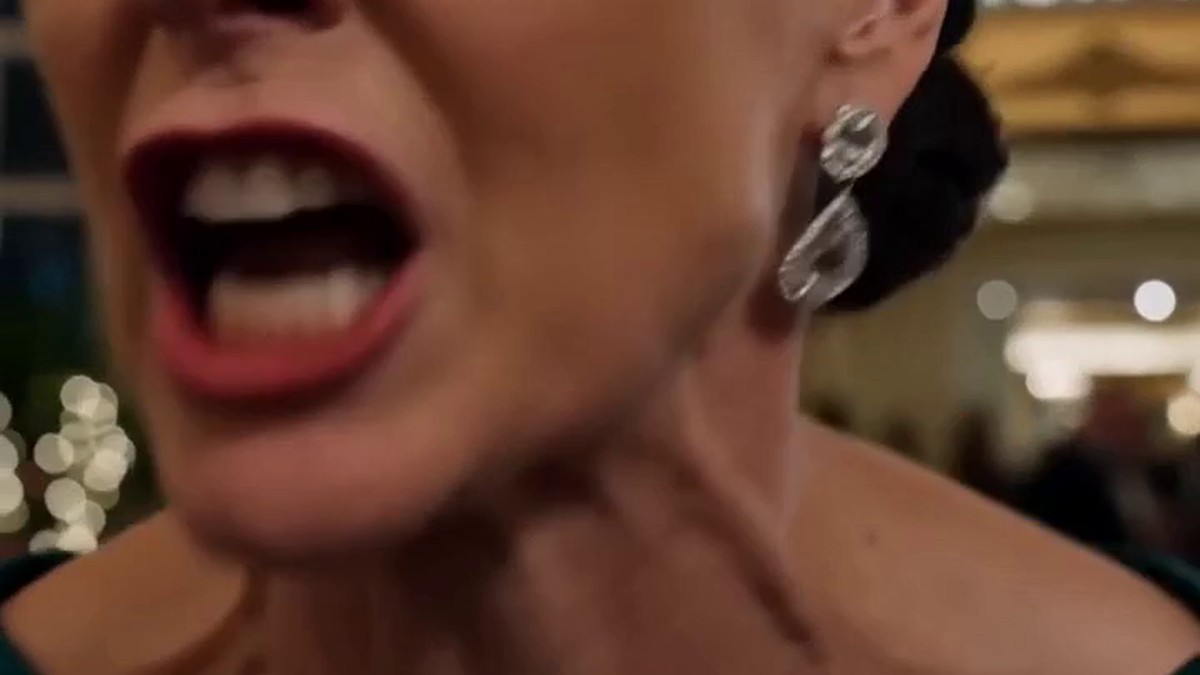
She stood near the grand staircase, one hand resting on the gilded railing, the other holding a half-empty glass of Bordeaux. Emerald satin hugged her figure, a slit up to her thigh, diamonds at her ears. Her hair was swept up in a way I’d only seen in magazines. She laughed at something a man in a gray suit said, tilting her head, exposing the small mole just below her right jaw.
I froze. My tray wobbled, and I felt the flutes tilt. I caught them, my heart drumming against my ribs.
It was her. Twenty-three years, and I’d have known that mole anywhere.
I started walking. Not toward the kitchen, not away from her. Straight through the clusters of guests, sidestepping a woman with a feather boa, ignoring the quizzical look from the event captain near the dessert table.
I stopped two feet behind her. The perfume hit me first—something spicy, expensive. I could feel the warmth radiating from her bare back. The man in gray glanced at me, already opening his mouth to tell me his wife didn't need another drink.
I tilted the tray.
Two streams of cold champagne cascaded down her spine. The green satin darkened instantly, the fabric clinging to her skin. She gasped, spinning around with a shriek that cut right through Vivaldi.
“You *idiot*!” Her face twisted, mascara already smudging. The man in gray stepped back, hands raised. “Do you have any idea what this cost?”
I just stood there. The tray still angled, the empty flutes rattling.
Then her palm connected with my cheek. The crack echoed. My head snapped sideways, and dots swam in my vision. Someone in the crowd let out a little “oh!” and then silence swallowed the room.
I didn’t move. I let the sting bloom, hot and sharp, all the way down to my jaw. My eyes watered, but I didn’t blink. I just looked at her.
She was breathing hard, her chest rising and falling under those emeralds. Her hand was still raised, trembling. The smear of red lipstick on her teeth from the snarl.
I put my fingers to my cheek. My skin was on fire. Through the blur of tears, I saw her pupils widen just a little—she was starting to see something familiar in the eyes staring back at her.
“What the hell is wrong with you?” she hissed, but her voice cracked on the last word.
I swallowed. My throat was dry. “Happy birthday, Gwen.”
Her name came out like a whisper, but it hit her like a second slap. She flinched. That hand finally dropped. Her mouth opened, closed, opened again. The man in gray said something, but neither of us heard him.
“What did you say?” She took a half-step back, wobbling on her heels. That tear I’d been holding back slid down my cheek and dripped onto my collar.
“I said happy birthday. You’re thirty-eight today. You always loved green.”
Her face crumpled. Not like a movie—slow, ugly, her nose running, her eyes wild with confusion and something that looked an awful lot like fear. She grabbed my wrist, her nails digging in.
“No. No, that’s impossible. You… you drowned. They told us you drowned in the river, twenty-three years ago.” Her voice went up an octave. “Who *are* you?”
“I’m Lily.” I pulled my hand free, gently, and touched the mole on my own jaw. The same one. “Your baby sister. The one you used to push on the swing at the old house in Oak Park. The one you called ‘Frog’ because I croaked when I laughed. I didn’t drown. Mom took me. She told Dad she was taking us to the park, but she drove to Nebraska and never came back. I’ve been looking for you since I was fourteen.”
The man in gray—her husband, I guessed—moved closer and put his hand on her shoulder. “Gwen, let’s go outside. We can talk somewhere quiet.”
Gwen didn’t move. She was staring at my mole, her lips trembling. All the arrogance, all the fury from ten seconds ago had drained out of her, leaving just a pale, shaking woman in a ruined dress.
“You’re dead,” she said, but it was barely a sound.
“I’m right here.” I took a deep breath and gestured toward the service hallway. “I have a break in fifteen minutes. The staff room has a bench. I’ll be there. You can come, or you can leave and pretend this was a weird prank. But I’m not going anywhere.”
I turned and walked away. The crowd parted like I was radioactive. Behind me, I heard her husband murmuring, and then the clatter of someone picking up a fallen clutch. I didn’t look back until I pushed through the swinging door into the fluorescent-lit back hallway.
Leaning against the wall, I let myself shake. The mark on my cheek was already turning purple. My supervisor, a stocky man named Diego, hurried over. “Ana, what the hell happened? Did a guest hit you?”
“It’s fine,” I said, waving him off. “She’s my sister. I deserved it. Sort of.”
Diego stared at me like I’d grown a second head, but before he could ask, the kitchen door swung open and a busboy stuck his head out. “Hey, there’s a lady out here soaked in wine demanding to see the waitress who attacked her. She’s crying. Do I call security?”
I pushed past him without answering.
Gwen stood in the corridor, her husband nowhere in sight. The green dress was ruined, her makeup a wreck, but she was there. Her arms were crossed tight over her chest, like she was holding herself together.
“You have a lot of nerve,” she said, but the anger was hollow. “Telling me you’re alive after twenty-three years, with champagne dripping down my back, in front of three hundred guests.”
“I sent you three letters over the last year. You never answered. I called your office. Your assistant said you don’t take personal calls. I had to get your attention somehow.”
She flinched. “Letters? What letters? I never got any letters.”
“The first one I mailed to the address of our old house. I didn’t know you’d sold it.” I pulled off my glove and rubbed my cheek. “The second one I sent to your husband’s law firm. The third one I slipped under your front gate eight months ago. I watched you pick it up. You threw it in the trash without opening it.”
The color drained from her face. I could see her replaying the memory, the manicured hand tossing the envelope into the bin by the pillar. She swayed, and I caught her elbow before she could stumble.
“I—I thought it was junk. I get so much junk mail. I didn’t know…” She grabbed my arm with both hands now, her fingers cold. “God, Lily. I named my daughter after you. I have a daughter named Lily. She’s twelve. She’s got the same mole. The same laugh.”
That hit me in the gut. I hadn’t known about a niece. The idea of a little girl with my name, somewhere in this city, laughing and swinging and not knowing I existed—it made the sting on my cheek feel like nothing.
Gwen sagged against the wall, her satin snagging on the rough paint. “Mom told us you ran into the river. She said she tried to save you but the current was too strong. They never found a body, but they said sometimes bodies don’t come back up. Dad drank himself into the ground over it. He died four years ago thinking his baby was at the bottom of the Des Plaines.”
“Mom never took me near water that day. We drove to a motel outside Omaha. She told me you and Dad didn’t want us anymore, that we were starting fresh. I didn’t believe her, but I was four. What was I supposed to do?” I felt tears running down my face now, warm and salty. “When I turned eighteen, I hired a private investigator with money from my waitressing tips. It took him two years to find you. By then, I didn’t know how to just show up. You had a life. A husband. A little girl named after a ghost.”
Gwen let out a sound somewhere between a laugh and a sob. “You poured champagne on me. At my birthday party.”
“You slapped me. Hard. We’re even.”
For a long moment, we just stood there in that ugly beige hallway, two sisters from Oak Park, one in a hundred-dollar apron and the other in a ruined designer gown. Someone on the other side of the door played a piano, oblivious.
Diego appeared at the end of the corridor. “Ana, your break’s almost over.”
Gwen looked at him, then back at me. “Ana?”
“She changed my name. Lillian became Ana. New life, I guess.” I shrugged. “I go by Lily again now. For the last five years.”
Gwen wiped her nose with the back of her hand, a gesture so un-ladylike it made me smile. She saw that and almost smiled back. Then she fumbled in her clutch and pulled out a phone, nearly dropping it twice.
“Put your number in this.” She shoved it at me. “Right now. And then I’m going to go out there and tell my husband I found my sister. And tomorrow morning, you’re coming to my house to meet your niece. Do you understand me?”
I took the phone. My fingers left a smear on the screen. “You’re not still mad about the dress?”
“It’s a dress.” She grabbed my wrist again, tighter this time, her eyes red-rimmed and fierce. “I’m not losing you again. Not over a dress, not over a slap, not over anything.”
I typed my number in, saved it as “Lily (Frog)” and handed it back. She looked at the name, and her face crumpled again, but this time she was laughing. The sound was wet and messy and absolutely perfect.
“You haven’t changed,” she said. “Still the dramatic one.”
“You cried first.”
We walked back into the ballroom side by side. The string quartet had switched to something brighter. Guests stared, whispers spreading like ripples in a pond. Diego stood near the kitchen, mouth open. Gwen’s husband rushed over, but she held up a hand.
“Everyone,” she announced, her voice shaky but clear, “I want you to meet my sister. She’s not a waitress tonight. She’s my family. And she’s taking the rest of the night off to have cake with me.”
Nobody cheered. It wasn’t that kind of crowd. But a few people smiled, and the man at the piano played a quiet chord like a punctuation mark. I untied my apron and left it on a chair.
We walked to the lobby, Gwen’s arm looped through mine, the damp satin sticking to both of us. Outside, the Chicago wind whipped down Michigan Avenue, cold and familiar. Gwen shivered in her ruined dress, and I pulled the cardigan from my bag and draped it over her shoulders.
“You always did run cold,” I said.
“And you always ran toward trouble.” She leaned her head on my shoulder for just a second. “I’m glad you ran toward mine.”
We stood there under the awning, the city glittering around us, two women knitted together by a mole and a slap and twenty-three years of silence. Neither of us said it would be easy. Neither of us knew if we’d actually like each other once the shock wore off. But tomorrow morning, I’d ring the doorbell of a house I’d never seen, and a twelve-year-old girl with my name and my laugh would open the door.
That was enough.