Claire stared past her reflection in the hallway mirror, the soft click of her pearl earring the only sound in the stifling quiet of the apartment. The pearls had belonged to her grandmother—a woman who had run a hardware store in Sioux Falls for forty years, and who would have laughed in the face of any man who told her to stay put. Claire fastened the second earring just as her husband’s voice, gravelly with sleep and entitlement, cut through the air.
“Where do you think you’re going, all painted up like that? Look at you. You look cheap. Wipe that stuff off your face and sit down.”
Derek leaned against the fridge, a half-empty Miller Lite in his hand despite the early hour. His flannel pajama pants hung low, his gut pressing against the worn cotton. He didn’t look at her with love, or even contempt—just the flat, proprietary gaze of a man who believed he owned every minute of her time.
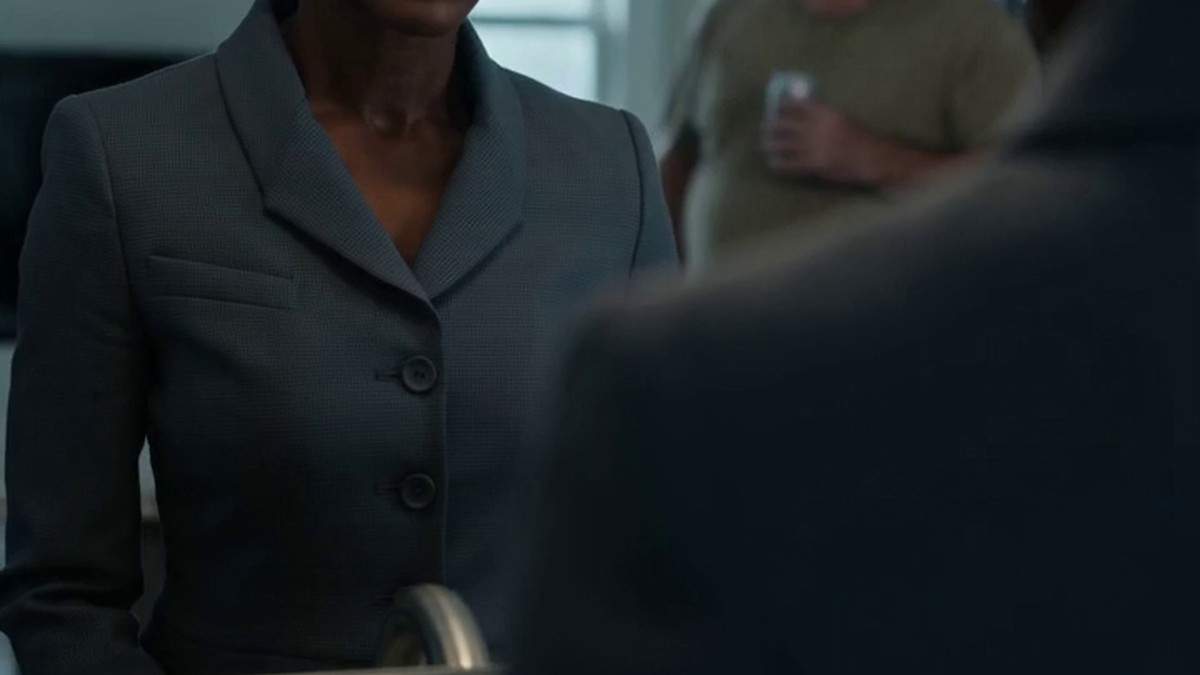
Claire didn’t turn. She smoothed the front of her navy blazer, a thrift-store find she’d hidden in the trunk of her Corolla for three weeks. “I’m going to an interview.”
“The hell you are.” The can hit the counter with a hard thud. Foam dribbled onto the laminate. “I didn’t say you could get a job. Who’s gonna make dinner? Who’s gonna watch the place?”
She finally turned, and the calm in her eyes startled him. For three years, she’d flinched, mumbled apologies, deferred. But the woman facing him now was someone he didn’t recognize—someone who had spent months learning to breathe underwater.
“I’m not asking, Derek.” She picked up her purse, a simple crossbody, and double-checked for the burner phone she’d bought at a Walmart three towns over. He didn’t know about it. He didn’t know about a lot of things.
“Claire, I swear to God—” He stepped forward, but she was already at the door, her hand on the knob. She didn’t slam it. She just pulled it closed behind her, the latch clicking like the final note of a song.
Derek rushed to the window and watched her walk across the parking lot, shoulders straight, not once glancing back. He snorted and took a long swallow of warm beer. She’d be back. Where else could she go? He’d made sure of that years ago, cutting her off from her friends, her colleagues, her own money. The idea that a folded note on the refrigerator door was already waiting for him never crossed his mind.
—
The city bus groaned down Main Street, past shuttered laundromats and a taqueria that hadn’t reopened since the pandemic. Claire pressed her forehead to the cold glass and replayed the message she’d received three weeks earlier. Dr. Naomi Redmond, her old marketing professor from the University of Nebraska, had reached out via LinkedIn—the one account Derek never thought to check because he thought social media was for “teenagers and unemployed losers.”
“Claire, there’s a brand strategist position opening up at Summit Creative. I thought of you immediately. The real you.”
The real you. Claire had read those words fourteen times in a locked stall in the public library, then deleted the message permanently. She’d set up the interview from the payphone at a Pilot truck stop outside town, whispering details to a receptionist as if she were planning a bank heist.
The building on Farnam Street was all glass and brushed steel, so different from the dim, cramped apartment where her ambitions had been slowly smothered. She stepped inside, the scent of espresso and printer toner hitting her like oxygen. Dr. Redmond—Naomi—met her in the lobby, eying her with a mix of relief and quiet fury.
“He still the same?” Naomi asked, not bothering with hello.
“Worse.”
The interview lasted an hour. Claire walked through campaign audits, SEO matrices, and funnel analytics with a precision that surprised even her. The knowledge hadn’t rusted; it had crystallized under pressure, waiting for a breach. By the time she shook hands with the creative director, she had a signed offer letter tucked into her blazer, a salary that was more than Derek had earned in two years, and a start date: Monday.
Twelve missed calls from Derek lit up her burner phone. She texted him a photo of the Corolla’s spare key, which she’d left under the office manager’s desk at his job site, along with three words: *Don’t contact me.*
Then she drove to her mother’s house on the west edge of town, where the yards were still big and the trees old enough to canopy the street.
Linda opened the screen door before Claire could knock. She was holding a dish towel and wearing the same skeptical look she’d had when Claire had announced the engagement four years ago. No interrogation. No tears. She just pulled her daughter inside and put the kettle on.
“I left him,” Claire said, staring at the bird feeder swaying in the backyard. A cardinal landed, then flew off.
Linda set a chipped mug of Earl Grey in front of her. “You want me to say ‘finally,’ or you want me to just sit here?”
Claire almost smiled. “Maybe both.”
The seeds of Claire’s escape had been planted ten months earlier, on a freezing February afternoon when she’d found a crumpled receipt from a jewelry store in the glove box of Derek’s truck. The line item—a diamond tennis bracelet for $3,200—was circled, with a date two days before Valentine’s Day. She had received a $14 crockpot from Walmart. She never mentioned it. Instead, she started building a wall, brick by invisible brick.
Derek controlled every visible bank account, doling out grocery money like an allowance, demanding receipts and justifications. But he didn’t know about the savings account she’d opened at a credit union during their first year of marriage, back when she still worked at the ad agency. With surgical patience, she began siphoning tiny sums—twenty dollars from the grocery envelope here, fifteen from the gas money there. She switched to generic brands, walked instead of Ubered, sold old textbooks online from a library computer. By August, she had six thousand dollars tucked away, enough for a deposit on a small apartment and a retainer for a lawyer, if it came to that.
While Derek slumped in front of football games, she stayed up past midnight, her laptop screen dimmed to its lowest setting, devouring courses on digital strategy and Google Analytics. She learned to read the rhythm of his snoring, to slip out of bed without disturbing him, to build a new life while he dreamed of nothing.
The Saturday after her job offer, Claire returned to the apartment while Derek was at his brother’s house, a weekly ritual he’d kept for years. She moved with a ghost’s efficiency, packing two suitcases: her grandmother’s pearls, her diplomas, a box of business suits she hadn’t worn since the Obama administration. She left the furniture, the wedding photos, the crockpot. On the refrigerator, she stuck a yellow Post-it note with three words in her neat handwriting: *I’m not coming back.*
When Derek found it, he called her twenty-seven times in an hour. She blocked his number and poured herself a glass of wine at her mother’s kitchen table.
Life at Summit Creative bloomed. Claire’s days filled with pitch meetings, creative briefs, and the rhythmic clack of a keyboard she chose for herself. She rented a studio apartment on the third floor of a converted warehouse, with exposed brick and a window that faced east. She bought a peace lily and named it Vindication. For the first time in years, she slept through the night without dreaming of locked doors.
But ghosts don’t vanish just because you change addresses. One evening in late October, an unknown number lit up her screen. “Claire, this is Evelyn Morris. Derek’s mother. We need to talk. It’s about a loan.”
They met at a Panera Bread on Dodge Street, a bland, neutral ground that smelled of broccoli cheddar soup. Evelyn was exactly as Claire remembered: a steel-haired woman in a camel coat, a retired county clerk who had raised her son to believe that accountability was something that happened to other people. She didn’t waste time on pleasantries.
“He took out a personal loan. A big one. Ninety-four thousand dollars, three months ago.” Evelyn’s voice was flat, clinical. “He forged your signature on the co-signer forms.”
The room tilted. Claire gripped the edge of the table, her knuckles white. Ninety-four thousand dollars. Debt tied to her name, her credit, her future. For a long moment, all she could hear was the hiss of the soda machine and the tinny chorus of a pop song from the overhead speakers.
Then the fear passed, replaced by something colder and far more useful.
She hired a lawyer the next morning. Leonard Briggs was a family law attorney with thick glasses and a slow, deliberate manner that belied a pit-bull tenacity. He filed a motion for a declaratory judgment, demanding the bank produce the original loan documents. The handwriting analysis took six weeks. The fraud was so obvious—Derek had misspelled her middle name—that the bank’s own investigator recommended criminal charges.
The court hearing lasted two days. Claire sat in the gallery, stone-faced, as Derek’s lawyer tried to paint her as a vindictive ex-wife. But the evidence was a fortress: the burner phone records, the credit union statements proving her financial independence, the testimony of a handwriting expert who called Derek’s forgery “amateurish at best, laughable at worst.”
Judge Patricia Okonkwo, a woman with a voice like smoked glass, read her ruling without a flicker of emotion. The debt belonged solely to Derek Morris. The forged signature rendered the co-signer obligation null and void. The court would forward its findings to the district attorney’s office for potential criminal review.
Claire walked out of the courthouse into a crisp November afternoon, the sky a high, pale blue. She stood on the steps for a full minute, feeling the sun on her face, and then she did something she hadn’t done in years: she laughed. It wasn’t hysterical. It was the sound of a lock finally turning.
By spring, she had led a campaign for a regional hospital system that earned Summit Creative a Clio nomination. Her name appeared in the credits, her photo in a company-wide email. She framed the email and hung it above her desk.
Her mother visited for Easter, bringing a Tupperware of ham and a bottle of Moscato. They sat on the floor, eating off paper plates, because Claire’s furniture still consisted of a mattress and a card table. Linda looked around the sunlit room, at the peace lily thriving on the windowsill, at the stack of marketing journals by the bed, at her daughter cross-legged and barefoot, wearing a faded UNL hoodie and no trace of the woman who used to whisper and tiptoe.
“You seem different,” Linda said.
Claire tilted her head. “Good different?”
Linda shook her head slowly, a small smile breaking through. “No. Just… you. Finally you.”
Later that evening, after her mother left, Claire stood by the window, a mug of tea warming her hands. The city lights flickered on below, a grid of possibility stretching toward the Missouri River. In the glass, she could see her own reflection, solid and unmistakable. No shadow behind her. No voice telling her she couldn’t.
She had spent three years looking at the floor, navigating a minefield of someone else’s rage. Now she had the luxury of simply standing still, watching the quiet, terrifying, beautiful expanse of a life she had always deserved to call her own.