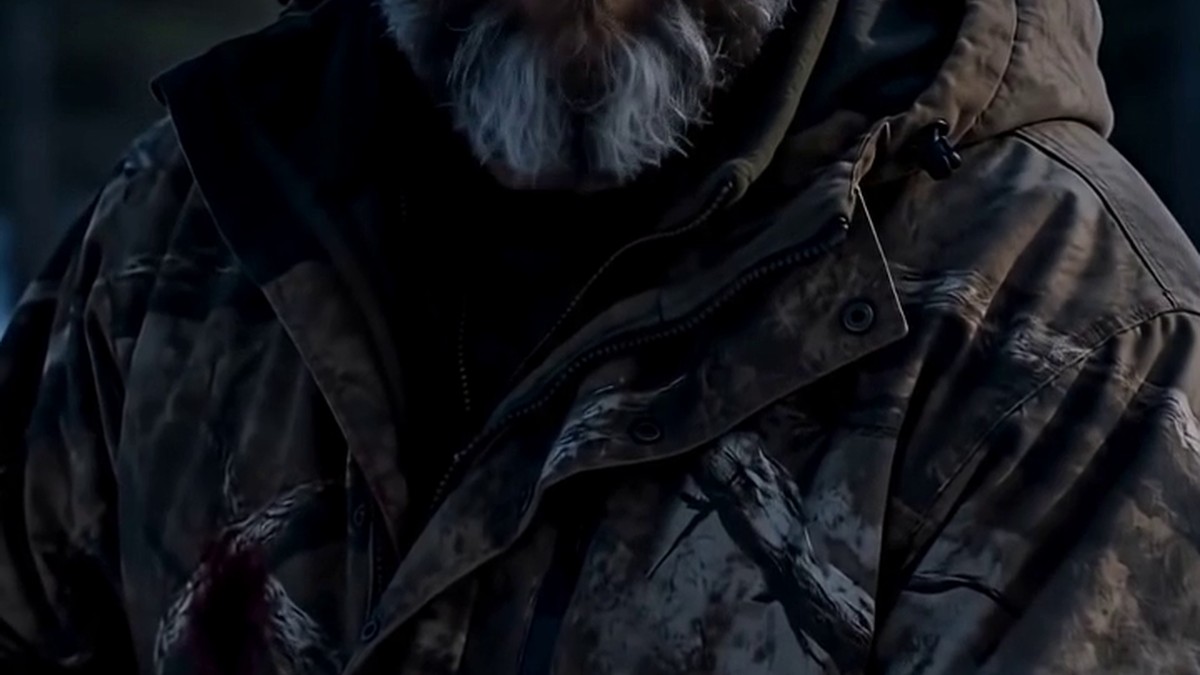
A thin, desperate cry stopped him cold. It was barely a sound—more a vibration in the frosty air—but after twenty-eight years as a backcountry ranger, Mike Hanson knew the difference between a jay’s squawk and something dying. His dog, a mud-colored mutt named Gus, froze ten yards ahead, a low whine caught in his throat.
Mike edged toward the rim of the outcropping. The drop below was a sheer slab of ice-veined basalt, where the wind off Mount Jefferson scraped the edge clean. He moved cautiously, one hand on a frozen juniper, and peered over.
A Canada lynx hung from the lip of the cliff.
The big cat’s front claws were sunk into a crack, her body dangling over a sixty-foot freefall to the rocks below. Her back legs churned uselessly against the stone. One hind leg was slick with blood, a dark, crusted gash that matted the fur. She tried to heave herself up, but the effort only sent pebbles skittering into the void. Her yellow eyes found him—wide, burning with pain and terror, not the cold menace of a predator. She snarled, a weak, wet sound, and one forepaw slipped.
Mike’s gut dropped. Five years without Janie. The empty half of the bed, Gus parked at the foot like he was guarding a ghost. He looked at the lynx’s belly, the slightly distended teats. A mother. Hell.
He dropped to his belly on the cold stone, snow crunching under his Carhartt jacket.
“Easy now… easy…” he breathed.
He stretched his arms over the lip. The lynx flinched, a claw raking the air. Mike grabbed her just above the elbows—thick, dense muscle—and immediately felt the strain rip through his shoulders. She was heavier than she looked, a solid forty pounds of sinew and panic. The snow under his chest gave a soft, grinding crunch as he pulled.
The lynx fought him, hissing, her damaged leg thrashing against the rock. He felt his own boots scrape for purchase, his heart slamming against his ribs. She slipped again, a sudden dead weight that nearly yanked him over. He locked his elbows and screamed through clenched teeth, a raw, wordless sound that echoed off the cliff. Inch by inch, he hauled her upward, her body a wet, shivering wreck against his forearms. Finally, with a last explosive pull, she rolled onto the snowy ledge beside him, gulping air.
Mike collapsed onto his back, gasping. He expected her to bolt—or to turn on him. Expecting it, he kept an arm up, shielding his throat.
She didn’t.
For a long, frozen moment, the lynx lay there, her flank heaving. Then she lifted her head, turned those gold-coin eyes on him, and let out a low, rumbling chirp—a sound no wild cat should make at a man. She closed her eyes briefly, as if in exhaustion, and then, with a clumsy, three-legged shuffle, she vanished into the timber. The snow swallowed her without a trace.
Mike sat up. Gus whimpered, pressing his nose into Mike’s neck. He stared after the lynx for a full minute, the echo of that chirp still vibrating in his chest.
—
Two days passed. He walked his normal patrols, fixed a stretch of boundary fence, tried not to replay the moment. But nothing felt normal. A neighbor, a fishing guide named Roy, stopped by to mention he’d seen fresh ATV tracks near the old fire road. “Poachers, probably. Saw some bloody snares last month. You might want to keep that sidearm handy.” Mike nodded and checked the clip in his Sig Sauer P226 nine-mil. The forest had always had a few bad actors, but lately it felt different. Darker.
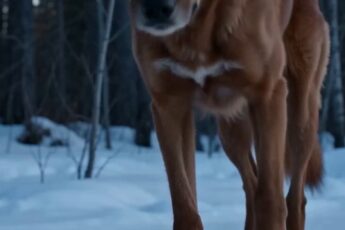
At dusk on the third day, he was splitting firewood behind the cabin when Gus started barking—not the frantic alarm bark for a stranger, but a low, insistent woof. Mike turned. Temperature had dropped to maybe five degrees. At the edge of the clearing, half-hidden by a hemlock, stood the lynx.
She looked worse. The leg wound had crusted over but was swollen, her ribs sharp under the patchy fur. She swayed on her three good pads, then turned her head deliberately, as if making sure he was watching, and limped back into the trees for five yards. Then she stopped, looked back at him again, and gave that same trilling chirp.
No way, Mike thought. Wild things didn’t lead people. That was Disney bullshit. But she did it again—took a few limping steps, stopped, looked back. Like waiting. Gus nosed his hand and whined. Whatever this was, the dog wanted to go. Mike grabbed his rifle—Winchester Model 70, .30-06—a flashlight, and the first-aid kit, and he went. Gus stayed close, bristling. The lynx led him off-trail, through a dense thicket of vine maple and fallen alder, her pace agonizingly slow. Mike kept his doubts, but his feet kept moving. A mile in, they broke into a small hollow near a creek, and his stomach turned.
A snare wire, vicious and crude, was cinched around the leg of a lynx kitten. The cub, no bigger than a house cat, whimpered and struggled, its black-tufted ears flat with fear. Its fur was matted with blood from a shallow gash on its flank. The mother hobbled to the trapped baby and licked its head, then fixed Mike with a stare that held every ounce of what she couldn’t say.
Behind the cub, a camp. A tent patched with duct tape, empty beer cans, a pack of Marlboro Reds, and a pile of dried pelts—fox, beaver, even a small wolf. The snare was fresh. The poachers would be back.
Mike had just freed the cub’s leg and was wrapping it in a strip of his T-shirt when he heard the voices.
“I’m telling you, that big bitch is still around. I hit her, I saw the blood. We find her, that pelt’s worth a grand.”
“Yeah, and that cub makes good bait. Relax, they ain’t far.”
Two men crashed through the brush. Both wore filthy camo and carried rifles. One, a heavy guy with a salt-and-pepper beard, spotted Mike first, and his rifle barrel started to rise. The other, younger and wiry, froze, his hand going to a knife on his belt.
Mike stood, putting his body between the poachers and the cats. His own rifle stayed slung across his back, but his right hand rested on the Sig at his hip. Gus growled, planted right beside the hurt cub.
“Shut it down,” Mike said, voice flat. “Step away from the guns.”
The bigger one laughed, a wet, nervous sound. “Or what, ranger boy? This your new pet project?” He took a step forward. “We got a right to run our traps.”
“Not in a national forest. Not with illegal snares. Not poaching lynx. You wounded that female, which is a felony under the Endangered Species Act. Put the weapons down, both of you. Now.”
The younger man’s knife hand twitched. Mike’s eyes never left him. The standoff tightened like a coiled spring. Then the mother lynx let out a long, unearthly yowl—part pain, part fury—and the big man flinched, his rifle jolting off-target. In that splinter of a second, Mike drew and fired one shot into the dirt six inches from the man’s boots.
The crack split the hollow. Both poachers stumbled back. Mike’s Sig was now leveled, steady.
“I said, on the ground. Face down.”
The younger one dropped instantly, cussing under his breath. The big man hesitated, his jaw working. Then the lynx slunk out from behind Mike, her lips drawn back, a deep rattling growl vibrating her chest. She limped straight toward the man, her eyes fixed on his. He let the rifle slip from his fingers and went to his knees, hands up.
Mike secured them both with zip-ties. He grabbed his radio—a Motorola HT1000—and keyed the mic. “Dispatch, this is Hanson. I’ve got two male suspects in custody, illegal trapping, endangered species. Mile marker seventeen on the old fire road, half a mile south of the creek fork. Need a state trooper and Fish and Wildlife.”
The radio crackled. “Copy, Ranger Hanson. ETA forty minutes.”
Mike stood there in the cold, the lynx mother now settled a few yards away with her cub tucked under her. She didn’t purr, didn’t approach. Just watched him with those unreadable gold eyes. Gus lay down between Mike and the cats, panting softly.
When the trooper and a wildlife officer finally hiked in, Mike handed over the two men along with the pelts and the photographs he’d taken on his phone. The younger poacher was still muttering; the big one said nothing. The wildlife officer, a woman named Delgado, looked at the cub and the mother, then at Mike. “They’d have died out here,” she said. “You did good. Transport for the cats is twenty minutes behind us.”
Mike just nodded.
—
The cub’s leg healed, though it would always have a slight hitch. A vet at the rehab center said the mother was healing too—“mean as a sack of hornets, but she’s alive.” She never called her by any name, just “the female.” Mike visited once. The lynx glared at him through the chain-link, but her cub hobbled over to the fence and sniffed his fingers. No chirp this time. He was fine with that.
On a cold morning in early December, Mike opened the cabin door to a soundless world of fresh powder. A dead snowshoe hare lay on the porch, still warm. A single set of lynx tracks led away from the house, then looped back and disappeared into the trees. He looked up and caught a flash of tawny gray between the hemlocks. Two sets of golden eyes stared back at him for a long, quiet moment. Then they vanished, leaving only the weight of a gift on the porch and the soft crunch of snow settling under his boots.