The text from my son landed like a blade.
"You can’t come to graduation," Gabriel wrote. "Look at your hands, the way you walk — you’d embarrass me in front of the Prescotts. Stay home. For once, think about my future."
I stared at the screen, my twisted fingers trembling around the phone. Thirty years of kneeling on Chicago’s finest marble, scrubbing until my skin burned from chemicals, had left me with hands that looked like crumpled tissue paper and a limp I could never hide. Every cent of my wages had gone into an envelope, then a savings account, then directly to Northwestern University’s medical school — for him. My only child. The boy whose father left before he could speak, the boy I promised would never have to break his own body for a living.
He had met Alexandra Prescott during his second year of residency rotations. She was the polished daughter of a healthcare billionaire, her smile as dazzling as the diamond on her finger. Gabriel had stopped inviting me to anything after that. I became a secret. He invented a backstory: I was a European art dealer, too busy enjoying my retirement in Tuscany to attend family gatherings.
That graduation morning, I sat at my kitchen table and wept until my chest ached. Then I pulled on my best dress — a faded navy thing I’d bought at a thrift store twelve years ago — and took the bus across the city. I wasn’t going to cheer for him. I was going to bear witness, even if he never knew I was there.
The auditorium at Northwestern’s Chicago campus was an ocean of burgundy robes and proud parents. I slipped in through a side door and found the last row of the upper balcony, where the shadows swallowed my uneven silhouette. Through scratched bifocals, I scanned the VIP section below.
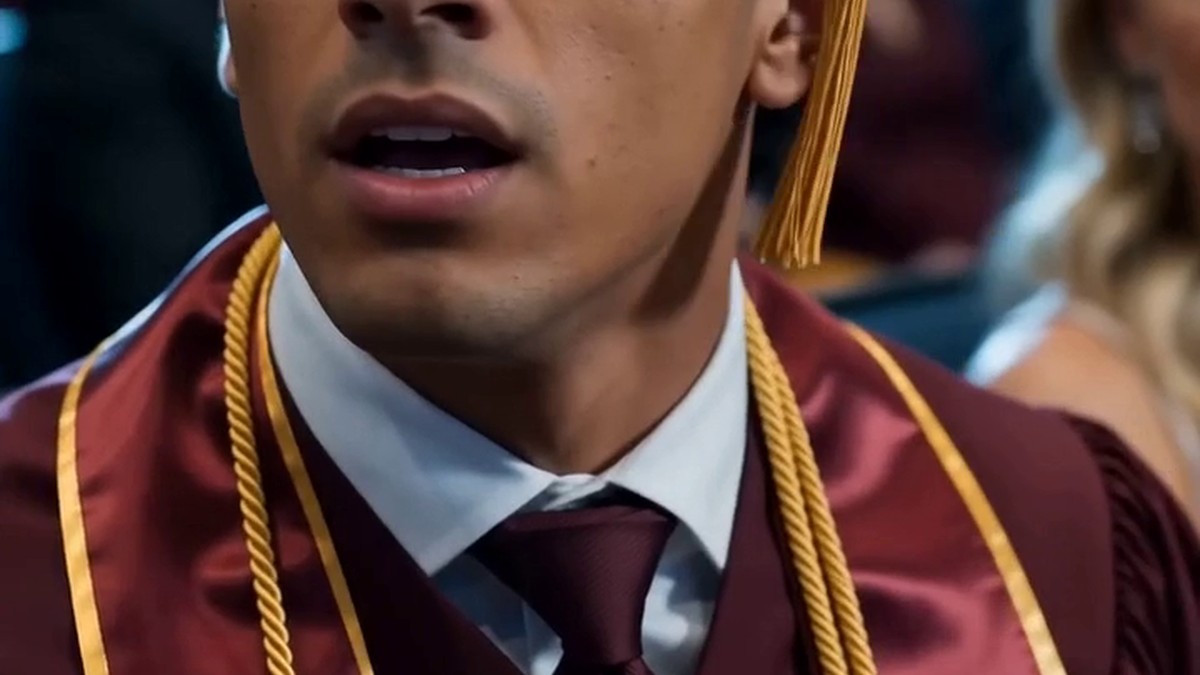
Gabriel sat near the center aisle, golden honor cords draped around his neck, his posture radiating the easy arrogance I’d paid for. Beside him, an empty chair — the ghost of me. Next to that, Alexandra beamed, her manicured hand resting on his arm. Her parents, Harrison and Elise Prescott, occupied the seats beside her, Mr. Prescott’s cufflinks glinting under the stage lights.
I could hear the conversation Gabriel had crafted: "My mother is in Paris, closing an auction. She desperately wanted to be here." The lie was so smooth it probably felt like truth to him.
Then I noticed Mr. Prescott lean toward his wife, his brow furrowed. "The president assured me the donor would attend," he murmured. "This partnership — the Foundation’s entire involvement — exists because of her. If she doesn’t show…"
Gabriel caught the whisper. A familiar, hungry flicker ignited in his eyes — the look of a man calculating how to turn a stranger’s generosity into his own advantage. He probably imagined some elderly philanthropist in Chanel, someone he could charm at the reception. I almost laughed. Almost.
The university president, Dr. Eleanor Glenn, stepped to the podium. The room hushed.
"Today, we inaugurate a historic award," she said, her voice rolling through the speakers. "The Lifetime Hero Award. This is not for academic achievement. It honors an anonymous benefactor whose endowment has quietly paid tuition for dozens of our most promising students over the past decade. A woman who never attended college, who never sought recognition. A woman who destroyed her own body for the chance to give someone else a future."
She paused. The silence was absolute.
"Tonight, we reveal her identity. Please welcome — Dolores Reyes."
My name. The name I’d signed on the bank drafts, never imagining it would be spoken aloud in this cathedral of privilege.
For a moment, I couldn’t move. Then instinct took over. I rose from the darkness, my cane tapping against the concrete floor as I limped toward the staircase. Murmurs rippled through the crowd.
Down the aisle I went, my gait unsteady but my spine straight as I’d taught myself to carry it under the weight of mop buckets. As I reached the VIP section, Gabriel turned his head — first casually, then with dawning horror.
Our eyes met.
The self-assurance on his face shattered. His mouth opened and closed. He jolted to his feet, half-reaching toward me as if to block my path, but his body locked in place, paralyzed by the impossibility of my presence. Alexandra stared, confused. Harrison Prescott leaned forward, squinting at the woman whose name he’d just heard.
"Mom—" Gabriel rasped, too quietly for anyone but me.
I didn’t stop. I walked past his row, my cane leaving soft thuds that echoed like a bell in the silent auditorium. I heard Alexandra whisper, "Gabriel? Who is that? Is that your… mother?" Her voice climbed with disbelief.
Dr. Glenn extended a hand to help me up the stage steps. When I finally turned to face the sea of faces, I saw that many were already on their feet. The ovation began as a ripple, then a crashing wave. Medical students, professors, parents — they understood the weight of what the president had just described. A cleaning woman. A lifetime of floors.
Dr. Glenn handed me a crystal plaque, warm to the touch. "Tell them," she said softly.
I adjusted the microphone. My voice came out steady, the way it did when I used to sing Gabriel to sleep in our single-room apartment.
"Thirty years ago," I said, "I kneeled on the marble floors of the Drake Hotel and promised myself that my son would never have to kneel for anyone. I couldn’t afford a single textbook, so I started a fund. I didn’t know it would grow. I only knew I had to keep scrubbing."
I looked down at Gabriel. He had collapsed back into his seat, his head in his hands. Alexandra was rigid, a mask of cold fury replacing her charm. Harrison Prescott stood slowly, his expression unreadable. Then, without a word, he began to clap — measured, deliberate, a sound that cut through everything.
"I remember the day you applied for the Prescott Foundation scholarship, Gabriel," I continued, addressing my son for the first time in this public arena. "I was the one who reviewed your application. Anonymously. I approved it myself. You were so talented, so driven. I wanted you to have every advantage I could steal from my aching body. And when you asked me not to come today, I almost obeyed. But I realized — if I’ve taught you nothing else, I can at least teach you that the woman you’re ashamed of is the only reason you’re here."
The silence that followed was so absolute I could hear a sob catch in someone’s throat.
Alexandra snatched her purse from the floor. "You told me she was in Europe," she said, the words clipped and cutting. "You told me your family had a foundation. Did you even…" She didn’t finish. She turned and marched toward the exit, her heels striking like gavels. Mr. Prescott gave Gabriel a long, searching look — not angry, but deeply disappointed — and then followed his daughter. Mrs. Prescott paused only to meet my eyes and mouth something that looked like "Thank you."
Gabriel scrambled out of his seat. "Mom — please, I can explain —"
I stepped off the stage, the plaque clutched against my chest. "Explain what, son? That you were ashamed of these?" I held up my scarred hands, the fingers that had fed him, washed him, worked themselves into deformities for him. "Or that you forgot that every floor I scrubbed was so you could stand tall? I never wanted your gratitude. I wanted your honesty. Instead, you turned me into a lie you couldn’t keep."
He reached for me, tears streaming down his cheeks now, but I stepped back. "I love you," he said, his voice broken.
"I know you do," I said softly. "But love isn’t hiding someone in the shadows. I’ve lived in shadows my whole life. I’m done." I looked past him at the crowd, at the faces that reflected not pity but profound respect. "I didn’t come for you today. I came for me. For the woman who deserved to walk into this room with her head high. And I just did."
I didn’t stay for the rest of the ceremony. I made my way to the lobby, where a few older women — mothers in simple dresses who had perhaps also scrubbed floors and strained budgets — approached me with tear-bright eyes and hands outstretched not for a handshake but for an embrace. I held them, and I let myself be held.
Gabriel found me an hour later, sitting on a bench outside the auditorium, watching the sunset eat into the Chicago skyline. He looked smaller, his robe gone, his face hollowed out. He sat beside me without a word.
"I lost her," he finally said. "Alexandra said she can’t marry a man who’d discard his own mother."
I didn’t gloat. I just nodded. "Maybe you needed to lose a few things, mijo. Maybe you were holding too tight to the wrong ones."
"I’ll spend the rest of my life making this right," he whispered.
"Then start tomorrow," I said, rising. "I’m going home to make myself some tea. With my knees up. You know how long it’s been since I sat in a chair I owned and did absolutely nothing?"
He choked on a laugh. "Can I… call you tomorrow?"
I looked at him — my son, the doctor, still somehow the little boy with a scraped knee asking for a bandage. "You can call. Whether I answer is a lesson you’ll have to earn."
As I walked toward the bus stop, the weight of the crystal plaque in my bag felt lighter than the years I’d carried. The city lights flickered on, one by one, and I imagined every floor I’d ever cleaned reflecting them now, shining not for the wealthy feet that walked on them but for the woman who had learned to shine in spite of everything.
I didn’t know what tomorrow would bring, but for the first time in thirty years, I knew I’d meet it on my own two feet — one step at a time, with a limp that told a story instead of a secret.