"Get out. Now."
The piano's first wrong note passed before anyone understood what they'd heard.
It didn't stop. Not immediately. Just a slight stutter — barely there, the way a pulse hiccups under sudden dread.
Then the doors swung open.
Cold night air pushed inside, sliding across warm lamplight and polished marble like something uninvited.
And she walked in.
A little girl.
Seven years old. Maybe eight.
Too small for the room. Too breakable for what was about to happen inside it.
Her dress had seen better years — the fabric washed pale in uneven patches, worn thin by weather and time. The hem unravelled at the edges. The sleeves were mismatched, one shorter than the other. Her shoes — whatever they'd once been — had split along the sides, the soles so thin that each step produced a soft, whispering drag across the marble.
She was carrying a plate.
Empty.
Not raised toward anyone. Not offered.
Pressed against her chest like a shield. As if she let go, she might stop existing altogether.
For one suspended second, nothing moved.
The restaurant held its shape — that perfect, expensive illusion. Crystal chandeliers blazed overhead. Wine glasses caught the light and threw it back like scattered diamonds. Soft laughter drifted between white-linen tables trimmed in gold.
Guests in tailored jackets and silk dresses slowed mid-gesture. Not from concern.
From confusion.
Because she was wrong for this place. Every inch of her.
In a room where a single watch on someone's wrist cost more than a life lived outside those doors — she had no business being here at all.
Then —
A chair scraped back.
Too loud. Too sudden.
The spell cracked. Heads turned. Eyes followed. Judgment traveled faster than any sound could.
A guard moved forward.
No hesitation. No questions. No second look.
His uniform was pressed to perfection, cut to match the standards of the establishment he served. Everything about him communicated order, hierarchy, and exclusion — three things she embodied none of. His arm shot out. Not violent enough to cause a scene. Just forceful enough to make a point.
It caught her across the chest and stopped her cold.
The plate shook in her hands. Porcelain rattling against small, exhausted fingers.
"Get out. Now."
The words didn't echo through the room. They didn't need to. They settled into the air the way a sentence does when it's been rehearsed so many times it no longer requires emphasis.
The girl didn't answer.
Not because she failed to understand. But because she had heard it before. In different doorways. From different mouths. With the same meaning every single time.
She stepped back. Her weight shifted. For a moment she held steady.
Then her foot caught wrong. Just barely. Just enough.
The second guard closed in.
Bigger. Closer. Quicker to anger.
He didn't knock her down. Didn't have to. The way he moved into her space — crowding it, erasing it — said everything a shove would have.
"You don't belong here."
That one hit differently.
Not louder. Not crueler. Just final. Like a door shutting on every possibility before she could even raise her hand to knock.
Her grip gave way — not by decision, but by surrender. The body releasing what it had carried too long.
The plate tilted. Held. But her shoulder dropped, and the small canvas bag hanging from it did not.
It hit the marble with a dull, hollow sound. The kind that doesn't demand attention. It just makes you feel that something is wrong.
The contents spread slowly. No drama. No cascade. Just enough to be visible.
A few pieces of bread. Dry. Irregular. Saved, not given.
An old photograph. Corners bent, surface worn soft from hands that had held it far too many times.
A folded square of cloth. Thin. Kept with care.
The room stilled. Not from compassion. From spectacle.
Because when poverty steps into a room like that, it becomes something to observe — a curiosity, an inconvenience, a conversation piece for later in the evening. A few guests leaned forward slightly, trying to see without seeming to look. One man exhaled a low laugh. Another pivoted deliberately back to his wine glass, refusing to let the disruption claim any more of his attention.
The piano stumbled again.
This time, it stopped entirely.
The silence that settled was not calm. It had weight.
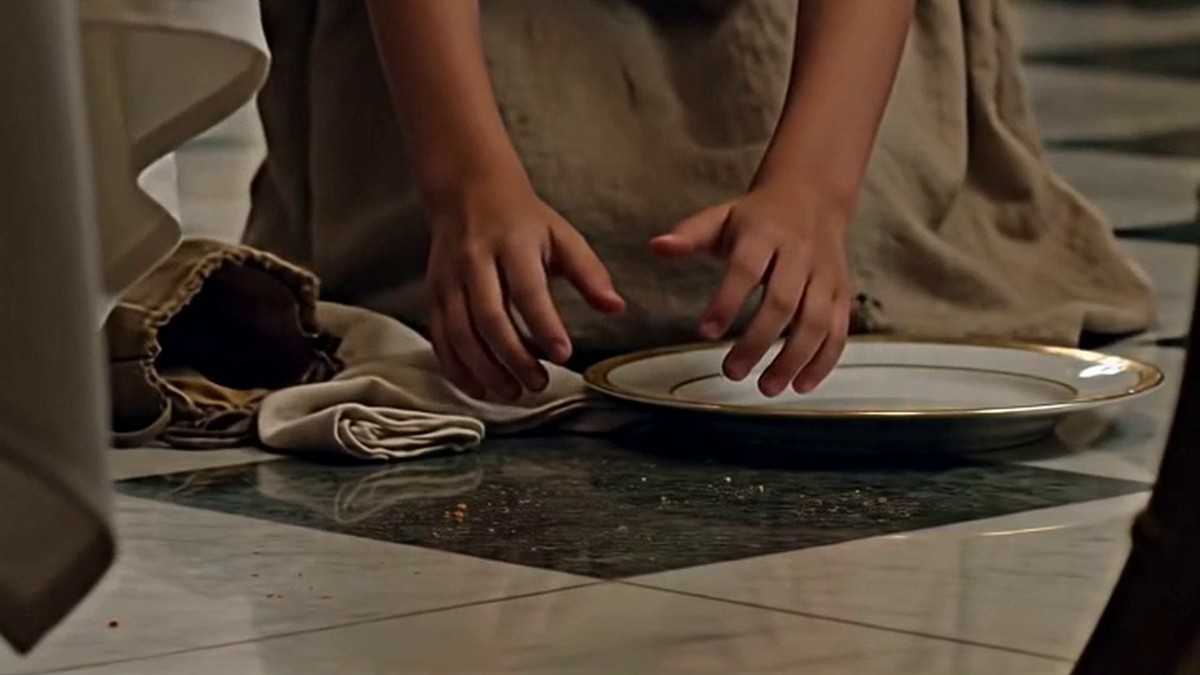
The girl went down on her knees. Not in collapse. Not in shame. Simply because her legs had finished their shift for the night.
Her hands moved fast — too fast for someone running on nothing. Reaching for the bread. Ignoring the dust. Ignoring the stares. Trying only to gather back what remained of what little she owned. Her fingers shook. Not from fear. From the kind of tiredness that lives in the bones.
She reached for a piece —
A polished shoe stepped forward. One sharp movement. The bread skidded across the marble. Scattered. Gone.
The second guard didn't look down. Didn't need to bother. He had already sorted the world into what mattered and what didn't.
The girl went still.
Her hand hung suspended where the bread had been a moment before. Then it lowered. Her head dipped. And for the first time since she'd walked through those doors — she stopped trying.
Across the room, at a corner table near the back, a man set down his fork. It hovered above his plate, trembling slightly, before he released it entirely and it came to rest against the china with a quiet click.
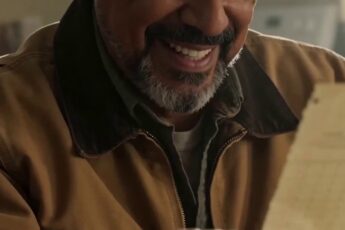
Adrian Vale.
Fifty-five, perhaps sixty. The kind of man who didn't need to announce himself in a room like this. The kind of man rooms already knew.
His eyes weren't on the guards. Weren't on the scattered bread. Weren't on the theater of it. They were fixed on something smaller. Something anyone else would have missed.
The girl's sleeve had ridden up. Just a fraction. Just barely. But under the chandelier's gold light, against skin far too pale for the warmth surrounding it — a mark. Distinct. Unmistakable.
His hand closed around the fork. The metal trembled. His jaw tightened, and he drew one slow breath through his nose, the kind a man draws when he needs a moment to be certain of what he's seeing before he allows himself to believe it.
He had last seen that mark on a birth certificate. On a hospital photograph. On the tiny wrist of his partner's newborn daughter — his goddaughter — the morning before the woman he'd loved like a sister went into surgery and did not come out, and before the child vanished from a ward that no one could adequately explain, taken by a man who was never found, into a city that had swallowed them both completely.
He had spent six years looking.
He set the fork down and stood.
The movement was quiet, measured — the stillness-in-motion that belongs to men who have spent decades crossing dangerous ground without announcing their steps. Yet the table shuddered slightly as he rose, and the wine in his glass tilted, recovered, settled.
No one noticed him yet. They were still watching the girl.
He crossed the room. Not quickly. Not slowly. Just — inevitably. The way water moves toward the lowest point without being invited.
The first guard saw him coming and adjusted his posture automatically. Recognition traveled through the man's eyes before his brain had finished processing it.
"Sir." The guard's voice had already recalibrated — softer at the edges now, uncertain where certainty had lived a moment before.
Vale didn't answer him.
He stopped in front of the girl. She was still on her knees, her hand resting against the cold marble where the bread had been, fingers slightly open — as though she had decided, somewhere in the last few seconds, that even the reaching was finished.
He crouched down. Slowly. Deliberately. Until they were level.
She looked up.
She didn't flinch. That was the thing that cost him a full breath. A child accustomed to cruelty learns to brace. She didn't brace. She simply looked at him with the steady, exhausted patience of someone who has lived long enough past hope that even a new threat no longer surprises her.
Brown eyes. Darker than the photograph. But the shape —
The shape was the same.
"What's your name?" he asked. His voice was barely above a murmur. The room pressed in around them, pretending not to listen with the intensity of people listening to every syllable.
She didn't answer immediately. Not defiance. Just the careful silence of a child calculating whether an answer costs more than a lie.
"Mara," she said finally.
The word dropped into his chest and spread outward, rings moving through still water.
He closed his eyes for exactly one second. Then opened them and reached into the inner pocket of his jacket. He produced a handkerchief — fine linen, initialled, the kind of object that belongs to a different century — and set it down beside her scattered things. Without ceremony, he began gathering the bread himself. Piece by piece. Setting each one on the cloth.
The room went genuinely silent now. The kind of silence that requires something to have broken.
The first guard shifted his weight. "Mr. Vale, this is a private establishment and the child doesn't have—"
"I know what she doesn't have."
He didn't raise his voice. He didn't need to. The guard went still.
Vale folded the handkerchief carefully around the bread, the small worn cloth, the photograph. He paused on the photograph. Turned it over in his hands just once. The guests nearest to him would later disagree about what expression crossed his face. Some would say grief. Some would say recognition. One woman, who had been watching him specifically, would say it was the look of a man identifying wreckage he'd hoped had survived the storm.
He set the photograph on top and pressed the parcel gently into the girl's hands.
She held it against her chest. The same posture as with the plate. The same instinct. You hold on to what you have left.
He straightened up and looked at the guards — both of them — then at the room. A slow, complete survey, unhurried, the way a man looks at something he intends to remember.
"Get my car," he said to no one specific, knowing it would be done.
"Mr. Vale." The second guard — the bigger one, who had moved into her space and erased it — stepped forward with the practised authority of a man who has forgotten the difference between his power and the institution's. "The girl needs to leave. That's policy. We don't make exceptions—"
"You made a decision tonight." Vale's gaze moved to him and settled there, didn't waver. "About what matters and what doesn't. You'll live with that. But she's leaving with me, and if your next word is 'policy,' I want you to think carefully about who owns the building that signs your cheque."
The second guard opened his mouth. Closed it. The first had already taken a step back.
Vale offered the girl his hand.
She looked at it for a long moment — this hand attached to a man she didn't know, in a room full of people who had watched her brought to her knees without intervening. Every instinct she'd built through years of wrong doors and wrong voices told her that hands extended in rooms like this came with costs she couldn't pay.
She looked at the hand. Then at his face. Whatever she found there — whatever passed between them in that fraction of a second that no observer could later adequately describe — she took it.
Her fingers closed around his. Cold. Light. Bird-boned.
He held on.
They walked through the restaurant together, and the room parted the way rooms do when they don't quite understand the authority moving through them but feel its gravitational pull anyway. Crystal caught the chandelier light. White linen gleamed. Guests sat with their wine glasses half-lifted, suspended in the amber moment of a scene they would spend years deciding how to retell.
At the door, Vale stopped. He turned once — not to survey, not to make a point. Just turned, the way a man turns to close a door behind him properly. His eyes landed on the second guard. The big one. The one who had stepped into her space and told her she didn't belong.
He didn't say anything more. He simply looked at him the way time looks at things it intends to settle later.
Then they were outside.
The cold night air hit them both. The girl pulled slightly into herself, instinctive, practised. Vale shrugged his jacket from his shoulders without breaking stride and draped it over her. It swallowed her entirely — shoulders, hands, half her face when the collar caught the wind.
A car materialised at the curb. Black. Quiet.
He opened the door himself.
She hesitated on the pavement. The jacket hanging off her like a borrowed skin. The parcel pressed to her chest. Her split shoes on the cold stone.
"Where are we going?" she asked.
The question had layers she was too young and too old to fully name. Not just direction. Not just destination. She was asking something larger, and she knew it, and so did he.
He crouched down again. Eye level. His hands rested on his knees and he made no move to rush her, to fill the silence with false reassurance.
"I knew someone," he said carefully, "a long time ago. Her daughter had a mark here—" he touched the inside of his own wrist, precisely, "—just like yours. From the hospital. When she was born."
The girl's eyes dropped to her own wrist. Then back to him.
"Her mother died," he said. "And the daughter disappeared the same day. I've been looking for her for six years. I was her godfather. I'd almost stopped."
The wind moved through the street. Somewhere behind them, through the restaurant's doors, the piano had started again — tentative, recovering, finding the melody it had lost.
She studied his face with that terrible patience of hers. Reading it the way children read faces when faces are all they've had to navigate by.
"She was lost?" Mara asked.
"Yes."
"Did someone take her?"
He held her gaze. "Yes. A man no one could find. She ended up alone — moved through too many places for anyone tracking her to follow. Until tonight."
A long moment. The city breathed around them. The light from the restaurant fell in a warm rectangle across the cold stone between them.
"Okay," she said.
Just that. Not a resolution. Not a reunion — those would come slower, harder, with documents and questions and long nights and longer silences while two people learned the shape of each other across six years of absence. There would be nothing clean about it. He knew that. He had always known that finding her would not be the end of anything — only the beginning of the real work, the harder thing.
But she took a step toward the car.
And he stood, and held the door, and she climbed in.
He sat beside her. The driver pulled away from the curb without being told.
She was asleep before they reached the end of the block.
The jacket still wrapped around her. The parcel held against her chest. Her head listing slowly sideways until it came to rest against his arm — and stayed there, trusting, without weight or warning, the way children sleep when the body finally accepts that the night is no longer something to survive.
His hand tightened once. Just once.
Then he looked out the window at the city moving past them, all its lit windows and dark gaps, its noise and its silence stacked together, and he stayed very still.
Because he was afraid that if he moved, he would wake her.
And the world she would wake into had not yet been made safe enough.
But he had tonight.
He had this.
The car moved through the dark, and the piano note that had stuttered and stopped inside that bright, indifferent room finished itself somewhere in his memory — found its resolution, landed clean, held.