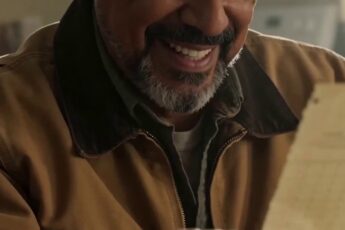
Mason did not touch the paper at first.
He just stared at the winged wheel.
For everyone else in Miller’s Diner, it was only a rough drawing in black pencil. Crooked lines. A child’s hand trying to copy something older than he was.
But Mason knew every curve.
He had once worn that mark on the back of his leather vest.
Not as decoration.
As a promise.
A promise that the men who rode under it did not leave one another behind.
And then, twenty years ago, one of them had.
Or so Mason had believed.
He looked at Noah.
“Who’s your father?”
The boy’s lips trembled.
“Eli.”
Mason’s fingers closed around the edge of the counter.
The waitress, Ruth, drew in a sharp breath.
One of the bikers at the counter muttered, “No way.”
Mason did not look away from the boy.
“Eli Callahan?”
Noah nodded.
The diner seemed to shrink around that name.
Eli Callahan.
Rook, they had called him back then.
Because he never moved first.
Only last.
Only when it mattered.
Mason had not spoken that name aloud in years.
Not because he had forgotten it.
Because remembering it hurt too much.
“He’s alive?” Mason asked.
Noah’s face changed.
That was answer enough.
“He was,” the boy whispered. “This morning.”
Mason stood so quickly the stool scraped against the floor.
Ruth set the coffee pot down with both hands.
“What happened?”
Noah flinched at the sudden movement, and Mason forced himself still.
The boy’s eyes went back to the window.
Rain ran down the glass in crooked lines. Outside, the highway lights glowed through the storm.
“He told me to come here,” Noah said. “He said if I saw a man with a scar and a gray beard, I had to give him the letter. He said not to trust anyone who came after me.”
Mason’s jaw tightened.
“Someone came after you?”
Noah nodded once.
“A man in a black truck.”
At that, all five bikers at the counter turned toward the windows.
Not dramatically.
Not loudly.
But together.
Like a door being locked from the inside.
Mason lowered his voice.
“Is that who you meant? When you said don’t make you go back with him?”
Noah nodded again.
“He said he was Dad’s friend. But Dad told me he wasn’t. Dad said if the man found me first, he’d take the letter.”
Mason finally picked up the folded paper.
It was damp, soft at the corners, and sealed with clear tape that had been pressed down carefully.
On the front, under the winged wheel, were three words.
For Scar Mason.
No one had called him that in twenty years.
Not to his face.
Not unless they had earned the right.
Mason opened the letter.
The handwriting inside was uneven, as if written by a man who did not have much strength left.
Mase,
If this reaches you, it means I ran out of road.
I know what you were told.
I know what you believed.
You thought I left you in that fire.
You thought I took the money, made a deal, and disappeared.
I let you believe it because it kept you alive.
That night at Halden’s garage, I stayed behind because I heard the kid crying in the back room. You were already halfway out, bleeding and blind from smoke. I pushed you through the side door and went back.
The money was never mine.
It was Victor Hale’s.
He used our mark to move things none of us had agreed to carry. I found the ledger. Names. Dates. Police. Judges. Men who would have buried every one of us if we talked.
So I took the book.
And they took my life apart.
They told me if I came back, they would finish what the fire started. They showed me a picture of your little girl on her school steps. They knew Ruth’s name. They knew where the old men drank coffee. They knew everything.
So I vanished.
I let you hate me because hate kept you from looking for me.
I had a son years later.
Noah.
He is the only good thing I did after leaving.
If he is standing in front of you, Mason, then I am asking the thing I never had the right to ask.
Protect my boy.
And tell him I did not leave because I did not love.
I left because I loved too many people and was too scared to lose them.
There is proof in the lining of his backpack.
The ledger pages.
The names.
The truth.
I am sorry, brother.
Rook.
Mason read the letter once.
Then again.
By the end, his hand was shaking.
For twenty years, he had carried one version of that night like a stone in his chest.
Eli had betrayed them.
Eli had run.
Eli had left Mason in the flames.
That story had helped him survive the pain because anger was easier than grief.
But now a twelve-year-old boy was sitting beside him with rain in his hair and his father’s eyes.
And the stone cracked.
Mason folded the letter slowly.
“What backpack?” he asked.
Noah slipped the wet pack off his shoulders and placed it on the counter.
It looked ordinary.
Cheap.
A school bag with one broken zipper pull and a patch of a blue dinosaur sewn badly over a tear.
Mason ran his thumb along the inside seam.
There.
A second layer.
He pulled out a thin plastic sleeve.
Inside were old photocopies, photographs, handwritten names, and pages that had been folded so many times the creases were nearly white.
One of the younger bikers, Colt, leaned in.
“Mase…”
Mason raised a hand.
No one touched the pages.
Not yet.
Ruth looked toward the window.
“Black truck.”
Everyone turned.
Across the road, beyond the flicker of the diner sign, headlights slowed near the gas pumps.
A black pickup rolled into the lot.
Noah stopped breathing.
The man behind the wheel did not get out at first.
He sat there with the engine running, wipers cutting hard through the rain.
Mason stood.
Noah grabbed his sleeve again.
“Please don’t let him take it.”
Mason looked down at the boy’s hands.
Small.
Cold.
Holding on like a drowning person.
He placed his own hand over them.
“No one’s taking you anywhere.”
The truck door opened.
A tall man stepped out.
Dark coat.
Baseball cap low over his eyes.
He moved like someone used to walking into places and being obeyed.
Ruth whispered, “I’m calling Sheriff Bell.”
Mason did not look back.
“Call the sheriff. Then call Nora.”
Ruth froze.
Nora was Mason’s daughter.
The little girl Eli had protected by disappearing.
Now grown.
Now a lawyer two towns over.
Ruth nodded and grabbed the phone.
The man from the truck pushed open the diner door.
The bell rang once.
Noah shrank back against the counter.
The man smiled as if he had walked into a birthday party.
“There you are,” he said. “Kid scared everyone half to death.”
Mason moved between him and Noah.
“Who are you?”
The man’s smile thinned.
“Family friend.”
“No name?”
“Grant.”
Mason’s eyes narrowed.
Grant Mercer.
The name was in the letter.
One of Victor Hale’s nephews.
One of the men who had helped turn the old club mark into something rotten.
Grant glanced at Noah.
“Come on, buddy. Your dad asked me to get you.”
Noah whispered, “No, he didn’t.”
Grant’s eyes hardened for half a second.
Then he looked at Mason.
“Old man, this is not your business.”
Mason smiled then.
Not warmly.
Not kindly.
The diner seemed to get even quieter.
“Funny thing about old men,” Mason said. “We remember business other people thought was buried.”
Grant looked toward the counter.
Toward the backpack.
Too quickly.
Mason saw it.
So did Colt.
So did every biker in the room.
Grant took a step forward.
“I don’t want trouble.”
“Then you picked a strange place to bring it.”
The cook appeared in the pass-through window holding a cast-iron pan.
The trucker in the corner stood slowly.
Ruth stayed behind the register, phone to her ear, voice low but steady.
Even the old couple by the window had moved away from the glass.
Grant looked around and realized, perhaps too late, that Miller’s Diner was no longer a room full of strangers.
It was a room full of witnesses.
He pointed at Noah.
“That boy has property that doesn’t belong to him.”
Mason’s voice went cold.
“That boy has his father’s truth.”
Grant’s face changed.
Only a little.
But enough.
“You opened it.”
“I did.”
“Then you don’t know what you’re holding.”
“I know exactly what I’m holding.”
Grant leaned closer.
“You think this is some old brotherhood story? You think you can fix twenty years with a wet letter and a scarred face?”
Mason stepped toward him.
Grant stopped smiling.
Mason’s voice was low enough that only the front half of the diner heard it.
“No. I think a man I loved let me hate him so I could live. And I think his son walked through a storm carrying the proof. So I’m going to make sure the right people see it.”
Sirens sounded faintly in the distance.
Grant heard them too.
He backed toward the door.
“This isn’t over.”
Mason said, “For once, it might be.”
Grant left without another word.
His truck tires spat water as he pulled back onto the highway.
Only after the taillights vanished did Noah start shaking.
Not crying.
Shaking.
Mason knelt in front of him.
It took effort.
His knees were not as kind as they used to be.
“Noah,” he said, “look at me.”
The boy did.
“You did exactly what your father told you to do.”
Noah’s mouth twisted.
“He said he’d be right behind me.”
Mason closed his eyes for one second.
Then opened them.
“He got you here.”
Noah shook his head.
“That’s not the same.”
“No,” Mason said quietly. “It isn’t.”
The sheriff arrived ten minutes later.
Sheriff Bell was a square-built woman with silver hair tucked under her hat and eyes that missed very little. She listened without interrupting. She read Eli’s letter. She looked at the copies in the plastic sleeve.
Then she looked at Mason.
“This is bigger than my office.”
“I know.”
“I’ll need to secure the originals.”
“You’ll get copies first,” Mason said.
Her eyebrow lifted.
Nora arrived before the sheriff could answer.
She walked into the diner with rain on her coat and her briefcase in one hand. She was forty now, sharp-eyed, calm, the kind of woman who could silence a room without raising her voice.
Then she saw Mason’s face.
And the boy beside him.
“Dad?”
Mason handed her the letter.
She read it standing by the counter.
By the time she reached the part about her school steps, her fingers tightened around the paper.
“He disappeared because of me?” she whispered.
Mason’s voice broke.
“Because of all of us.”
Nora looked at Noah.
Her expression changed at once.
She folded the letter carefully and crouched to his level.
“You’re Noah?”
He nodded.
“I’m Nora.”
“My dad talked about you,” Noah said.
Nora went still.
“He did?”
“He said you used to steal fries from his plate. He said Mason pretended not to see.”
Nora covered her mouth.
Mason turned away.
For the first time that night, the big man with the scar looked like he might fall apart.
Ruth set a fresh mug of coffee in front of him.
Then, without asking, she placed hot chocolate in front of Noah.
The boy stared at it.
“It’s okay,” she said softly. “No one charges kids who come in from storms.”
For a while, everyone moved quietly.
Sheriff Bell made calls.
Nora took photographs of every page.
The bikers stood near the door and windows, not blocking anyone, just watching the rain.
Mason sat beside Noah.
Neither spoke much.
Then Noah asked:
“Did you hate him?”
Mason did not pretend not to understand.
He looked at the letter on the counter.
“Yes.”
Noah’s eyes filled.
Mason turned toward him fully.
“And I was wrong.”
“My dad said you wouldn’t believe it at first.”
“He knew me.”
“He said you were stubborn.”
“He was right.”
Noah looked down at the hot chocolate.
“He said you were his brother.”
Mason’s throat tightened.
“He was mine.”
The boy wiped his eyes with his sleeve.
“Then why didn’t he come back?”
Mason took a long breath.
Because men had threatened him.
Because fear can build cages stronger than steel.
Because sometimes people make wrong choices for reasons that came from love.
Because the world can punish good men until they start calling disappearance protection.
But Noah was twelve.
So Mason said the truest thing in the simplest way.
“He thought staying away kept people safe.”
Noah stared at him.
“Was he right?”
Mason looked toward Nora, who stood near the sheriff reading one of the ledger pages with a face like stone.
“I don’t know,” he said. “But he shouldn’t have had to make that choice alone.”
Near dawn, the rain stopped.
The diner windows turned gray with morning.
Sheriff Bell left with sealed evidence bags, two deputies, and a promise that Grant Mercer would not get far.
Nora stayed.
Noah had fallen asleep in the corner booth under Mason’s leather jacket, one hand still resting on the strap of his backpack.
Mason stood by the window, watching the wet road.
Nora came beside him.
“What happens to him?”
Mason did not answer right away.
“Eli had no one else?”
“No one safe,” Nora said. “I made calls. His mother died years ago. The neighbors said he kept mostly to himself. Worked nights. Paid cash. Never stayed long anywhere.”
“That sounds like Eli.”
Nora looked at her father.
“You want to take him.”
Mason’s eyes stayed on the road.
“He found me.”
“That’s not an answer.”
“It’s the only one I have.”
Nora sighed.
Not because she disagreed.
Because she knew him.
“Then we do it properly. Temporary emergency placement if the court allows it. I’ll handle the petition. Sheriff Bell can support it. We find out what Eli arranged, if anything. We don’t just bring a child home because guilt tells us to.”
Mason nodded.
“Good.”
Nora touched his arm.
“And Dad?”
He looked at her.
“You don’t fix twenty years by saving one boy.”
Mason swallowed.
“I know.”
“But you start somewhere.”
He looked over at Noah.
At the too-small shoulders under his jacket.
At the child Eli had sent into the rain because, at the end, he still trusted the man with the scar.
Mason whispered, “I should have looked for him.”
Nora’s voice softened.
“You thought he betrayed you.”
“I should have looked anyway.”
She did not argue.
Some regrets do not need comfort.
They need room.
Two days later, Mason stood at the cemetery outside town.
The sky was pale.
The ground still soft from rain.
Eli Callahan had been buried in a simple grave under the name he had used for the last twelve years.
Eli Moore.
Noah stood beside Mason in a clean hoodie Ruth had bought from the store across the road. Nora stood on the other side of him. The bikers stood behind them in a quiet line.
No colors.
No old club marks.
Just men who had come to say goodbye to a man they had misunderstood.
Noah held the folded winged wheel drawing in his hands.
The preacher spoke softly.
When it was over, Noah stepped forward and placed the drawing on the grave.
“He told me to give it to you,” he said to Mason. “But I think he should have it too.”
Mason nodded.
“That’s right.”
Noah looked at the name on the temporary marker.
“Can we put his real name there?”
Nora said, “Yes.”
Mason added, “And Rook.”
Noah looked up.
“What does that mean?”
Mason smiled sadly.
“It was what we called him. Rook. In chess, the rook moves straight. No tricks. No fancy turns. Just straight lines.”
Noah looked back at the grave.
“Dad was like that.”
Mason thought of twenty years of hiding, false names, locked doors, returned letters of his own kind.
Then he thought of a dying man sending his son to the one person he believed would stand between him and danger.
“Yes,” Mason said. “He was.”
Over the next weeks, the story broke.
Not the whole story.
Nora made sure of that.
Noah’s name stayed out of it.
Eli’s proof went to people with enough authority to reopen old cases and enough caution not to get buried by them. Grant Mercer was arrested two counties away. Victor Hale, old and sick but still dangerous, learned too late that paper survives longer than fear.
Men who had hidden behind badges, courtrooms, and polished offices began receiving visits they had spent twenty years believing would never come.
Mason did not celebrate.
He had no taste for victory.
Justice, he learned, did not feel like thunder.
It felt like paperwork.
Phone calls.
Statements.
Long nights.
A boy waking from nightmares.
A grown daughter reading page after page of what had been done in her name.
And a scarred old biker sitting at his kitchen table, trying to forgive a dead friend and himself at the same time.
Noah came to live with Mason before winter.
Not because stories need neat endings.
Because the court agreed that the boy needed someone who understood both the danger and the promise Eli had trusted him to keep.
Mason’s house was small.
Too quiet at first.
Noah kept his backpack beside his bed every night.
For the first week, he slept in his shoes.
Mason never commented.
He only left a nightlight in the hallway and kept the front door locked in a way Noah could see.
One evening, Noah found the old motorcycle in the garage.
It was covered with a canvas tarp and twenty years of dust.
“What is it?” he asked.
Mason stood in the doorway.
“Your dad’s bike.”
Noah turned.
Mason pulled the tarp away.
The motorcycle underneath was black, dented on one side, its chrome dulled but not ruined. On the fuel tank, barely visible beneath age and scratches, was the winged wheel.
Noah reached out but stopped before touching it.
“Why do you have it?”
“Because he left it behind that night.”
“And you kept it?”
Mason nodded.
“I told myself it was evidence that he ran.”
Noah looked at him.
“What is it now?”
Mason ran a hand over the dusty seat.
“A reminder that I didn’t know the whole story.”
They spent that winter repairing it.
Not fast.
Not for riding.
For remembering.
Noah learned the names of tools. Mason learned that boys ask hard questions at the worst times. Nora came by with groceries and legal papers and sometimes stayed to help polish chrome while pretending not to cry.
Ruth brought pies.
Sheriff Bell brought updates.
The bikers came and went, quieter than they used to be.
One afternoon, Noah held up a wrench and said:
“Dad said you had the scar because you went back for him.”
Mason shook his head.
“No. I got the scar because he pushed me out before the roof came down.”
Noah looked at the pale line on Mason’s face.
“So he saved you.”
“Yes.”
“And you saved me.”
Mason looked at the boy.
Outside, snow had started to fall over the yard.
“Noah,” he said, “your dad saved you first.”
The boy considered that.
Then nodded.
“Maybe you both did.”
Mason had to look away.
In spring, they placed a proper stone on Eli’s grave.
Eli “Rook” Callahan.
Beloved father.
Loyal brother.
He stayed behind so others could live.
Noah read the words twice.
Then he leaned against Mason’s side.
“Do you think he’d like it?”
Mason put a hand on the boy’s shoulder.
“He’d say it was too much.”
Noah smiled a little.
“Then he’d like it.”
Mason laughed.
It surprised him.
It surprised everyone.
A real laugh.
Rusty.
Brief.
But alive.
That summer, Miller’s Diner looked the same from the outside.
Same red sign.
Same bell above the door.
Same smell of coffee, frying onions, and rain when storms rolled over the highway.
But if you looked closely, one thing had changed.
Behind the counter, next to a photo of Ruth’s late husband and an old newspaper clipping about a charity ride, there was a small framed drawing.
A winged wheel.
Drawn in pencil by a twelve-year-old boy on rain-soft paper.
Under it, Ruth had written:
Some people do not come in looking for help from anyone.
They come looking for the one person who still needs the truth.
Noah still had bad nights.
Mason still had regrets.
Nora still kept every document in three separate folders because trust, once broken, makes a person careful.
But the house was no longer quiet in the same way.
There were schoolbooks on the table.
A muddy pair of sneakers by the door.
A half-built model airplane on the counter.
Sometimes, on Saturday mornings, Mason would find Noah sitting in the garage beside Eli’s motorcycle, talking softly.
He never interrupted.
Some conversations belong to the living and the dead together.
One morning, Noah found Mason there instead.
The old biker was sitting on a wooden stool, looking at the repaired bike.
Noah stood beside him.
“Do you miss him?”
Mason nodded.
“Every day now.”
“Only now?”
Mason took a long breath.
“I missed him before too. I just called it anger.”
Noah thought about that.
Then he asked, “Are you still mad?”
“At him?”
“At everything.”
Mason looked at the winged wheel on the tank.
“Yes,” he said honestly. “Sometimes.”
Noah nodded.
“Me too.”
Mason put an arm around his shoulders.
They stayed that way for a while.
No big speech.
No perfect healing.
Just an old man with a scar and a boy with his father’s eyes standing beside a motorcycle that had carried a truth longer than either of them understood.
Years later, people would still talk about the night Noah ran into Miller’s Diner.
Some would say the boy was brave.
He was.
But Mason always corrected them when they said it like a happy thing.
“No child should have to be that brave,” he would say.
Then he would look toward the framed drawing behind the counter and add:
“But if he has to be, someone better be ready to believe him.”
That was the lesson Mason carried from that stormy night.
Not that the past always comes back to punish you.
Sometimes it comes back soaked in rain, wearing muddy sneakers, holding a folded piece of paper.
Sometimes it grabs your sleeve with both hands and asks you not to send it away.
And if you are lucky, if you are brave enough, if you have finally grown tired of believing the easiest lie…
You sit the child beside you.
You open the letter.
And you let the truth come home.
Dear readers, what would you have done if you were Mason? Would you have believed the boy right away, or would the past have made you hesitate? Share your thoughts in the comments — because sometimes one frightened child is carrying the truth an entire town tried to bury.