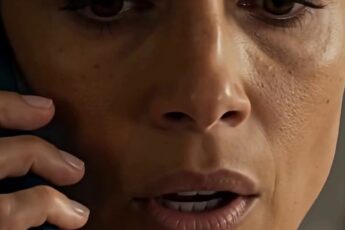
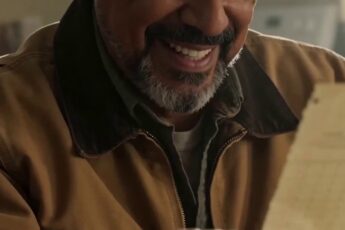
For a long moment, nobody moved.
Not the young men by the pool table.
Not the bartender with a glass in his hand.
Not Rex, who had been laughing loudest only a minute earlier.
Even the jukebox seemed to lower itself behind the sound of rain tapping against the roadhouse windows.
Mason kept staring at the photograph.
The young man in the picture was impossible to mistake.
The same sharp jaw.
The same narrow eyes.
The same half-smile men still talked about when they told stories after midnight.
Hawk.
Not the legend.
Not the patch.
Not the ghost on the wall.
A man.
Young, alive, with one arm around a woman and hope in his face.
Mason slowly lowered himself back into his chair.
“What’s your name?” he asked.
The woman swallowed.
“Evelyn.”
Mason’s eyes closed.
“Evelyn,” he whispered.
She looked startled.
“You knew?”
Mason did not answer right away.
His hand shook as he reached for the back of the chair beside him.
“Hawk used to say if he ever had a daughter, he’d name her Evelyn. After his grandmother.”
The woman pressed the photograph against her chest.
A sound moved through the room.
Not quite a gasp.
Not quite grief.
The sound of hard men realizing that the past had walked in wearing an old scarf and carrying a suitcase.
Rex stood slowly.
“Ma’am,” he said, voice rough now, “I’m sorry for what I said when you came in.”
Evelyn looked at him.
She did not smile.
She did not tell him it was all right.
It wasn’t.
But she nodded once, and somehow that was more generous than he deserved.
Mason pointed toward the table nearest the fireplace.
“Sit down, Evelyn.”
She hesitated.
“I didn’t come to cause trouble.”
An old biker near the bar muttered, “Trouble was here before you opened the door.”
Nobody laughed.
Evelyn sat.
She placed the patch on the table with both hands, as gently as someone laying down a folded flag.
The cracked leather looked small under the roadhouse lights.
Too small to carry fifty years of silence.
Mason looked at it as if it might accuse him.
“Your mother’s name?”
“Rose,” Evelyn said. “Rose Miller.”
Mason covered his mouth again.
Across the room, two older men bowed their heads.
Rex whispered, “Who was Rose?”
Mason did not look at him.
“The woman Hawk was going to marry.”
The room shifted.
One of the younger bikers frowned.
“I thought Hawk never settled down.”
Mason’s eyes hardened.
“That’s what we were told.”
Evelyn leaned forward.
“My mother said he was kind. She said he wrote letters. She said he wanted out before I was born.”
Mason nodded slowly.
“He did.”
“Then why didn’t he come?”
The question landed in the middle of the table like a stone.
Mason stared at his hands.
Because the answer had waited fifty years.
Because some truths rot when they stay buried, and when they finally come up, they do not smell like justice.
They smell like shame.
“Hawk’s real name was Caleb Ward,” Mason said.
Evelyn’s lips trembled.
“I know. My mother told me.”
“He was one of the first five who built this club back when it was nothing but a garage, a borrowed flag, and five fools who thought the road could save them from whatever they were running from.”
Mason looked toward the wall.
An old photograph hung above the bar: five young men in denim and leather, standing beside motorcycles, grinning like they owned the horizon.
Hawk stood in the middle.
Alive forever in black and white.
“He was the best of us,” Mason continued. “Not the loudest. Not the meanest. The best. If a man was stranded, Hawk stopped. If a kid needed food, Hawk paid. If someone weaker got pushed around, Hawk stood up before anyone asked.”
Evelyn’s eyes filled.
“My mother said he fixed her truck in a storm.”
Mason smiled faintly.
“That sounds like him.”
“She said he came back the next day with flowers.”
“He stole those from O’Malley’s wife’s garden.”
A few men laughed softly.
Not mocking now.
Remembering.
Evelyn let out a small breath, half laugh, half sob.
Then Mason’s smile faded.
“Rose was pregnant when things went bad.”
Evelyn gripped the edge of the table.
“With me.”
“Yes.”
Mason looked toward the back hallway.
“There was a man back then. Not one of the First Five, but close enough to poison everything. Victor Cross.”
At the name, one of the oldest bikers swore under his breath.
Rex looked around.
“Cross? The old treasurer?”
Mason nodded.
“He handled money. Papers. Messages. He had a clean face and dirty hands. Hawk found out Cross had been skimming from the club and using our name to lean on people who owed him.”
Evelyn listened without blinking.
“Hawk was going to expose him,” Mason said. “But he also wanted to leave. Rose had told him about the baby. He was done with the road life. Said he’d keep the patch, but not the blood and smoke that had started gathering around it.”
He touched the old leather.
“He told me, ‘Mase, I’m going to be somebody’s father. I can’t keep living like I’m nobody’s son.’”
Mason’s voice broke on the last word.
No one looked away.
“What did Cross do?” Evelyn asked.
Mason took a long breath.
“He lied.”
The answer was simple.
Too simple for all the pain it had caused.
“He intercepted letters from Rose. She had gone to stay with her aunt two towns over because her own father didn’t want a biker anywhere near the family. Hawk kept sending money and notes through Cross, because Cross had a car and looked respectable enough to walk into a post office without people watching him.”
Evelyn whispered, “My mother said the letters stopped.”
“They never stopped,” Mason said. “They were stolen.”
Her face crumpled.
Mason continued, each word heavier than the last.
“Cross told Hawk that Rose had died. Said the baby died too. Said her family blamed Hawk and didn’t want him at the burial.”
Evelyn’s hand flew to her mouth.
A young biker near the pool table whispered, “God.”
Mason’s eyes were wet now.
“Hawk didn’t believe it at first. He rode there. Rose’s aunt had moved. The house was empty. Cross had arranged it all. Sent Rose a letter too.”
Evelyn’s voice was barely there.
“What did it say?”
Mason looked at her.
“That Hawk had chosen the club. That he didn’t want a wife. Didn’t want a child. That if she came looking for him, she’d only find trouble.”
Evelyn closed her eyes.
“My mother waited,” she whispered. “She waited for months.”
Mason bowed his head.
“I know.”
“No,” she said, suddenly sharper. “You don’t know. She waited with a baby in her arms and people telling her she had been foolish. She waited through winters. Through sickness. Through every time someone asked where my father was.”
Mason took it.
He did not defend himself.
He deserved that much.
“You’re right,” he said. “I don’t know it the way she did.”
Evelyn wiped her cheek.
“Then what happened to him?”
The room seemed to brace itself.
Mason stared at the patch.
“Hawk changed after he thought you were gone. Not louder. Not wilder. Quieter. Like somebody had cut the road out from under him but he kept riding anyway.”
He swallowed.
“One night he found proof that Cross had been stealing. They argued. Cross ran. Hawk chased him out in a storm.”
Rain struck the windows harder, as if the old night had returned to listen.
“There was a bridge washed out on County 12. Cross made it over. Hawk didn’t.”
Evelyn stopped breathing.
Mason’s voice dropped.
“They found his bike in the ravine the next morning. Found him a little ways downriver.”
The old roadhouse went silent.
Not respectful-silent.
Wounded-silent.
Evelyn looked at the photograph in her hands.
“So he died believing we were dead?”
Mason could not speak.
He nodded.
The old woman bent forward over the patch.
For fifty years, she had carried a question.
Now the answer had arrived, and it was crueler than abandonment.
Her father had not left her.
He had been robbed of her.
And she had been robbed of him.
Rex turned away, wiping his face roughly with his sleeve, pretending no one saw.
Mason reached into his vest pocket and took out a key.
His hand shook so badly the metal rattled against the table.
“There’s something you need to see.”
He stood.
Everyone rose with him, as if the room understood before anyone gave an order.
Mason led Evelyn down the narrow hallway behind the bar. The others followed at a distance. Even Rex stayed back, quiet now, hat in his hands.
At the end of the hall was a locked door.
On it hung a small sign:
FOUNDERS’ ROOM
Mason opened it.
The room smelled of dust, leather, old paper, and oil.
There were framed photographs on the walls. Rusted license plates. A cracked helmet. A folded flag. Five wooden chairs around a table scarred by decades of glasses, knives, cigarette burns, and fists.
At the far wall was a glass case.
Inside lay four patches.
The First Five.
One space was empty.
Evelyn looked down at the patch in her hands.
Mason’s voice was soft.
“We never replaced it.”
“Why?”
“Because some men leave. Some die. Some are taken. But founders don’t get replaced.”
Evelyn stepped closer to the glass.
Beside the empty space was a small metal plate.
HAWK
CALEB WARD
BROTHER. FOUNDER. LOST ON COUNTY 12.
Evelyn read it twice.
Then she said:
“You wrote ‘lost.’ Not dead.”
Mason looked away.
“I suppose part of me always knew something was unfinished.”
He walked to an old cabinet, unlocked it, and pulled out a tin box.
The kind cookies used to come in long ago.
Blue and silver.
Dented on one side.
“I kept this after Cross died,” he said. “Found it in his storage unit when nobody claimed his things. I should have opened it sooner.”
“You didn’t?” Evelyn asked.
“I did.”
His honesty came with no excuse.
“I opened it ten years ago.”
The room tightened around him.
Evelyn’s face hardened.
“Ten years?”
Mason nodded.
“I found letters. Yours. Your mother’s. A birth announcement she never got to send. A note from Hawk. I was a coward.”
The word hung there.
No one rushed to soften it.
Mason opened the box.
Inside were envelopes tied with a faded ribbon.
Some addressed in Rose’s hand.
Some in Hawk’s.
Evelyn touched them as if they were living things.
Her fingers trembled over one envelope.
It was yellowed, unopened.
Written across the front:
To my daughter, when she’s old enough to ask.
Evelyn made a sound.
Small.
Broken.
Mason placed the letter in her hands.
“I had no right to keep it.”
“No,” she said.
He flinched.
She looked at him through tears.
“You didn’t.”
Mason bowed his head.
“I know.”
Evelyn held the letter but did not open it yet.
Not there.
Not in front of all those men.
Some words had waited fifty years.
They could wait until her hands stopped shaking.
Rex stepped into the doorway.
“Mason,” he said quietly, “why didn’t the club go after Cross? Why didn’t anybody make it right?”
One of the oldest men at the back answered before Mason could.
“Because we were young, stupid, and scared of our own shadows. And later, because shame gets heavier the longer you carry it.”
Mason nodded.
“Cross was dead before I found the box. Hawk was gone. Rose was gone, I thought. And I told myself bringing it up would only hurt people who weren’t here to heal from it.”
He looked at Evelyn.
“But that was another lie. A quieter one.”
Evelyn closed the tin box.
“My mother died last spring,” she said. “She told me on her last good day that I needed to bring the patch back. She said, ‘Don’t go looking for revenge, Evie. Go looking for the place where your father’s name still has breath.’”
Mason covered his face.
“She called you Evie?”
Evelyn nodded.
“Hawk called every stray dog Evie when we were young,” Mason whispered. “Said if he had a daughter, he hoped she’d come when he whistled but bite anyone who deserved it.”
A laugh moved through the room.
This time Evelyn laughed too.
Through tears.
For a moment, Hawk was not only tragedy.
He was there.
In a joke.
In a name.
In the way men who had forgotten how to grieve suddenly remembered how to smile.
They returned to the main room.
No one sat at the largest table until Evelyn did.
That mattered.
Rex pulled out a chair for her.
She looked at him.
He lowered his eyes.
“I was raised better than what I showed you,” he said.
“Then show it next time first,” she answered.
A few men murmured approval.
Rex nodded.
“Yes, ma’am.”
Mason placed the old patch in the center of the table.
“What do you want to do with it?” he asked.
Evelyn looked at the leather.
For fifty years, that patch had been a mystery in newspaper.
A warning from her mother.
A question with wings.
Now it was something else.
Proof.
“I don’t know,” she said. “Part of me wants to keep it. Part of me thinks it belongs here.”
“It belongs where you say it belongs,” Mason replied.
That answer seemed to surprise her.
Maybe because so much of her life had been shaped by men deciding things before she arrived.
She touched the edge of the patch.
“My mother carried the pain. I carried the question. You all carried the legend. Maybe it’s time he stopped being carried in pieces.”
The bartender, a woman named Jo who had run O’Malley’s for twenty years, set a cup of coffee in front of Evelyn.
“Then we put all the pieces on the wall,” Jo said.
And that was what they did.
Not that night.
That night belonged to the letter.
Mason drove Evelyn to a small motel down the road, but before she got out of the truck, she finally opened the envelope.
Mason did not look.
He kept both hands on the wheel and stared through the rain.
Evelyn unfolded the paper.
The ink had faded, but Hawk’s handwriting was clear.
My little girl,
If you are reading this, then somebody finally told you I was real.
Evelyn pressed the letter to her mouth.
Mason’s jaw trembled.
She read silently for several minutes.
Only once did she whisper a line aloud:
“He said he hoped I had my mother’s courage and not his temper.”
Mason gave a broken laugh.
“He had both.”
When Evelyn finished, she folded the letter carefully.
“What did he say?” Mason asked, then immediately shook his head. “I’m sorry. That’s yours.”
Evelyn looked out at the rain.
“He said if he ever failed to come home, I should know it wasn’t because the road meant more than me.”
Mason shut his eyes.
For fifty years, the cruelest lie had been answered by a dead man’s own hand.
The next morning, every bike outside O’Malley’s had its headlight on.
Even in daylight.
The men stood in two lines when Evelyn arrived.
She stopped at the edge of the lot, startled by the sight.
Rex stepped forward first.
Not loud.
Not grinning.
Just honest.
“Ma’am, yesterday I made you feel small in a room where your father’s name should have made you welcome. I’m sorry.”
Evelyn studied him.
Then nodded.
“Do better with the next stranger.”
“I will.”
Mason came next.
In his hands was a small wooden frame, empty.
“We’d like to ride to County 12,” he said. “If you want.”
Evelyn looked at the bikes.
“I don’t ride.”
“You don’t have to. Jo’s got a truck. You can lead.”
A strange little smile crossed Evelyn’s face.
“My father was a biker, and I’m leading in a truck?”
Mason smiled back.
“Hawk would have loved that.”
They drove to the old bridge site.
It had been rebuilt long ago. Guardrails new. Asphalt smooth. No sign of the ravine unless you knew where to look.
But Mason knew.
He led Evelyn down a muddy path to a flat stone near the river.
There was already a small marker there, weathered and half hidden by grass.
Hawk
First Five
Evelyn knelt.
No one followed her.
The bikers stood back by the road, helmets in hand, rain misting over their jackets.
She touched the stone.
“Hello, Dad,” she whispered.
The word seemed to cost her everything.
Then she cried.
Not politely.
Not quietly.
She cried for the baby who waited for a man who never came.
For the mother who folded a patch in newspaper and carried heartbreak like a second spine.
For the father who died believing love had been buried without him.
For the fifty years stolen by one man’s lie and many men’s silence.
Mason stood beneath a pine tree and wept openly.
No one mocked him.
No one looked away.
At last, Evelyn rose.
She took the old patch from beneath her coat.
Mason stepped forward with the frame.
“Are you sure?”
She nodded.
“My mother kept it until I was ready. I brought it until you were ready. Now he can be whole.”
Back at O’Malley’s, they cleared the wall above the bar.
Not a corner.
Not a hallway.
The center.
Jo wiped the wood herself.
Mason placed the restored photograph in one frame: Hawk and Rose, young and smiling, standing close enough that the future still looked possible.
Beside it, they mounted the old patch.
Below both, Rex attached a new brass plate.
He had paid for it himself that morning.
It read:
CALEB “HAWK” WARD
FOUNDER. BROTHER. FATHER.
His road did not end in silence.
His daughter brought him home.
Evelyn stood before it for a long time.
Then she took a small envelope from her suitcase.
“My mother’s picture,” she said.
In it was a photograph of Rose later in life, gray-haired, tired-eyed, still wearing a necklace with a tiny silver wing.
Jo found another frame.
They placed Rose beside Hawk.
Not behind him.
Not beneath him.
Beside him.
“That’s better,” Evelyn said.
From that day on, the story at O’Malley’s changed.
Young bikers no longer heard only about Hawk outriding storms or standing up to men twice his size.
They heard about Rose.
They heard about Evelyn.
They heard about letters stolen and silence mistaken for loyalty.
They heard that a patch is not just leather, and a legend is not worth much if it forgets the people who loved the man inside it.
Mason changed too.
He was already old, but after Evelyn came, he stopped using age as an excuse to keep secrets.
He called families of men long gone.
He returned things kept in boxes.
A ring.
A photograph.
A war medal.
An apology.
Some doors opened.
Some stayed closed.
He accepted both.
Evelyn did not move near O’Malley’s.
She had her own life four hundred miles away. A small house, two grown sons, a garden her mother had planted. But once a month, she drove back.
At first, the men didn’t know what to do when she entered.
Then Jo solved it by putting her coffee down before she even reached the bar.
“Cream, no sugar,” Jo said.
Evelyn smiled.
“You remember.”
“Hawk’s daughter doesn’t get served last in this house.”
Rex always stood when she came in.
Every time.
Not because she asked.
Because he remembered the first time he hadn’t.
One afternoon, months later, Evelyn brought her oldest grandson.
A shy boy of seventeen with too-long hair and eyes that took in everything.
He stood in front of Hawk’s patch for a long time.
“That’s my great-grandfather?” he asked.
Evelyn nodded.
“Yes.”
“Was he a good man?”
The room went quiet, but not painfully.
Mason answered.
“He was not perfect. None of us were. But he loved before he knew he had the right to. And when he thought he had lost that love, it broke him because it had mattered.”
The boy considered that.
Then he said:
“That sounds like a good man.”
Mason nodded.
“It does.”
Years later, people would still talk about the night the old woman walked into O’Malley’s with rain on her scarf and Hawk’s patch in her hands.
Some remembered Rex’s cruel joke.
He never forgot it.
That was good.
Some shame should not destroy a man.
It should teach him where his mouth ends and another person’s story begins.
Some remembered Mason’s confession.
Some remembered the photograph.
Some remembered the letter.
But Evelyn remembered something else most clearly.
The moment after she placed Rose’s picture beside Hawk’s.
When the room full of bikers stood in silence, not as a club, not as legends, not as hard men guarding old pride.
Just as witnesses.
That was what she had driven four hundred miles to find.
Not revenge.
Not even answers only.
Witnesses.
People who could finally say:
Yes.
He existed.
Yes.
He loved you before he knew your face.
Yes.
You were stolen from him too.
And no.
You were never nobody.
On the wall at O’Malley’s, beneath the patch, Jo later added one more small line.
Nobody knew who suggested it.
Maybe Mason.
Maybe Rex.
Maybe Evelyn herself.
It simply said:
Tell the truth while someone is still alive to hear it.
And every time rain hit the windows, the old roadhouse grew a little quieter around that wall.
Not because Hawk was a ghost.
Because at last, he was a man again.
A son.
A brother.
A lover.
A father.
And his daughter no longer carried the patch like a burden.
She carried his name like something returned.
Dear readers, have you ever discovered a truth that changed the story of someone you thought you understood? What did Evelyn’s journey make you feel? Share your thoughts in the comments — sometimes the truth arrives late, but it can still give a name back to the heart that waited.