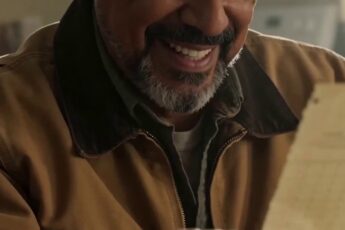
The whole bar disappeared around him.
There was only the child.
The bracelet.
And a second chance Wade thought life would never give him.
For a moment, the old biker could not speak.
The silver bracelet lay across his palm, bent at the clasp, scratched along the edges, but unmistakable. He knew the weight of it. Knew the engraving. Knew the tiny dent near the first letter where Rosie had once dropped it on the garage floor while dancing barefoot to an old country song.
For Rosie.
He had given it to her when she was fourteen, after she crashed her bicycle into the mailbox and insisted she had done it “with style.”
She had been wild, bright, impossible to control, impossible not to love.
And Wade had made the mistake too many frightened fathers make.
He confused love with holding tight.
Rosie grew older.
The fights grew louder.
Then came one terrible night. One sentence too cruel. One door slammed too hard. One daughter walking into the dark with a backpack and tears she refused to let him see.
Wade told himself she would come home.
Then he told himself she was stubborn.
Then he told himself she had chosen to stay gone.
Years passed.
The empty chair at every birthday became normal.
Her name became something people lowered their voices around.
And Wade learned to sit alone near the jukebox with black coffee and a silence full of things he should have said differently.
Now a little girl under his table was looking up at him with Rosie’s eyes.
The man by the door took a step forward.
“She’s confused,” he said. “Her mother isn’t well.”
Wade did not look away from the child.
“What’s your name, sweetheart?”
The girl swallowed.
“Annie.”
The name landed gently, painfully.
Rosie had once said, when she was sixteen and still believed the future was something she could draw in a notebook, that if she ever had a daughter, she would name her Annie after an old song Wade used to play in the garage.
Wade closed his fingers around the bracelet.
“Annie what?”
“Annie Mae.”
The man snapped:
“Enough.”
That was the wrong word.
Three chairs moved at once.
Not violently.
Not dramatically.
But the men in the bar shifted as if the whole room had silently agreed on one thing: the child would not be pulled back into the storm just because a man said she should be.
Wade slowly stood.
His knees hurt. His back complained. The years had taken plenty from him.
But when he rose, the room remembered who he had been before age softened only the outside.
“You got a name?” Wade asked the man.
“Travis.”
“Travis what?”
“Travis Cole.”
“You Annie’s father?”
Travis hesitated.
That hesitation was small.
But in a room full of men who had spent lives reading danger in mirrors, roads, bars and alleys, it was loud.
“I take care of her,” Travis said.
Under the table, Annie whispered:
“No, you don’t.”
Wade felt something cold move through him.
The bartender, June, quietly reached for the phone behind the counter.
Travis noticed.
“There’s no need for that.”
June smiled without warmth.
“Honey, a child just crawled under a table in my bar during a storm. There’s every need.”
Travis’s polished calm started to crack.
“This is a private matter.”
Wade looked at Annie.
“Did your mama tell you to come here?”
She nodded.
“If he got angry again. If she couldn’t answer me. If I got scared.”
Her lip trembled.
“She said find the old man by the music box. The one with the snake tattoo.”
Wade looked down at his forearm.
The faded snake tattoo was older than Rosie had been when she left.
His throat tightened.
“She remembered that?”
Annie nodded.
“She said you looked mean, but you weren’t.”
Someone at the bar coughed to hide emotion.
June turned away and wiped the same clean spot on the counter twice.
Wade crouched slowly beside the booth.
“Where’s your mama now, Annie?”
The child’s face changed.
“She was on the floor.”
The bar went completely still.
“I tried to wake her. Travis said she was being dramatic. But she didn’t open her eyes.”
Travis stepped forward.
“She fell. That’s all. She falls when she drinks.”
Annie shook her head hard.
“Mommy doesn’t drink.”
Wade stood again.
This time, the old softness vanished from his face.
“Police are coming,” June said from behind the bar.
Travis turned sharply toward the door.
Two bikers were already there.
One of them, a broad man named Ray, folded his arms.
“Storm’s bad,” he said. “Best wait.”
Travis glared at him.
“You people don’t know what you’re doing.”
Wade answered:
“We know exactly what we’re not doing. We’re not handing a scared child to a man she ran from.”
Annie crawled out from beneath the table. She was soaked to the bone. Her small boots were muddy. One sleeve of her red hoodie had a tear near the wrist.
And there, partly hidden beneath damp fabric, Wade saw faint marks on her arm.
Finger marks.
His jaw tightened.
Travis saw him notice.
“She bruises easy,” he said quickly.
Ray muttered:
“Funny how people always say that after somebody sees the bruise.”
Annie reached into the pocket of her hoodie and pulled out a folded note sealed inside a plastic bag.
“Mom said to give this to you if I found you.”
Wade took it carefully.
The paper shook in his hand before he even opened it.
The handwriting was older now, tighter, but it was Rosie’s.
Dad,
if Annie is standing in front of you, then I finally trusted the right memory. I know I do not deserve to ask for help after all these years, but she does.
I stayed away too long. At first because I was angry. Then because I was proud. Then because I was ashamed of how much time had passed. And then because Travis made the world so small I forgot there were doors outside it.
He was kind in the beginning. Men like him know how to begin kind. Then he started correcting me. Then checking my phone. Then making every friend sound dangerous. Then making me feel like no one would believe me if I ran.
But I told Annie about you. I told her you gave me the bracelet and said it meant I was always your girl, even when I was mad at you. I told her if she ever had to run, she should find Wade Mercer, the old biker with bad coffee and a worse temper.
Please don’t let my stubbornness leave her alone.
She is your granddaughter.
Her full name is Annie Rose.
I put your daughter’s name in hers because some part of me still wanted to come home.
Rosie.
Wade read the letter once.
Then again.
By the end, his eyes were wet and his hands were shaking so badly that June came around the bar and stood near him, not touching, just near enough.
Annie stared at him.
“Are you mad at Mommy?”
Wade closed his eyes.
That question was almost too much.
“No, baby.”
His voice broke on the word.
“I’m mad at the years. I’m mad at myself. I’m mad at him.”
He looked toward Travis.
“But I’m not mad at your mama for sending you to me.”
Annie exhaled like she had been holding that fear all the way from the road.
The sheriff’s deputies arrived ten minutes later.
Travis tried to speak first.
Men like him usually do.
He said Rosie was unstable.
He said Annie was easily frightened.
He said Wade was an estranged relative with no legal claim.
He said everything in a smooth, careful tone meant to sound reasonable.
But this time he was not speaking to a frightened woman alone in a hallway.
He was speaking in a bar full of witnesses.
June gave the deputies Rosie’s note.
Ray pointed out the bruises on Annie’s arm.
Wade handed over the bracelet only after one deputy promised to photograph it and give it back.
Annie sat beside Wade in the booth wrapped in an old leather jacket that smelled like rain and smoke and coffee. June put hot chocolate in front of her with too many marshmallows.
A young deputy tried to ask questions.
Wade placed one hand flat on the table.
“She gets a child advocate first.”
The deputy looked like he might object.
Then he looked at Annie’s trembling hands.
He nodded.
“Fair.”
Rosie was at a hospital in Nashville.
Alive.
That was the first word Wade heard.
Alive.
He held onto that word so hard it almost hurt.
June drove him because nobody trusted him on a motorcycle in that state. Ray followed behind. Annie rode in the back seat, still clutching the bracelet, still looking at the windows as if the storm might change its mind and come inside.
At the hospital, Annie would not let go of Wade’s sleeve.
So he walked through the white hallway with his granddaughter attached to him and his daughter’s letter folded in his shirt pocket.
When he entered Rosie’s room, he stopped.
She lay pale against the pillows, one side of her face bruised, her wrist bandaged, her hair tangled around her cheek.
She was older.
Of course she was.
Twenty-two years had not waited politely.
But beneath the bruises, beneath the exhaustion, beneath the life he had missed, Wade saw his daughter.
The girl who used to steal his bandanas.
The girl who once painted his toolbox pink because he said nobody would dare.
The girl who shouted, “You never listen!” before she walked out.
Maybe she had been right.
Rosie opened her eyes.
For a moment, she looked lost.
Then she saw him.
“Dad?”
Wade moved to the bed.
All the speeches he had carried for decades fell apart before he could use them.
He took her hand carefully.
“I’m here.”
Rosie’s face crumpled.
“Annie?”
“Safe.”
“With you?”
“With me.”
She cried then.
Not loudly.
Not beautifully.
Like someone whose body had finally found permission to stop holding everything upright.
“I wanted to come back,” she whispered.
Wade nodded.
“I know.”
“No, you don’t.”
He touched the folded letter in his pocket.
“I do now.”
Rosie looked away.
“I thought you hated me.”
Wade swallowed.
“I thought you hated me too.”
A broken little laugh escaped her, then turned into a wince.
“I was scared.”
“I believe you.”
Rosie stared at him.
Those three words seemed to reach deeper than any apology.
Wade looked down at her hand.
“I loved you so hard I made it feel like a cage. I know that now.”
Tears slipped down her temples.
“I should have called.”
“Yes.”
The honesty hurt, but he kept going.
“And I should have kept looking after my pride got tired.”
Rosie closed her eyes.
For a long time, neither of them spoke.
There was too much between them for one night.
But there was also something new.
A door cracked open.
A hand still held.
A child safe down the hall.
Travis was arrested before dawn.
At first he denied everything.
Then deputies found Rosie’s phone hidden behind a toolbox in the garage.
They found messages.
Photos.
Emergency room records.
A note saved in her drafts:
If I don’t wake up, Annie knows where to go.
Neighbors began to talk once they realized someone else had seen the pattern too.
A teacher remembered Annie flinching when a man raised his voice during pickup.
A nurse remembered Rosie changing her story whenever Travis stood beside her bed.
The truth had been scattered everywhere.
It took a six-year-old girl running into a biker bar to gather it in one place.
Rosie and Annie did not move straight into Wade’s house.
He wanted them to.
He had already pictured cleaning the spare room, fixing the porch light, buying Annie a bed with yellow sheets if she liked yellow and purple ones if she didn’t.
But a woman from the shelter told him gently:
“Safety is not just a big man with a locked door. Sometimes safety is letting them choose what happens next.”
Wade wanted to argue.
Then he saw Annie jump when a hospital cart rattled by.
He saw Rosie apologize for asking for more water.
He saw both of them watching every entrance like peace was temporary.
So he nodded.
“Then we do it right.”
That became the first new rule.
Right.
Not fast.
Not proud.
Not like a movie.
Right.
For the first few weeks, Rosie and Annie stayed in a protected apartment.
Wade visited only when invited.
At first, just fifteen minutes.
He brought chicken soup, warm socks, a coloring book, and an old photograph of Rosie at twelve sitting on his motorcycle, grinning like she owned the whole highway.
Rosie held the photo for a long time.
“I forgot I smiled like that.”
Wade sat across from her.
“You did.”
“Was I hard to love?”
He answered carefully.
“You were stubborn, loud, allergic to rules, and born with too many opinions.”
She almost smiled.
Then he added:
“And I loved you so much I tried to steer your whole life. That was my mistake.”
Rosie cried again.
This time, Wade did not panic.
He simply stayed.
Some tears do not ask to be fixed.
Only witnessed.
Annie learned slowly that the roadside bar was not a scary place.
It was the place where no one gave her back.
June kept crayons behind the counter.
Ray taught her to play checkers and lost badly on purpose.
A biker named Cole fixed the clasp on the bracelet with hands so careful Annie watched in awe.
Wade let her sit at his table whenever she wanted.
He never asked her to go under it again.
One afternoon, she asked:
“Can a bar be a safe place?”
Wade looked around at the old booths, the jukebox, the rain-streaked windows, the men pretending not to listen.
“It can,” he said. “If the people inside decide that it is.”
A week later, June taped a sign near the entrance:
IF YOU NEED HELP, ASK FOR ROSIE.
Wade said it was too much.
The next morning, beneath it, someone had added another sign in his handwriting:
KIDS DON’T HIDE FOR NO REASON.
Nobody admitted crying.
But the napkin holder stayed empty all day.
The bar changed after that.
Quietly at first.
A woman came in one afternoon and asked to use the phone.
A teenage boy came in after midnight and said he could not go home.
A mother with a baby came during a storm and asked if anyone knew a shelter that would take both of them.
June kept a folder of numbers.
Ray became very good at standing near doors without making a show of it.
Wade learned to ask, “What do you need right now?” before asking, “What happened?”
That was hard for him.
He liked facts.
He liked engines.
He liked problems with bolts he could tighten.
But fear does not always tell a story in order.
Sometimes it only sits in a booth and shakes.
So Wade learned to sit beside it.
Rosie healed slowly.
Some days she laughed.
Some days she could not answer the phone.
Some days she snapped at Wade for hovering.
Some days she cried because he stepped back too quickly.
They learned each other again.
Not as father and little girl.
Not as guilt and wound.
As two adults carrying pieces of the same broken bridge.
Annie started school.
She chose a yellow backpack because red, she said, was “for running,” and yellow was “for staying.”
Wade bought it without a word.
On the first day, she asked if he would come.
Rosie looked at him.
Wade said:
“Only if you want me there.”
Annie nodded.
“But don’t bring your motorcycle. It growls.”
Wade looked offended.
“My bike is a classic.”
“It’s a dragon with wheels.”
Rosie laughed.
The sound went through Wade like sunlight.
So he drove the truck.
Years passed.
Travis went to prison.
Not long enough, Wade thought.
But long enough for Rosie to sleep without a chair under the doorknob.
Long enough for Annie to stop hiding snacks under her pillow.
Long enough for ordinary days to become ordinary.
The first time Annie called him “Grandpa,” she was eight.
It happened at the bar.
She sat at Wade’s table doing homework while he pretended not to watch her spell every word.
“Grandpa, how do you spell bracelet?”
Wade froze.
June nearly dropped a plate.
Ray suddenly stared at the jukebox as if it had spoken.
Annie looked up.
“What?”
Wade cleared his throat.
“Nothing.”
“You’re crying.”
“No.”
“You are.”
“Old bikers don’t cry.”
June muttered:
“They do. They just blame smoke, rain, onions, pollen, engine fumes, and Democrats.”
Ray added:
“And Republicans, depending on the biker.”
Annie pushed her worksheet toward Wade.
“Can you cry after you spell it?”
Wade laughed.
A real laugh.
The kind that knocked dust off old grief.
“B-R-A-C-E-L-E-T.”
Annie wrote:
My grandpa gave my mom a bracelet so she would remember home.
Wade kept that paper in his wallet until the folds nearly erased the words.
Rosie eventually began helping at the shelter that had helped her.
Later, she worked there.
When women whispered, “I should have left sooner,” Rosie would say:
“You left when you could. That is not failure.”
When someone said, “I feel stupid,” she answered:
“Fear is not stupidity. It is what your body learns when love becomes unsafe.”
Wade heard her say that once at a community event and had to step outside.
Not because he was sad.
Because pride, the good kind, had filled his chest too full for breathing.
On Rosie’s forty-first birthday, Wade gave her the bracelet back.
She held it in both hands.
“I don’t know if I deserve it.”
Wade sat across from her at the kitchen table.
“I gave it to my daughter. You’re still her.”
Rosie touched the engraving.
“For Rosie.”
“That’s you.”
“I’m not the same Rosie.”
“No.”
He smiled gently.
“But you’re still home.”
She cried.
He cried too.
This time neither of them pretended otherwise.
Many years after that stormy night, the Tennessee roadside bar was renovated.
June claimed it was because the roof leaked.
Everyone knew it was because Annie once said the bathroom looked “like a haunted truck stop with plumbing.”
They fixed the roof, painted the walls, replaced the cracked tiles, and built a small shelf near the entrance with cards for shelters, child services, legal aid, counseling, hotlines, and safe housing.
Above Wade’s old table, they hung a framed photo.
Not of Annie.
Not of Rosie.
Not of Wade.
Just a red hoodie folded beside a silver bracelet.
Under it were the words:
THE SAFE TABLE
For anyone who comes in from the storm needing to be believed.
Annie, now seventeen, stood in front of it and groaned.
“Grandpa, this is so dramatic.”
Ray called from the bar:
“I voted for ‘Annie’s Table,’ but somebody said that was embarrassing.”
“It is embarrassing!”
Wade sat at his usual place, older now, slower, his beard almost white.
“Kids don’t get to edit legends.”
“I’m not a kid.”
He looked at her.
“You are to me.”
She rolled her eyes.
But she sat beside him and leaned her shoulder against his arm.
Rosie arrived with three coffees and one hot chocolate.
Annie stared.
“Mom. I’m seventeen.”
“Hot chocolate.”
“I can drive.”
“Hot chocolate.”
“I pay taxes when I buy stuff.”
“Hot chocolate.”
“Fine.”
They sat together.
Not perfect.
Not untouched.
But together.
Later that night, the door opened.
Rain blew in.
A young woman stood in the doorway holding a little boy against her hip. Her sleeve was torn, her eyes terrified, her whole body leaning backward as if part of her still wanted to run.
“Someone told me,” she said quietly, “that if I needed help, I should ask for Rosie.”
Rosie set down her cup.
Wade looked at Annie.
Annie was already standing.
“Come in,” she said. “You’re soaked.”
And she was.
June brought coffee.
Ray moved near the door like he happened to enjoy that exact spot.
Rosie spoke softly.
Annie sat with the little boy and showed him how to draw motorcycles that looked more like horses.
Wade remained at the old table.
He looked at the rain on the windows and thought about the night a little girl crawled beneath it with a bracelet in her fist and fear in her eyes.
Travis had said he needed the girl.
He had been wrong.
No child is something a man needs.
No woman is something a man owns.
No frightened person belongs to the person they are running from.
But sometimes people are entrusted to us.
For one night.
For one phone call.
For one safe table.
For one whole life.
And when that happens, the door must open.
Not because we are heroes.
Because we are human.
People later told the story of the old biker and the little girl in many ways.
Some made it about tough men standing up.
Some made it about Wade finding his daughter’s child.
Some made it about Travis finally being stopped.
But Wade told it differently.
“A child came in from the rain,” he would say, “because too many adults had stayed quiet too long.”
And when people asked if he saved Annie, he always shook his head.
“She got herself to the door. We just didn’t close it.”
On Annie’s eighteenth birthday, Rosie fastened the silver bracelet around her daughter’s wrist.
Wade watched quietly.
Annie touched the engraving.
“For Rosie.”
Rosie smiled.
“It was mine. Now it’s yours.”
Annie looked at Wade.
“And his.”
Wade shook his head.
“I only bought it.”
“You waited.”
“Not well enough.”
“You were here when I came.”
That ended the argument.
Because sometimes love is not proven by a perfect past.
Sometimes it is proven by the door that opens when every other door is closed.
Outside, rain began again, soft against the roof.
Inside, the silver bracelet caught the warm light above the table.
The room smelled of coffee, fried onions, leather jackets, old wood, and something Wade had not recognized for years.
Peace.
The little girl did not ask the bikers for help.
She only hid beneath the old man’s table and gave him a bracelet.
But that bracelet carried a daughter’s regret.
A mother’s last plan.
A child’s courage.
And the road back to a home that had waited, badly and imperfectly, but waited all the same.
Wade once thought life would never give him a second chance.
He was wrong.
It came through the door in a red hoodie, with tiny boots, wet hair, and a whisper:
“My grandpa.”
And for the first time in years, Wade Mercer remembered that being hard had never saved anyone.
Opening the door had.
💬 Do you think Wade should have kept searching for Rosie longer, or did Annie arrive at exactly the moment the family could finally be saved? Can a bond broken by pride and fear heal after so many years? Share what this story made you feel — because sometimes a child brings not only fear into a room, but the road back home.