For a moment, no one clapped.
No one whispered.
No one even reached for a glass.
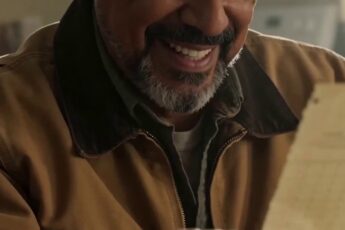
The ballroom at the Waverly Foundation seemed to hold its breath while the boy in the worn brown jacket guided Clara Bennett’s wheelchair beneath the chandeliers.
He moved carefully.
Not like someone showing off.
Not like someone trying to prove anything.
He kept one hand on the side of the chair, his steps soft, his eyes watching Clara’s face instead of the crowd.
Every few seconds, he asked quietly:
“Still okay?”
And every time, Clara nodded.
“Yes.”
Her pale blue dress shimmered under the lights. The paper flower rested in her lap, folded from an old program, its edges uneven, its petals creased by small fingers.
But Clara was not looking at the flower.
She was looking at the dance floor.
No.
She was looking as if, for the first time that night, the dance floor had finally looked back.
Arthur stood frozen near the balcony.
He had spent years learning how to protect his daughter.
From careless pity.
From cruel children.
From adults who spoke to her too loudly, too slowly, or not at all.
From stairs.
From stares.
From invitations that were never really invitations.
And because he loved her so fiercely, he had built a wall of care around her.
Only now, watching that boy guide her in slow circles, Arthur saw the truth.
A wall can keep pain out.
But it can also keep music away.
The orchestra softened, following them.
Clara lifted one hand.
Her fingers moved with the melody.
Small at first.
Then wider.
Then freely.
She was not pretending to stand.
No one was pretending she had been “fixed.”
Her wheelchair was not erased from the dance.
It was part of it.
The wheels turned.
Her hands answered the music.
Her smile opened like something that had been waiting years for permission.
When the song ended, the boy stopped at once.
Not because the crowd expected it.
Because Clara’s hand lowered.
He leaned forward slightly.
“Was that enough?”
Clara’s eyes were wet.
“No.”
He looked worried.
“No?”
She laughed.
A real laugh.
“No. It wasn’t enough. I want another one.”
A sound moved through the room.
Not a gasp.
Not pity.
Something warmer.
The boy smiled.
“Then we need better music.”
The orchestra conductor blinked, then glanced at Arthur as if asking permission.
For once, Arthur did not answer for Clara.
He looked at his daughter.
Clara looked back at him, her smile trembling.
“Papa?”
The word contained more than a question.
It contained every time she had let him decide because she knew fear was easier for him than trust.
Arthur swallowed.
“What do you want?”
The room changed when he asked that.
Clara knew it.
The boy knew it.
Arthur knew it too.
“I want to dance again,” she said.
Arthur nodded slowly.
“Then dance.”
The conductor lifted his bow.
This time the music came brighter.
Not loud.
But alive.
The boy turned to Clara.
“Left or right?”
“Right.”
“Fast or slow?”
“Beautiful.”
He nodded solemnly.
“I can try beautiful.”
And again they moved.
This time, people did not watch her the way they had watched before.
They did not look at the wheelchair first.
They looked at Clara.
Her face.
Her hands.
The way she leaned into the turn.
The way joy made her look taller than anyone standing in the room.
Arthur pressed a hand over his mouth.
A woman near the dessert table whispered:
“It is touching.”
Arthur turned toward her.
The old Arthur might have accepted that word.
Touching.
Safe.
Soft.
A word people used when they wanted to feel kind without changing anything.
But now it sounded too small.
“She is not touching,” he said quietly.
The woman startled.
“She is dancing.”
The woman lowered her eyes.
When the second song ended, applause rose.
This time Clara did not flinch from it.
She lifted the paper flower as if accepting a bouquet.
The boy gave an exaggerated bow, nearly losing his balance in his wet shoes.
Clara laughed again.
Arthur walked toward them.
The boy immediately stiffened.
He stepped back from the chair.
“I didn’t mean to cause trouble, sir.”
Arthur stopped.
That sentence hurt.
Because the boy said it as if trouble was something children like him carried into rooms by existing.
“What is your name?” Arthur asked.
“Eli.”
“Eli what?”
“Eli Carter.”
Arthur looked at the paper flower.
“Who taught you to dance like that, Eli Carter?”
The boy’s face changed.
Not completely.
Just enough for grief to enter quietly.
“My sister.”
Clara touched the flower.
“The sister who used to count music?”
Eli nodded.
“Her name was Rose.”
The room became still again.
“She was in a wheelchair too,” he said. “After she got sick. People started speaking around her like she was furniture with feelings.”
Clara’s fingers tightened around the paper flower.
Eli looked down at his wet shoes.
“She hated that.”
Arthur’s voice softened.
“What did she say?”
Eli’s mouth trembled, but he smiled a little.
“She said, ‘If people feel awkward, let them. I’m not here to make them comfortable.’”
A few people in the ballroom looked away.
Clara smiled through tears.
“I think I would have liked her.”
“She would have liked you,” Eli said. “She liked anyone who got tired of being called brave for doing normal things.”
Clara laughed, but the laugh broke at the end.
Arthur closed his eyes.
How many times had he called Clara brave when what he really meant was:
I don’t know how to talk about your pain.
I don’t know how to face my fear.
I love you, but I keep turning your life into something fragile because I am the one who cannot bear it.
Eli lifted the paper flower slightly.
“She made these. From old newspapers. Flyers. Menus. Anything. She said flowers that came from trash were honest because they knew what it was to be overlooked.”
Clara looked down at the flower in her lap.
“Why did you give it to me?”
Eli hesitated.
“Because you looked like you were waiting for someone to ask. And because Rose told me if I ever saw someone sitting at the edge of music, I should not pity them.”
“What should you do?”
“Ask if they want in.”
Arthur looked at his daughter.
There it was.
So simple.
So impossible for the adults in the room.
Ask.
Not assume.
Not protect first.
Not praise from a distance.
Ask.
The woman who had whispered earlier stepped forward now, uncomfortable and red-faced.
“I’m sorry,” she said to Eli. “I shouldn’t have said that.”
Eli shrugged.
People who had been hurt often learned to make apologies easier for those who offered them.
But Clara spoke before he could dismiss it.
“You can say thank you,” she told him softly. “You don’t have to say it didn’t matter.”
Eli looked at her.
Then at the woman.
“Thank you.”
The woman nodded, ashamed.
Arthur bent down slightly, bringing himself closer to Eli’s height.
“Where is your mother?”
Eli looked toward the service doors.
“She works in the kitchen. I was supposed to wait by the coats. I heard the orchestra.”
A murmur moved through the room.
Arthur heard it and hated that he understood it.
The boy had entered through the wrong door.
But perhaps he was the only one in the room who had come with the right question.
“Would you like to bring your mother here?” Arthur asked.
Eli’s eyes widened.
“To the ballroom?”
“Yes.”
“She’s working.”
“Then she should know where her son is.”
Eli looked as though he expected a trap.
Arthur added:
“And I would like to meet the woman who raised a boy brave enough to ask what the rest of us avoided.”
Eli disappeared toward the service hall.
For several minutes, the ballroom remained awkward.
But it was a useful awkwardness.
The kind that comes when people begin noticing how many invisible rules have been holding a room together.
Clara turned to her father.
“Papa.”
Arthur looked at her.
“I’m sorry,” he said before she could speak.
She blinked.
“For what?”
“For answering for you too often.”
Her lips trembled.
“You were trying to keep me safe.”
“Yes.”
“And sometimes you did.”
He nodded.
“And sometimes I kept you still.”
Clara looked toward the dance floor.
“Yes.”
The word was quiet.
But it stayed.
Arthur gripped the back of her chair, then released it deliberately.
Clara noticed.
A small smile touched her face.
“I don’t need you to stop worrying,” she said.
“I don’t know if I can.”
“I know. I only need you to ask before your worry becomes my decision.”
Arthur’s eyes filled.
“I can learn.”
“You have to.”
He laughed once through tears.
“That sounds like your mother.”
Clara’s face softened.
“She would have told you much earlier.”
“She tried.”
They both looked toward the balcony, where Clara’s mother used to stand during old foundation events before her death. For years after losing her, Arthur had carried grief like a locked room. Clara’s accident had come only a year later, and fear had finished building the walls grief began.
“I lost her,” Arthur whispered. “Then I almost lost you. I thought if I controlled everything, nothing else could be taken.”
Clara took his hand.
“I was still losing things.”
He bowed his head.
“I know that now.”
Eli returned with a woman in a black kitchen apron.
She was small, with tired eyes and flour dust on one sleeve. When she saw the chandeliers, the guests, and Eli standing in the middle of the ballroom, her face went pale.
“Eli,” she whispered. “What happened?”
“I danced,” he said.
Her hand flew to her mouth.
“With permission,” Clara added.
The woman looked at her, then at Arthur.
“I’m so sorry, Mr. Bennett. He was supposed to wait. He didn’t mean—”
“He changed the evening,” Arthur said.
She looked terrified.
“For the worse?”
“For the better.”
She did not seem able to believe him.
Clara held out the paper flower.
“He told us about Rose.”
The woman’s face broke.
“Oh.”
Eli moved closer to her.
“I used her song, Mom.”
“I heard,” she whispered. “From the hall.”
Arthur looked at her.
“Mrs. Carter, would Rose have wanted her name spoken here?”
The woman swallowed.
“She would have wanted to know why nobody spoke it before inviting donors to fund kindness.”
The answer struck the room harder than any accusation could have.
Arthur accepted it.
“You are right.”
Mrs. Carter looked startled by the admission.
Arthur turned toward the orchestra platform where a microphone waited for the formal speeches.
He had a speech prepared.
Pages about donations.
Medical research.
New equipment.
Polished phrases about courage and resilience.
He took the cards from his jacket.
Looked at them.
Then folded them in half and set them aside.
When he stepped to the microphone, the ballroom quieted.
“I came tonight prepared to speak about helping children with disabilities,” Arthur began. “I had numbers, plans, and several sentences I was told were moving.”
A few uneasy laughs flickered.
He looked at Clara.
“Then a boy entered through the wrong door and asked the right question.”
No one moved.
Arthur continued:
“For years, I have believed I was protecting my daughter. And sometimes I was. But sometimes protection becomes a beautiful word for fear. Sometimes we place someone at the edge of a room and call it safety, when really we have not made the room large enough for them.”
Clara wiped her cheek.
Arthur’s voice trembled, but did not fail.
“My daughter did not need a miracle tonight. She did not need to be fixed. She needed to be asked. She needed space. She needed people to stop pitying her long enough to see that she had been keeping time with the music all along.”
A silence, deep and honest, filled the ballroom.
Arthur looked at Eli and his mother.
“Tonight, with the permission of Mrs. Carter and Eli, the Waverly Foundation will create the Rose Carter Program for Dance, Music, and Movement. Not therapy disguised as generosity. Not performances for donors to cry over. Spaces where children and young people with disabilities can move, create, dance, and be seen on their own terms.”
Mrs. Carter began to cry silently.
Eli stared at Arthur.
“My sister?”
Arthur nodded.
“If you allow it.”
Eli looked at his mother.
Mrs. Carter pressed a hand to her heart.
“Rose would have said the name is too fancy.”
Eli wiped his face with his sleeve.
“She would have asked if there would be snacks.”
Clara laughed.
The room followed.
This time the laughter did not make anyone smaller.
It made Rose feel present.
After the speech, the gala changed.
Not perfectly.
Not magically.
But noticeably.
Guests who had spent the first hour avoiding Clara’s eyes now came to speak to her directly.
Some were awkward.
Some said too much.
Some apologized badly.
But a few simply asked:
“Would you like another song?”
A young man with a cane joined the dance floor. Then a girl with a hearing aid who said she felt rhythm in the floor. Then an older woman who admitted her knees were unreliable but her shoulders still knew a waltz.
The dance floor became less elegant.
And more alive.
Eli played Rose’s simple tune again near the end of the night.
The orchestra followed him.
For once, the most expensive musicians in the room listened to a boy with wet shoes.
Clara danced with Eli.
Then with her father.
That dance was harder.
Not because Arthur could not move the chair.
Because he had to learn not to lead before she chose a direction.
Once, he reached too quickly.
Clara touched his hand.
“Ask.”
Arthur closed his eyes.
“May I?”
“Now you may.”
They moved slowly.
Unevenly.
Honestly.
By morning, everything had not changed.
Real change rarely arrives in a single night wearing a beautiful dress.
Arthur still worried too much.
Clara still had days when attention felt heavy, when pity exhausted her, when her own body felt like a room with too many locked doors.
Eli still went home to a small apartment where the heater clicked at night and his mother counted every dollar twice.
But something had begun.
Arthur kept his promise.
The Rose Carter Program opened six months later in a bright building near the river. It had wide doors, smooth floors, low mirrors, ramps that did not feel like afterthoughts, and rooms where movement was not judged by how closely it resembled standing.
On the first wall, Clara insisted they paint Rose’s words:
If people feel awkward, let them. I am not here to make them comfortable.
Underneath, in smaller letters, Eli added:
Ask if they want in.
On opening day, Clara spoke from the center of the room.
Not from the side.
Not beside a podium built too high.
From the center.
“I used to think I was waiting for someone to give me dance back,” she said. “But that was not true. The music was already mine. I was waiting for a room that knew how to make space.”
Arthur stood beside her.
Not behind.
Beside.
Eli sat in the front row with his mother. He wore a new jacket, but kept the old paper flower carefully tucked in a small box.
When the music began, children moved in every way.
Wheels.
Hands.
Shoulders.
Eyes.
Hips.
Breath.
Some moved boldly. Some barely moved at all. Some laughed. Some cried. Some needed help. Some did not.
No one called it inspiring as a way to avoid calling it normal.
They called it what it was.
Dance.
Years passed.
The paper flower from the gala was eventually framed inside the Rose Carter Studio. The program paper had yellowed. One petal had loosened. It was not beautiful in the way expensive things are beautiful.
It was beautiful because it had survived being overlooked.
Below it was a brass plaque:
ROSE CARTER
She taught us that dance does not begin in the feet.
It begins when someone is asked.
Eli stood before it often.
One day Arthur found him there.
“You think she would like it?” Arthur asked.
Eli tilted his head.
“She would say the flower is crooked.”
Arthur studied it.
“It is.”
“Don’t fix it.”
“Why not?”
“So people know she was here.”
Arthur smiled.
“Then it stays crooked.”
Clara grew older.
She did not become a symbol, though people tried to make her one.
She became herself.
Sometimes joyful.
Sometimes angry.
Sometimes tired of explaining.
Sometimes eager to teach.
Sometimes graceful.
Sometimes not.
She learned that being seen could feel wonderful, but also exhausting. She learned to say yes. She learned to say no. She learned that inclusion was not a favor, and access was not a gift from generous people.
It was a right.
Arthur learned too.
Slowly.
Imperfectly.
He learned to ask before pushing.
To wait before helping.
To let Clara risk small failures without treating them like disasters.
To understand that dignity is not built by removing every possible difficulty from someone’s path.
Sometimes dignity is being allowed to choose the path anyway.
Eli became part of their lives.
He came to performances, openings, birthdays. He grew taller, though his eyes stayed serious when music began. He learned more instruments, but kept the paper flowers.
Every year on Rose’s birthday, he brought one to the studio.
Not always red.
Sometimes yellow.
Sometimes blue.
Once, black, because he said Rose would have liked being dramatic.
Mrs. Carter laughed until she cried.
Many years later, another gala was held at the Waverly Foundation.
The chandeliers still glittered.
The roses were no longer all white.
The dessert table was still too elaborate.
But the room was different.
The dance floor was open from the beginning.
Not as a special moment.
Not as a surprise.
As the rule.
Clara arrived in a deep blue gown with silver at the sleeves. Arthur, older now, walked beside her with slower steps.
He did not stand behind her chair.
He stood beside her.
“May I have the first dance?” he asked.
Clara looked up.
“You still ask.”
“I finally learned the difference.”
“Between what?”
“Between guarding a door and opening it.”
She smiled.
“Yes.”
But before he could move, she looked across the room.
Eli stood near the orchestra, no longer a street boy in wet shoes, but a young man with the same careful eyes. In his hand, as always, was a folded paper flower.
Clara called to him.
“Eli.”
He looked up.
“Will you start it?”
He laughed, embarrassed.
“Again?”
“You began it the first time.”
Arthur held out a hand toward the dance floor.
“And some beginnings deserve to become traditions.”
Eli came forward.
He placed the paper flower in Clara’s hand.
“Still okay?” he asked softly.
The words were the same as that first night.
Clara’s eyes filled.
“Yes.”
“Left or right?”
“Right.”
“Fast or slow?”
She looked around the room — at children moving freely, at parents learning to step aside, at her father waiting for her answer, at Mrs. Carter wiping her eyes, at Rose’s name printed on the program.
“Beautiful,” Clara said.
Eli nodded.
“I can try beautiful.”
The music began.
This time no one wondered if they should clap.
No one wondered whether Clara was being brave simply by being present.
No one watched the wheelchair as if it were the story.
They watched Clara.
And Clara danced.
Afterward, when the room filled with movement, Arthur stood quietly beside Mrs. Carter.
“I thought I was saving her,” he said.
Mrs. Carter looked at him.
“Parents do that sometimes.”
“Save too much?”
“Hold too tight because losing is unbearable.”
Arthur nodded.
“Rose used to tell me I hovered like a weather warning,” she said.
Arthur laughed softly.
“Clara would agree.”
“Did you learn?”
“I am learning.”
Mrs. Carter watched Eli guide a younger child through a slow turn.
“So is he,” she said.
Arthur looked at Eli.
“He changed my daughter’s life.”
Mrs. Carter shook her head.
“No. He saw the part of her that was already alive. That is different.”
Arthur thought about that for a long time.
At the end of the night, Clara sat beneath the balcony where she had once watched the dance floor like it belonged to another world.
Now children were still moving across it, some wildly, some barely, all belonging.
Eli sat beside her.
“Do you ever think about that first night?” he asked.
“Only every time someone asks me if your paper flower was real.”
“It was real paper.”
She laughed.
“You know what I mean.”
He looked at the floor.
“I thought I was giving you something.”
“You did.”
He shook his head.
“No. I think Rose would say I was only returning something people had misplaced.”
Clara smiled.
“She would be right.”
Eli looked at her.
“You never lost the dance.”
“No,” she said. “But I had almost stopped asking where it could go.”
He nodded.
“I’m glad you didn’t.”
“So am I.”
People later told the story many ways.
Some called it the night a street boy interrupted a gala.
Some called it the night Clara Bennett danced again.
Some called it the beginning of the Rose Carter Program.
But Clara always told it differently.
“It was the night someone asked me,” she would say. “Not what was wrong with me. Not what I needed fixed. Not what would make everyone else comfortable. He asked if I wanted to dance.”
And that was the part that mattered.
Because sometimes love becomes a wall when it forgets to listen.
Sometimes pity wears polite clothes and calls itself kindness.
Sometimes the person sitting at the edge of the room is not waiting to be rescued.
They are waiting to be included.
And sometimes a boy with wet shoes, a paper flower, and the memory of a sister who refused to disappear can teach an entire ballroom that joy does not need perfect legs, perfect timing, or permission.
It only needs space.
It only needs music.
And someone brave enough to ask:
“Do you want in?”
👇 Do you believe protection can become a cage, even when it comes from love? Have you ever seen someone who did not need to be saved, but simply needed to be asked? Share what this story made you feel — because sometimes the most powerful kindness is not doing something for someone, but giving them room to choose.