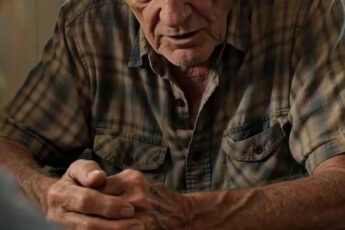
Miriam pushed with everything left in her old bones.
The white hand tightened around the edge of the door.
Its fingers were too long.
Too smooth.
Like roots grown under moonlight.
For one terrible second, Miriam thought she would not be strong enough. Forty years of guilt had made her tired. Forty years of silence had bent her back. Forty years of hearing a child cry in winter fog had worn grooves into her heart.
Then the suitcase at her feet trembled again.
“Nana,” the tiny voice whispered. “The bell.”
Miriam gasped.
“The bell?”
“In the pocket. Sewn where you hid my name.”
The pale hand pushed harder.
The door opened another inch.
Cold spilled through, carrying the smell of damp earth, old milk, and ashes.
From the other side, the thing behind the branches breathed:
“You promised us the child.”
Miriam’s tears ran hot down her wrinkled face.
“No,” she said, though her voice shook. “I was a coward. I was silent. But I never promised her.”
She dropped to one knee, keeping her shoulder pressed against the door, and fumbled at the side pocket of the leather suitcase. Her fingers found the torn lining. Beneath it, sewn into the old fabric with black thread, was a small silver bell.
She had not touched it in forty years.
It had belonged to the child’s cradle.
Miriam yanked it free.
The bell rang once.
Not loudly.
Not like church bells.
It made a thin, bright sound, no bigger than a tear hitting glass.
But the forest answered.
The white hand jerked back.
The tall shape hissed from behind the branches.
Miriam shoved the door with all her strength.
It slammed shut.
The black iron lock clicked.
For a moment, there was silence.
Then something on the other side began to laugh.
Softly.
Patiently.
As if it had all the time in the world.
Miriam sat on the cold stone floor, clutching the bell, her breath breaking in her chest.
The darkness around her was not the same as night. Night has edges. Night has stars somewhere above it. This darkness seemed to lean close, listening for weakness.
The suitcase trembled again.
“Nana?”
Miriam put one hand on the lid.
“I’m here.”
“Don’t say my name.”
“I won’t.”
“Not yet.”
Miriam closed her eyes.
Not yet.
For forty years she had carried that name like a burning coal hidden inside her.
She had never spoken it aloud.
Not in church.
Not at the market.
Not in her empty kitchen when the rain tapped against the windows.
Because the first rule of Briar Hill was this:
What the dark knows by name, it can keep.
And forty years ago, Miriam had learned that rule too late.
She lifted the suitcase onto the stone floor and unfastened the rusted clasps.
Inside was no child.
Only folded things.
A yellow wool dress.
One tiny shoe.
A wooden horse with a missing ear.
A strip of nursery curtain embroidered with blue flowers.
And beneath them all, wrapped in oilcloth, a birth certificate that had never been filed.
Miriam touched it with shaking fingers.
The writing was faded, but still readable.
Daughter of Thomas and Elspeth Vale.
Born under spring rain.
Name: Elowen Ruth Vale.
Miriam folded the paper quickly before the darkness could drink the letters.
“I kept it safe,” she whispered.
The voice came from somewhere ahead now, not from the suitcase.
“I know.”
Miriam looked up.
A narrow stairway descended beneath the hill.
The steps were wet and curved, cut into black stone. Roots hung from the ceiling like ropes. Far below, a faint golden glow flickered.
Miriam gripped the suitcase handle.
“I’m coming,” she said.
The voice answered:
“Then don’t look into the cradles.”
Miriam’s blood chilled.
“What cradles?”
But the child did not answer.
So Miriam began to descend.
Each step took her deeper into the place Briarwick pretended did not exist.
The air changed as she went.
At first it smelled of rain and earth.
Then of smoke.
Then of lavender soap.
Then of warm bread.
Then, worst of all, of milk.
Miriam nearly stumbled.
That smell dragged her backward through time.
Forty years earlier, she had been younger. Her hair had still been dark. Her hands had been strong. Her daughter Elspeth had lived in the cottage beyond the mill with her husband, Thomas, and their little girl.
Elowen.
A child with dark curls and serious eyes.
A child who called Miriam “Nana” and hid biscuits in her pockets for the sparrows.
A child who loved the silver bell on her cradle even after she was too big for cradles.
Then came the bad harvest.
The sheep died.
The river turned black for three days.
The old mill wheel stopped turning though no stone blocked it.
And the elders of Briarwick began to whisper the story everyone knew and no one wanted to admit.
Once, long before the church was built, the village had made a bargain with the thing under Briar Hill.
A child for a generation of safety.
One child given.
Many children spared.
That was how they said it.
They made murder sound like arithmetic.
Miriam had not believed it.
Not until the night Elowen vanished from her bed.
Not until she followed tiny footprints through mud behind the mill.
Not until she saw the elders standing before this very door with lanterns in their hands and shame hidden behind prayer.
Her own brother had been among them.
Edmund Vale.
The village magistrate.
A good man, people said.
A man who always tipped his hat.
A man who helped widows mend fences.
A man who looked Miriam in the eye and said:
“It has always been this way.”
Miriam had struck him hard enough to split his lip.
Then she had stolen the golden key from his coat and run through the door before the elders could stop her.
But she had been too late.
The dark had already taken Elowen below.
Miriam remembered running down these steps.
Remembered the cradles.
Remembered the white hands.
Remembered the child screaming, “Nana, don’t let them know my name!”
Miriam had found the silver bell on the ground.
She had rung it.
The dark had shrieked.
The door had begun to close.
And Miriam, terrified, wounded, half-mad with grief, had done the only thing she understood in that moment.
She locked the door.
She locked the thing beneath Briar Hill inside.
And Elowen with it.
The village called Miriam cursed after that.
Some said she had killed the child herself.
Some said grief had made her wicked.
Some said never to speak the little girl’s name, because names call back ghosts.
So Miriam stopped speaking.
Not because she forgot.
Because she was afraid the hill would hear.
The stairway ended.
Miriam stood in a vast chamber beneath Briar Hill.
It was not a cave.
Not truly.
It was a nursery.
Or a cruel memory of one.
Hundreds of wooden cradles hung from the roots above, swaying though there was no wind. Some were ancient, carved with symbols no living villager could read. Some were newer, painted in colors long faded by damp. Some had names scratched away from their sides.
Miriam remembered the warning.
Don’t look into the cradles.
So she kept her eyes on the path.
But she heard them.
Soft breathing.
Tiny sighs.
A lullaby hummed by no human mouth.
Then whispers began.
“Miriam…”
Her heart twisted.
The voice sounded like her daughter.
“Elspeth?” she breathed.
A cradle to her left creaked.
“Mama,” a little voice called from another. “Why didn’t you come?”
Miriam clenched the suitcase handle.
“No.”
Another voice giggled from the dark.
“Look at us.”
She did not.
The cradles swayed harder.
“Look at what the village gave us.”
Miriam walked faster.
Roots brushed her face like cold fingers.
At the far end of the chamber, beneath a circle of pale light, stood a small wooden bed.
Not a cradle.
A bed.
On it sat a girl in a yellow wool dress.
Her dark curls fell over her shoulders.
Her knees were drawn to her chest.
In one hand, she held the broken wooden horse.
Miriam stopped breathing.
Elowen looked exactly as she had the night she disappeared.
Five years old.
No older.
No younger.
Only her eyes had changed.
They were too old for her face.
“Nana,” she whispered.
The suitcase fell from Miriam’s hand.
She crossed the chamber, stumbling, sobbing, reaching.
Then she stopped just short of the bed.
Because Elowen flinched.
Not from fear of Miriam.
From fear of what might happen if they touched too quickly.
Miriam lowered herself to her knees.
“I’m sorry,” she said. “Oh, my little bird, I am so sorry.”
Elowen’s chin trembled.
“You shut the door.”
“I did.”
“You left me.”
“I did.”
The words struck like stones, but Miriam did not defend herself.
She had spent forty years building excuses in the lonely rooms of her mind.
I was afraid.
I was bleeding.
I thought I could come back sooner.
I thought the bell would hold it.
I thought the key would work from outside.
I thought someone would help me.
None of those excuses mattered to the child who had waited in the dark.
“Yes,” Miriam whispered. “I left you. I was wrong. I was scared, and I was wrong.”
Elowen stared at her.
For a long moment, only the cradles creaked above them.
Then the child said:
“I tried to stay angry.”
Miriam bowed her head.
“You had every right.”
“But if I stayed angry too long, it heard me better.”
Miriam looked up.
Elowen touched her own chest.
“So I kept remembering the kitchen instead.”
“The kitchen?”
“You making jam. Mama singing. Papa dropping the flour. The blue cup with the crack.”
Miriam covered her mouth.
Elowen’s eyes filled.
“I remembered everything it didn’t give me.”
The pale light around the bed flickered.
A voice rolled through the chamber.
Not loud.
Not shouted.
But everywhere.
“Touching.”
Miriam turned.
The tall shape stood between the hanging cradles.
Its face was still hidden by branches, but now Miriam could see what those branches were.
Not wood.
Hair.
Long, dead, tangled hair hanging over a face too smooth to be human.
Its body was thin and pale, wrapped in strips of old christening cloth. Tiny bells hung from its sleeves, all rusted silent.
“The grandmother returns,” it said. “Old. Guilty. Breakable.”
Miriam rose slowly, placing herself between Elowen and the thing.
“You will not have her.”
The creature tilted its head.
“We already have her.”
“No.”
The cradles above them rocked.
The thing laughed softly.
“The village gave. The door closed. The name was hidden. The child stayed. A bargain is a bargain.”
“There was no bargain,” Miriam said. “There was a crime.”
The thing leaned closer without moving.
“Words.”
Miriam’s fingers tightened around the silver bell.
The creature noticed.
Its hidden face shifted.
“Ah. The little noise.”
It raised one long hand.
The bell grew heavy in Miriam’s palm.
“Ring it,” the thing whispered. “Wake the cradles. Let all the forgotten mouths cry. Do you think your old heart will bear it?”
Miriam looked up.
Against her will, her eyes caught the nearest cradle.
Inside lay a bundle of cloth.
Not a body.
Not bones.
A name.
Letters scratched into the blanket, writhing like worms.
She looked away too late.
A child’s voice whispered:
“Agnes.”
Another cradle answered:
“Peter.”
Another:
“Mary.”
Another:
“Thomas.”
Names.
The stolen names of Briarwick’s children.
Each one forgotten so the village could pretend it had survived cleanly.
Miriam felt the chamber tilt.
Elowen grabbed her skirt.
“Nana, don’t listen.”
The creature spread its arms.
“Give us the girl’s name, Miriam Vale, and we will let you leave. You can die in your own bed. You can be remembered kindly. The village will say you were mad but harmless. Give us the name, and your guilt can sleep.”
Miriam looked at Elowen.
The child was trembling, but she did not hide.
For forty years, she had protected her name in darkness.
For forty years, she had kept herself from becoming another nameless whisper in a cradle.
Miriam took the birth certificate from the suitcase.
The chamber stirred.
The cradles stopped rocking.
The creature went very still.
“Miriam,” it said, and now its voice was sharp.
“Do not.”
Miriam unfolded the paper.
Elowen gasped.
“Nana, it will hear.”
“Yes,” Miriam said.
The creature smiled beneath its curtain of hair.
“At last.”
Miriam looked at the child.
“But it will not hear a secret. It will hear the truth.”
She lifted the paper high.
Then she rang the silver bell.
Once.
The sound cut through the chamber.
Thin.
Bright.
Alive.
Miriam spoke, her voice shaking at first, then growing stronger.
“This child is Elowen Ruth Vale.”
The creature screamed.
Miriam rang the bell again.
“She was born under spring rain to Elspeth Vale and Thomas Vale.”
The cradles began to shake.
“She was stolen from her bed by men and women who called fear tradition.”
The roots above them writhed.
The creature rushed forward, white hands outstretched.
Miriam rang the bell a third time.
“She was not promised.”
The creature shrieked.
“She was not given.”
Elowen stood on the bed.
Her small voice joined Miriam’s.
“I was not forgotten.”
The cradles split open.
Not all at once.
One by one.
Names burst from them like sparks.
Agnes.
Peter.
Mary.
Thomas.
Jane.
Samuel.
Rose.
Little voices filled the chamber, not crying now, but speaking.
Remember me.
Remember me.
Remember me.
The creature staggered, clutching its head.
The hair-branches fell back.
For the first time, Miriam saw its face.
There was nothing there.
No eyes.
No mouth.
Only smooth pale skin stretched over hunger.
It had worn the fear of the village for so long that it had no face of its own.
“No names,” it rasped. “No truth. No witness.”
Miriam reached for Elowen.
This time the child came.
Her small hand slid into Miriam’s.
Warm.
Real.
Miriam sobbed.
The chamber cracked.
Water poured down the walls. Roots snapped. The path behind them began to crumble.
“Run,” Elowen said.
Miriam grabbed the suitcase with one hand and Elowen with the other.
They ran beneath the breaking cradles.
The nameless thing came after them, crawling now, its long fingers scraping the stone.
“You owe us!”
Miriam did not look back.
At the foot of the stairs, Elowen stumbled.
Miriam lifted her.
Her old body screamed with pain, but she carried the child as she had carried her once through summer fields, long ago, when Elowen was sleepy and full of berries.
Step by step.
Breath by breath.
Behind them, the creature climbed.
The door above stood at the top of the stairway, a thin line of gray light around its frame.
But the golden key was gone.
Miriam’s heart stopped.
She searched her pocket.
Nothing.
The creature laughed from below.
“Lost things stay lost.”
Elowen touched Miriam’s cheek.
“Nana. The key was never gold.”
Miriam stared at her.
“What?”
“The key was what they buried.”
Elowen reached into the suitcase and pulled out the strip of nursery curtain embroidered with blue flowers.
Then she turned it over.
On the back, in Elspeth’s hand, was a stitched line Miriam had never been able to look at without breaking.
My daughter, Elowen Ruth Vale. Loved before birth. Loved beyond fear.
The door trembled.
Miriam understood.
The lock had never truly answered to metal.
It answered to memory.
To truth.
To what had been preserved when everyone else chose silence.
Together, Miriam and Elowen pressed the embroidered cloth against the black iron lock.
The door opened.
Rain and dawn spilled in.
Miriam carried Elowen through.
The creature lunged.
Its long white hand caught Miriam’s scarf.
For one terrible moment, the darkness pulled.
Elowen screamed.
Not a frightened scream.
A furious one.
“My name is Elowen Ruth Vale!” she cried. “And you cannot keep what is called home!”
The silver bell rang by itself.
The sound rolled across Briar Hill, down through the abandoned mill, over the wet roofs of Briarwick.
Every window in the village rattled.
Every sleeping villager woke with a child’s name on their tongue.
Agnes.
Peter.
Mary.
Thomas.
Jane.
Samuel.
Rose.
Elowen.
The dark thing released Miriam.
The door slammed shut.
The cradle carved into the post reappeared beneath the scratches, glowing faintly as if the wounded wood had remembered its first shape.
Then the black iron lock cracked in two.
Miriam collapsed on the wet grass with Elowen in her arms.
For a while, neither moved.
Rain fell softly.
Birds began to sing.
Real birds.
Small and uncertain at first, then louder.
Miriam opened her eyes.
Elowen was still there.
Still five years old.
Still warm.
Still clutching the broken wooden horse.
The child looked toward the trees.
“Is it morning?”
Miriam wept.
“Yes, little bird. It’s morning.”
By noon, half the village had climbed Briar Hill.
They came with lanterns, coats, crosses, shovels, rifles, prayers, and fear.
But no one found a monster.
No one found a door that opened.
They found Miriam Vale sitting beside the broken lock with a child in a yellow wool dress asleep against her lap.
At first, nobody spoke.
Then old Mrs. Harrow, who had been a girl when Elowen disappeared, stepped forward with trembling hands.
“I remember her,” she whispered. “I remember the day they said she wandered into the river.”
Miriam looked up.
“No,” she said. “She was taken.”
The word moved through the villagers like a cold wind.
Taken.
Not lost.
Not cursed.
Not imagined.
Taken.
That afternoon, the church bell rang without anyone pulling the rope.
Once for every name found beneath Briar Hill.
The old records were opened.
The locked boxes in the magistrate’s house were searched.
Letters were found.
Payments.
Lists.
Generations of careful handwriting proving what Briarwick had hidden behind harvest festivals, clean windows, and Sunday hymns.
A child given whenever the village feared hunger.
A child erased whenever the village wanted peace.
The guilty were mostly dead.
That was the cruelty of time.
But their names were not.
Miriam insisted on that.
“If the children must be named,” she said, standing in the church with Elowen’s hand in hers, “then so must those who handed them over.”
Some villagers wept.
Some lowered their eyes.
Some said their grandparents would never have done such things.
Then the oldest church ledger was opened, and the handwriting answered.
No one slept well in Briarwick that winter.
But for the first time in generations, no child cried from Briar Hill when the fog came down.
Elowen did not become ordinary overnight.
How could she?
She still looked five years old, though forty years had passed.
She woke screaming if a door closed too loudly.
She hid bread in her pockets.
She would not sleep in a room with a cradle, even a painted one.
Miriam brought her home to the little stone cottage at the edge of the village.
The same cottage where dust had gathered on shelves and grief had eaten meals alone for decades.
Now there were muddy shoes by the fire.
A yellow dress drying near the stove.
A wooden horse on the mantel.
A silver bell hanging beside the door.
Every night, Miriam made soup.
Every morning, Elowen asked if the hill was still closed.
Every morning, Miriam answered:
“Yes.”
“And my name?”
“Still yours.”
“And Mama?”
Miriam’s heart hurt each time.
Elspeth had died years before, never knowing the whole truth. Thomas too. Both had gone to their graves believing their daughter had been taken by a river, because Miriam had been too afraid to speak and too ashamed to stay near them.
One rainy evening, Miriam took Elowen to the churchyard.
The child stood before the two graves, small hands clenched.
“This is Mama?”
“Yes.”
“And Papa?”
“Yes.”
Elowen stared at the stones.
“She waited?”
Miriam closed her eyes.
“Every day.”
“Did she think I forgot her?”
“No, little bird. She thought the world had been cruel. But she never thought you forgot.”
Elowen placed the broken wooden horse between the graves.
Then she said, very softly:
“I came back.”
The wind moved through the yew trees.
For a moment, Miriam could almost hear her daughter’s voice.
I know.
Years passed differently after that.
Not easily.
But honestly.
Briarwick changed because it had to.
The abandoned mill was torn down stone by stone. Beneath it, villagers found old offerings: shoes, ribbons, carved toys, tiny spoons, locks of hair tied with thread. Each one was cleaned, named if possible, and placed in the church beneath a new window made of blue and gold glass.
The window showed no saint.
No king.
No angel.
It showed a grandmother holding a child’s hand before a closed door.
Under it were the words:
What is hidden in fear must be returned in truth.
Miriam lived long enough to see Elowen grow.
Not as other children grew.
For the first year, she remained five.
Then slowly, as if time had to learn how to touch her gently, she began to change.
Six.
Seven.
Eight.
She learned letters at the kitchen table.
She planted beans in the garden.
She laughed for the first time at a cat chasing its own tail, and Miriam cried so hard Elowen had to fetch her a towel.
“Are you sad?” the child asked.
“No,” Miriam said, laughing through tears. “That is the trouble with old hearts. Sometimes joy leaks out strangely.”
Elowen considered this.
Then she handed Miriam the towel and said:
“You leak a lot.”
Miriam laughed until the kettle screamed.
Not everyone in Briarwick loved the truth.
Some hated Miriam for disturbing old graves and older reputations.
Some crossed the street when Elowen passed.
Some whispered that a child who came back from under the hill could not be entirely human.
The first time Elowen heard that, she came home silent.
Miriam found her sitting under the kitchen table with the wooden horse in her lap.
“Am I wrong?” Elowen asked.
Miriam lowered herself stiffly to the floor beside her.
“No.”
“They look at me like I’m the door.”
“You are not the door.”
“What am I?”
Miriam took her hand.
“You are the child who came through it.”
Elowen leaned against her.
That was enough for that day.
Years later, when Miriam’s hair had turned white as milk and her hands shook too much to sew, Elowen was nearly grown. Her face carried both childhood and the strange oldness of someone who had survived a place without clocks.
She became the keeper of Briarwick’s names.
Every winter, when fog rolled down from Briar Hill, she walked to the church and read aloud from the book they had made.
Agnes Wren.
Peter Moss.
Mary Vale.
Thomas Reed.
Jane Holloway.
Samuel Cross.
Rose Alder.
And all the others.
No child cried from the hill anymore.
But the village listened.
It learned to listen.
On Miriam’s last night, rain tapped softly against the cottage windows.
Elowen sat beside her bed, holding the silver bell.
Miriam’s breath was thin.
“Are you afraid?” Elowen asked.
Miriam smiled faintly.
“Of dying? No.”
“Of the door?”
“No.”
Elowen’s eyes filled.
“I was angry with you for a long time.”
“You should have been.”
“I still am sometimes.”
“You may be.”
“But I love you too.”
Miriam turned her hand palm up.
Elowen took it.
“I love you,” Miriam whispered. “I loved you before fear. I loved you through it. I loved you badly for many years. But I loved you.”
Elowen bent over her hand.
“I know.”
Just before dawn, Miriam Vale heard birdsong.
She smiled once.
Then she was gone.
They buried her beside Elspeth and Thomas, beneath a stone carved with a small silver bell.
Elowen stood through the whole service without lowering her head.
When the priest asked if anyone wished to speak, she stepped forward.
“My grandmother was not brave when she first ran from the hill,” she said. “She was afraid. She made mistakes. Her fear hurt me. But she came back. And when she came back, she told the truth. That does not erase what happened. But it opened the door.”
No one moved.
Elowen looked toward Briar Hill.
“Remember that. Some doors stay closed because monsters hold them. Others stay closed because people are ashamed to open them.”
After the funeral, she returned alone to the top of Briar Hill.
The old doorpost remained, though the door itself would never open again.
The cradle carving was whole now.
Moss grew in the lines.
Elowen placed the silver bell at its base.
For a moment, the forest went silent.
Then, from somewhere deep below, a faint sound rose.
Not crying.
Not laughter.
Only one soft chime, answering goodbye.
Elowen did not run.
She stood in the rain, her hand on the healed wood.
Then she spoke her name clearly.
“Elowen Ruth Vale.”
The trees shivered.
Nothing took it.
Nothing answered.
The name belonged to her.
And that was the end of the bargain.
Years later, children in Briarwick were told not to fear the path behind the old mill.
They were told to respect it.
They were told what people had done there, what fear had excused, what silence had protected, and what truth had finally undone.
And when winter fog rolled down Briar Hill, mothers no longer pulled children away from the windows.
They opened them.
They listened.
Not for crying.
For bells.
Because sometimes the thing buried under a village is not a monster.
Sometimes it is a secret.
Sometimes it is a name no one was brave enough to say.
And sometimes, after forty years of silence, an old woman climbs a hill in the rain with a suitcase full of proof and brings a child home.
❤️ Do you believe some truths wait for years until someone is finally brave enough to speak them? Can love still matter if it comes late, wounded, and full of regret? Share what this story made you feel — because sometimes the most haunted doors are not opened by keys, but by names remembered.