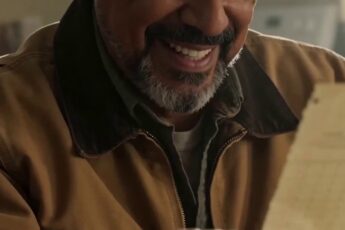
For a long moment, Caleb only stared at the letter in his hands.
The paper was yellowed with age and thin at the folds. The ink had faded in places, but the words were still there, careful and slanted, as if someone had written them with a shaking hand and a full heart.
If my son ever stands before this portrait, let him know he was loved before he knew words.
Caleb traced one finger under the sentence.
Not touching the ink.
Just following it.
As if the words might disappear if he breathed too hard.
The hall stayed silent around him.
The guests who had come for champagne and an unveiling now stood with their coats half-buttoned and their glasses forgotten. The donors near the front no longer looked important. The silver trays, the candles, the polished floor, the soft piano music — all of it seemed suddenly too small for the moment happening in the middle of the room.
Dr. Hayes knelt beside Caleb.
“Do you know who gave your mother the drawing?” he asked gently.
Caleb nodded.
“My grandma kept it in a Bible.”
“Your grandmother?”
“She said it belonged to her mother before that. But nobody knew why.” He looked at the portrait again. “Mom said if I ever saw the lady in blue, I should bring the folder. She said some stories wait until people are ready.”
Dr. Hayes looked down at the fragile drawing.
The same blue skirt.
The same white lily.
The same small hand reaching from the blanket.
It was not a copy.
It was a missing piece.
A small, unfinished corner of a much larger truth.
One of the museum board members, a tall man in a gray suit, stepped closer.
“Dr. Hayes,” he said quietly, “are you suggesting this child is connected to the painting?”
Dr. Hayes did not look away from Caleb.
“No,” he said. “I am suggesting the painting may be connected to him.”
A murmur passed through the hall.
Caleb’s shoulders drew inward, as if the attention had become too heavy.
Dr. Hayes noticed immediately.
He turned to the room.
“Everyone, please give him space.”
The guests moved back.
Some reluctantly.
Some with shame.
A woman in pearls wiped at her eyes with a napkin. A young server stood frozen near the staircase, holding a tray of untouched glasses. Even the pianist had stopped playing.
Caleb still held the letter.
“Can I read the rest?” he whispered.
Dr. Hayes looked surprised.
“There is more?”
Caleb turned the paper over.
There, on the back, in smaller writing, were more lines.
Dr. Hayes had not seen them before.
Caleb held the letter out.
His hand trembled.
“You read it,” he said. “My voice gets stuck.”
Dr. Hayes took the paper carefully.
Then he stood beside the portrait and read.
“If my son is old enough to ask why I did not come for him, tell him I tried.”
A sound moved through the room.
Not a gasp exactly.
Something softer.
A shared ache.
Dr. Hayes continued.
“I painted him in my arms because that is the only place I wanted him to remember himself. Not as a burden. Not as a secret. Not as the child others said would ruin my future. He was my future.”
Caleb lowered his eyes.
The cardboard folder bent slightly under his fingers.
“I was told this portrait would be sold, cut, hidden, renamed, or forgotten,” Dr. Hayes read. “So I placed this letter where only the missing lily would lead someone to look. If my child or his child or any child of his blood ever finds it, let them know this: love does not always arrive in time to save the day, but it can still leave a path.”
Dr. Hayes paused.
His own voice had roughened.
Caleb looked up at him.
“Keep going.”
Dr. Hayes nodded.
“The cradle was never empty. The name was never erased. His name is written beneath the paint, under the white blanket, where no one thought to look.”
Every eye in the hall moved to the painting.
The baby in the portrait was wrapped in white cloth, one tiny hand visible, the rest softened by shadow and age.
Dr. Hayes turned toward the museum staff.
“Bring the conservation light.”
Within minutes, an assistant returned with a narrow ultraviolet lamp from the back room. The event guests stood in a wide circle now, watching not like patrons at a gala, but like witnesses at a bedside.
Dr. Hayes put on cotton gloves.
He looked at Caleb.
“May I?”
Caleb nodded.
The curator carefully moved the light across the lower section of the painting.
At first, nothing happened.
Just the blue dress.
The cradle.
The white blanket.
The lily.
Then, beneath the thin layers of old varnish, something appeared.
Faint.
Almost ghostlike.
Letters.
Dr. Hayes leaned closer.
The museum assistant covered her mouth.
There, hidden beneath the painted fold of the baby’s blanket, was a name.
Caleb.
The boy stopped breathing.
The name was not new.
It was his.
But seeing it there, sleeping under paint that was older than everyone in the room, made it feel like the world had just reached back through time and touched his shoulder.
“My name,” he whispered.
Dr. Hayes swallowed.
“Yes.”
Caleb shook his head slowly.
“But how could she know?”
An older woman standing near the coat rack stepped forward.
She had come in quietly with Caleb and had stayed behind him the entire time. Her wool coat was worn at the cuffs, and her gray hair was tucked beneath a knitted hat.
Dr. Hayes turned to her.
“Are you with him?”
The woman nodded.
“I’m Mrs. Parker. I live downstairs from Caleb and his mother.”
Caleb glanced at her.
She smiled gently at him.
“Your mama told me to bring you if she couldn’t.”
The boy’s face changed.
“Don’t say it like that.”
Mrs. Parker’s eyes filled.
“I’m sorry, sweetheart.”
Dr. Hayes softened his voice.
“Is Caleb’s mother here?”
Mrs. Parker shook her head.
“She’s at St. Luke’s. She’s been ill.” She looked at Caleb carefully. “But she’s fighting.”
Caleb hugged the folder against his chest.
“She wanted to come,” he said quickly. “She tried to stand up this morning, but she got dizzy. She said the painting was only here for one night, and if we missed it, maybe it would go away again.”
Dr. Hayes looked toward the portrait.
Something in his expression changed.
Not professional curiosity anymore.
Responsibility.
“It will not go away from him,” he said.
The board member in the gray suit cleared his throat.
“This is all very moving, of course, but we need verification before making any public claims.”
Dr. Hayes turned to him.
“Of course.”
The man nodded, relieved.
Then Dr. Hayes added, “But compassion does not require verification.”
The man had no answer.
Mrs. Parker looked at Caleb.
“Your mother told me one more thing,” she said.
Caleb frowned.
“What?”
“She said if they found the name, you should ask about the blue ribbon.”
Caleb opened the folder again and pulled out something tucked behind the drawing.
A thin strip of faded blue ribbon.
It was old, frayed at both ends, and tied in a loose knot.
Dr. Hayes stared at it.
Then he turned to the portrait.
Around the painted woman’s wrist was a blue ribbon.
Almost hidden in the folds of her sleeve.
The same shade.
The same width.
Mrs. Parker whispered, “His mother kept that ribbon in a little envelope. She said it was passed down with the drawing.”
Dr. Hayes looked at Caleb.
“Do you know your mother’s full name?”
“Anna Lily Morgan.”
At the word Lily, several people looked toward the painted flower.
Dr. Hayes closed his eyes briefly.
“The portrait was cataloged as Woman in Blue with Lily. The artist was unknown for years. But last month, when it was donated, we found a partial signature. E. Morgan.”
Caleb’s lips parted.
“Morgan?”
“Yes.”
“That’s Mom’s name.”
Dr. Hayes looked at the painting again.
“And perhaps the artist’s.”
The room stirred.
The famous painting had arrived with a story made for wealthy guests: mysterious, elegant, rare, valuable.
But now its mystery had a name.
A family.
A child in scuffed shoes.
A mother in a hospital bed who had spent years protecting a drawing because she believed a picture could remember what people tried to forget.
Caleb looked at the woman in blue.
“Was she my family?”
Dr. Hayes knelt again.
“I think she may have been.”
“My mom said the lady looked sad.”
Dr. Hayes studied the portrait.
“She does.”
Caleb shook his head.
“No. Not sad like crying. Sad like waiting.”
That sentence made the curator look back at the painting differently.
Everyone did.
The woman in blue was not posed like a grand lady.
She was holding the baby close, almost protectively. Her eyes were not fixed on the painter or the viewer. They seemed turned toward a door that had not opened.
Or one she hoped someday would.
A young assistant came from the back office carrying a folder of records.
“Dr. Hayes,” she said, voice trembling, “the donation file includes an old inventory note. The painting came from a private estate in Boston. There was a mention of a removed panel. It says the lower section was damaged during transport in 1931.”
Dr. Hayes looked at Caleb’s drawing.
“Or removed.”
The assistant nodded.
“There’s more.”
She handed him the paper.
He read quickly.
Then slower.
Then he looked at Caleb.
“The original title was not Woman in Blue with Lily.”
Caleb waited.
Dr. Hayes spoke carefully.
“It was called Mother Holding Caleb.”
The boy’s face crumpled.
Not fully.
Just enough for everyone to see the child beneath the courage.
“She knew his name,” Caleb whispered.
“Yes.”
“Then why did people forget it?”
No one answered immediately.
Because sometimes the questions children ask are too honest for adult explanations.
Finally, Dr. Hayes said:
“Sometimes people hide things because they are ashamed. Sometimes because they are afraid. Sometimes because the truth would cost them something.”
Caleb looked at the painting.
“But she didn’t hide me.”
“No,” Dr. Hayes said. “She hid the truth for you to find.”
Caleb held the letter against his coat.
Mrs. Parker wiped her face.
The woman in pearls near the front suddenly stepped forward.
“I’m sorry,” she said softly.
Caleb looked at her, confused.
She pressed a hand to her chest.
“When you came in, I thought…” She stopped, ashamed of her own thought. “I thought you didn’t belong here.”
Caleb looked down at his shoes.
The left one had a loose lace.
Mrs. Parker moved closer to him.
Dr. Hayes said gently, “He may be the person in this room who belongs here most.”
The woman’s eyes filled.
“You’re right.”
Caleb did not answer.
But he stood a little straighter.
That mattered.
Dr. Hayes looked at Mrs. Parker.
“Can we call his mother?”
Caleb’s head lifted.
“Now?”
“If you want to.”
He nodded quickly.
Mrs. Parker pulled out an old phone with a cracked case. Her hands shook as she found the number.
The hall stayed silent while the call rang.
Once.
Twice.
Three times.
Then a weak voice answered.
“Mrs. Parker?”
Caleb took the phone.
“Mom?”
A soft sound came through the speaker.
“Caleb? Did you see it?”
His eyes filled.
“I saw her.”
Everyone in the room seemed to lean closer without moving.
“She had the lily,” he said. “And the letter. And my name was in the painting.”
There was silence on the other end.
Then his mother began to cry.
Not loudly.
Not dramatically.
Just a tired, relieved cry that told everyone she had been carrying this hope longer than a child could understand.
“She remembered you,” Caleb said, as if comforting her.
His mother laughed through tears.
“No, baby. She remembered us.”
Caleb looked at Dr. Hayes.
“He says maybe she was family.”
His mother breathed shakily.
“My grandmother always said we came from a woman who painted her child so the world couldn’t erase him. But no one believed her.”
“I believed you,” Caleb said.
“I know you did.”
His small face became very serious.
“Mom, can you come see it?”
There was a pause.
Too long.
Caleb’s fingers tightened around the phone.
Then Dr. Hayes stood.
“Mrs. Morgan,” he said clearly, “this is Dr. Hayes, curator at Westbridge Cultural Center. The painting will remain here. I give you my word. When you are well enough, you and Caleb will see it together privately.”
The voice on the phone broke.
“Thank you.”
“No,” Dr. Hayes said, looking at Caleb. “Thank you for sending him.”
Caleb handed the phone back to Mrs. Parker after his mother whispered that she loved him three times.
He did not cry until the call ended.
Then his chin trembled.
Mrs. Parker opened her arms.
Caleb leaned into her, still holding the letter and the folder, and finally cried into her coat.
No one rushed him.
No one told him to be brave.
He had already been brave enough.
A few minutes later, Dr. Hayes asked the staff to close the exhibit early.
The board member began to object, but the look on the curator’s face stopped him.
“This painting has waited long enough,” Dr. Hayes said. “Tonight it belongs to the family it called back.”
They moved Caleb and Mrs. Parker into a smaller room off the main gallery. Someone brought hot chocolate. Someone else found a sandwich from the catering kitchen and cut it in half. A volunteer quietly retied Caleb’s scarf, asking permission first.
He sat at a small table with the letter in front of him.
Dr. Hayes placed the drawing beside a printed image of the portrait. Together, the two pieces aligned almost perfectly.
The missing edge.
The reaching hand.
The lily.
The blue ribbon.
Caleb touched the paper.
“Can Mom have a copy?”
“She can have more than a copy,” Dr. Hayes said. “We will make sure this drawing is preserved properly. But it remains yours unless your mother decides otherwise.”
Caleb looked surprised.
“Mine?”
“Yes.”
“Even though it belongs with the painting?”
Dr. Hayes smiled softly.
“Belonging together does not always mean one thing must take the other away.”
Caleb seemed to think about that.
Then he nodded.
“My mom will like that.”
The next morning, the story reached the local news.
By afternoon, people were calling the cultural center.
Some wanted to donate.
Some wanted to see the painting.
Some wanted to know whether the boy was really connected to the woman in blue.
Dr. Hayes refused to turn Caleb into a spectacle.
He released only one statement:
A family drawing has helped restore the history of a painting long separated from its truth. Further study will continue with the family’s consent.
But inside the cultural center, things changed.
The label beneath the portrait was removed.
No longer:
Woman in Blue with Lily, artist unknown.
A temporary card replaced it:
Mother Holding Caleb. Artist believed to be E. Morgan. History under restoration.
Under that, Dr. Hayes added one sentence:
This painting was incomplete until a child brought back what it had lost.
Two weeks later, Anna Morgan arrived.
She came in a wheelchair, wrapped in a green coat, with a knitted hat pulled low over her hair. Caleb walked beside her, holding the folder with both hands. Mrs. Parker came too, carrying a thermos of tea because she said hospitals and museums both forgot that people needed warmth.
Dr. Hayes met them at the entrance before the doors opened to the public.
“No guests today,” he said. “Just you.”
Anna looked toward the gallery.
Her face was pale and tired, but her eyes were bright.
“I was afraid I wouldn’t make it.”
Caleb squeezed her hand.
“You made it.”
They moved slowly into the hall.
The portrait waited beneath soft light.
When Anna saw it, she covered her mouth.
Caleb watched her closely.
“Mom?”
She nodded, crying.
“I’m okay.”
But she was not only okay.
She was looking at a story her grandmother had whispered, her mother had doubted, and she had chosen to believe anyway.
She reached for Caleb’s hand.
“There she is,” she whispered.
“The lady in blue,” Caleb said.
Anna shook her head gently.
“Our lady in blue.”
Dr. Hayes gave them space.
Anna sat before the painting for a long time.
Then she looked at the baby in the cradle.
“At first, I thought the baby was you,” Caleb said.
Anna smiled.
“In a way, maybe he is.”
“But he was named Caleb too.”
“Yes.”
“Why did you name me that?”
Anna’s tears fell freely now.
“Because my grandmother asked me to. She said the name had been carried through the family like a candle in a storm. I didn’t know why. I only knew it mattered.”
Caleb stood very still.
“A candle in a storm,” he repeated.
Anna nodded.
Then she took the old blue ribbon from the folder and held it in her palm.
“My grandmother said this ribbon came from a woman who tied it around her wrist so her child would know her if the world separated them.”
Dr. Hayes looked at the portrait.
The painted ribbon around the woman’s wrist glowed faintly in the light.
Caleb leaned against his mother’s chair.
“Did she find him?”
Anna kissed the top of his head.
“I don’t know.”
Caleb looked at the painting.
“I think she found him today.”
No one corrected him.
Because sometimes history is not only dates and documents.
Sometimes it is a boy standing in front of a painted mother and deciding that waiting can end.
In the months that followed, Anna grew stronger.
Slowly.
Not like a miracle in a movie.
Like real healing.
With difficult mornings.
With doctor visits.
With soup from Mrs. Parker.
With Caleb doing homework at the kitchen table while his mother rested nearby.
Dr. Hayes visited them more than once, bringing copies of records and old photographs. Together, they traced names through archives, census pages, estate inventories, and family stories that had almost disappeared.
They learned that the artist, Eleanor Morgan, had painted the portrait after being forced to give up her son because she was unmarried and poor. The painting had been taken by relatives, renamed, trimmed, sold, and passed through private collections until everyone forgot the baby had a name.
But Eleanor had hidden the letter.
She had hidden the name under paint.
She had painted the lily.
She had left a path.
And generations later, a boy named Caleb had walked into the room carrying the missing piece.
When the research was complete, the Westbridge Cultural Center held a new unveiling.
This time, it was not a gala for donors.
It was a quiet community event.
There were folding chairs instead of crystal glasses.
Cookies on paper napkins.
Hot cider in paper cups.
Children from Caleb’s school sat cross-legged near the front.
Anna sat beside Mrs. Parker.
Caleb wore a new scarf, still tied unevenly because he insisted on doing it himself.
Dr. Hayes stood before the portrait and spoke.
“For years, this painting was admired for its beauty,” he said. “But beauty without truth is incomplete.”
He looked at Caleb.
“This child brought us the truth.”
Caleb looked down, embarrassed.
The audience smiled.
Dr. Hayes continued:
“The painting is now restored in name, in history, and in purpose. It will remain here with the family’s blessing, not as an object separated from life, but as proof that memory can survive hiding, distance, and time.”
Then he pulled away the small cloth covering the new label.
Mother Holding Caleb
Eleanor Morgan
Restored with the help of Caleb Morgan and Anna Lily Morgan, descendants of the child named in the painting.
Beneath it was the sentence from the hidden letter:
He was loved before he knew words.
Anna began to cry.
Caleb took her hand.
“You okay?”
She smiled.
“Yes. These are the good tears.”
After the ceremony, people lined up quietly to see the painting.
Not pushing.
Not whispering like gossip.
Standing with respect.
The woman in pearls who had apologized that first night came too. She knelt carefully beside Caleb and handed him a small envelope.
“I wrote something for the museum,” she said. “About judging too quickly. I wanted you to know I haven’t forgotten.”
Caleb looked at Anna.
Anna nodded.
He accepted the envelope.
“Thank you.”
The woman smiled.
“No. Thank you.”
Later, when the hall emptied, Caleb stood alone before the portrait.
Dr. Hayes approached.
“What do you see now?” he asked.
Caleb thought for a long time.
“The first time, I saw the lady in blue.”
“And now?”
Caleb looked at the painted mother, the baby, the lily, the blue ribbon, the hand reaching from the blanket.
“Now I see that she wasn’t just waiting.”
Dr. Hayes waited.
Caleb smiled softly.
“She was holding on.”
Dr. Hayes looked at the painting.
Then at the boy.
“Yes,” he said. “I think she was.”
Caleb reached into his cardboard folder one last time and took out a new drawing.
Not old.
Not fragile.
This one was made with colored pencils.
It showed the woman in blue, the baby, the lily, and beside them a boy in a crooked scarf holding his mother’s hand.
At the bottom, Caleb had written:
The picture found us.
Dr. Hayes framed that drawing too.
Not beside the original, where it might become part of the exhibit in a formal way.
He placed it in his office, above his desk, where he could see it every morning.
To remind himself that museums were not built only for paintings.
They were built for the people who come looking for themselves inside them.
Years later, visitors would stand before Mother Holding Caleb and read the story on the wall.
Some cried.
Some smiled.
Some held their children closer.
Some called relatives they had not spoken to in years.
And many noticed the smallest detail last:
the painted white lily near the cradle.
A flower that once seemed decorative.
A flower that had led a boy to the truth.
A flower his mother had told him to follow.
Caleb still visited the cultural center every winter.
He grew taller. His sleeves eventually fit. His shoes stopped being scuffed. But he never stopped carrying things carefully.
Sometimes he brought his mother.
Sometimes Mrs. Parker.
Sometimes he came alone and sat on the bench across from the painting.
One snowy afternoon, years after that first night, Dr. Hayes found him there.
Caleb was older now, almost grown, but his scarf was still tied unevenly.
“Still checking on her?” Dr. Hayes asked.
Caleb smiled.
“Still letting her check on me.”
They sat together in silence.
The hall was warm. Snow melted from visitors’ coats near the entrance. Somewhere by the stairs, a pianist played softly.
And on the wall, beneath gentle light, the woman in blue held her child forever.
Not hidden.
Not renamed.
Not forgotten.
The painting had remembered him.
And because one quiet boy had been brave enough to bring a worn cardboard folder into a room full of people who almost looked past him, the world remembered her too.
💬 Have you ever kept an old drawing, photograph, letter, or small family object that turned out to carry more meaning than anyone realized? Or has a forgotten piece of your family’s story ever found its way back to you? Share your thoughts in the comments — I’d truly love to know what this story made you feel.