For a few seconds, Rosie’s Café was so quiet that everyone could hear the old wall clock above the pie case ticking.
The youngest biker stood beside table seven with his hands half-raised, as if he still felt the weight of the cane even after he had put it back.
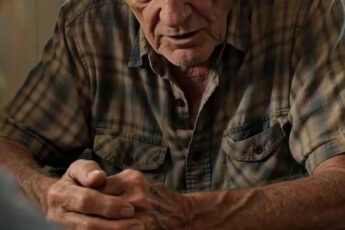
Walter Hayes sat exactly where he always sat.
By the window.
Coffee cooling beside his oatmeal.
Toast untouched on the small white plate.
His right hand rested on the silver eagle at the top of the cane, not gripping it in fear, not showing it off, just holding it the way a man holds something that has carried him through many years.
The tall man who had called him Dad stood behind him now.
His name was Michael Hayes.
Most people in town knew Michael. He ran a small repair yard outside the county road, the kind with old trucks, coffee in paper cups, and men who could fix a broken engine before some people found the hood latch. But in that moment, he did not look like a mechanic or a business owner.
He looked like a son.
Behind him stood his brothers, Daniel and Robert, and two younger men Walter had helped raise after their own fathers disappeared from their lives. They did not speak. They did not threaten. They simply stood there, solid and quiet, the way people stand when love has already decided what side it is on.
The youngest biker swallowed.
His friends had stopped laughing.
The leader of their group, a broad man with a gray beard and a faded tattoo on his neck, looked from Walter to the men at the door.
Then he looked at the young biker.
“Jace,” he said low, “apologize.”
Jace’s face went red.
He was no longer grinning. No longer leaning into the room like it belonged to him. He looked younger now, almost boyish beneath the leather jacket and hard expression.
“I didn’t know,” he muttered.
Walter looked at him.
“That is not an apology.”
Rosie, behind the counter, slowly lowered the coffee pot she had been holding. Her eyes were bright, but her mouth stayed firm.
Jace looked at the cane again.
Then at Walter.
“I’m sorry,” he said, a little louder. “I shouldn’t have touched it.”
Walter waited.
The room waited too.
Jace shifted his boots on the tile.
“And I shouldn’t have spoken to you like that.”
Walter nodded once.
Not warmly.
Not cruelly.
Just enough to say he had heard him.
Michael stepped closer, but Walter lifted one hand slightly.
The son stopped.
That small gesture said more than a shout could have.
Walter did not need anyone to fight his battle for him.
He only needed the room to remember that quiet people still deserved respect.
The biker with the gray beard took off his gloves and tucked them into his pocket.
“Mr. Hayes,” he said, “we didn’t come in here to cause trouble.”
Rosie gave him a look from behind the counter.
He cleared his throat.
“All right. Maybe we came in too loud.”
A few people in the café almost smiled.
Almost.
Walter leaned back in his chair.
“Loud is not always the problem,” he said. “It is what a man does with his loudness.”
The gray-bearded biker nodded slowly.
“That’s fair.”
Jace stared at the floor.
Michael’s jaw remained tight, but he kept silent.
Walter turned the cane slightly, and the silver eagle caught the morning light from the window. Its wings were carved with remarkable detail. The handle was worn smooth beneath Walter’s fingers, but the eagle’s eyes were still sharp.
Jace looked at it again.
This time, not like a toy.
Like a thing with history.
Walter noticed.
“My wife gave me this cane,” he said.
The room softened at the word wife.
Rosie’s face changed immediately. She had known Evelyn Hayes before the illness took her. Everyone who had ever spent time in that café knew Walter still came to table seven because it had been Evelyn’s favorite table.
“She bought it for me after my knee gave out,” Walter continued. “I told her I didn’t need a fancy stick. She told me if I was going to be stubborn, I might as well be stubborn with style.”
A small laugh moved through the café.
Even Michael smiled, though his eyes had grown wet.
Walter looked at the silver eagle.
“She said the eagle was to remind me to keep my head up.”
Jace’s expression shifted.
Something in him loosened.
For the first time, he seemed to understand that he had not just grabbed an old man’s cane.
He had put his hand on a memory.
On a marriage.
On Friday mornings.
On a woman who was no longer there to defend the man she loved.
“I really am sorry,” Jace said.
This time the words sounded different.
Walter heard it.
So did Rosie.
So did everyone else.
Walter studied the young man for a long moment.
“What is your name?”
“Jace.”
“How old are you, Jace?”
“Twenty-two.”
Walter gave a faint nod.
“Old enough to know better. Young enough to learn.”
Jace looked up quickly.
He had expected anger.
Maybe humiliation.
Maybe one of Walter’s sons to drag him outside by the jacket.
He had not expected a lesson.
Walter pointed with the cane toward the empty chair across from him.
“Sit down.”
Jace froze.
“What?”
“Sit.”
Michael frowned.
“Dad…”
Walter did not look away from Jace.
“Let him sit.”
The gray-bearded biker gave Jace a push between the shoulder blades.
“Do what the man says.”
Jace sat across from Walter at table seven.
He looked uncomfortable there, his leather jacket creaking, his hands locked together on the table. He seemed too big for the chair and too small for the moment.
Rosie came over with the coffee pot.
“Coffee?” she asked Walter.
Walter lifted his cup.
Rosie filled it.
Then she looked at Jace.
He hesitated.
“Yes, ma’am.”
Rosie poured.
“No sugar on the table,” she said. “You want sweet, ask politely.”
“Yes, ma’am.”
A few customers hid smiles behind napkins.
The other bikers stood awkwardly near the door until Rosie pointed toward an empty booth.
“You boys going to stand there blocking the entrance all morning, or are you ordering breakfast?”
The gray-bearded biker blinked.
Then he gave a short, humbled laugh.
“Breakfast sounds good.”
“Good,” Rosie said. “Boots off the chair, voices inside your bodies, and nobody touches anything that doesn’t belong to him.”
“Yes, ma’am,” he replied.
Just like that, the café began breathing again.
Not normally.
Not yet.
But enough.
The men in dark jackets stayed near the window, though Walter’s sons slowly relaxed. Daniel walked over to the counter and kissed Rosie on the cheek because she had known him since he was eight and still called him Danny when she wanted to annoy him.
Michael remained behind his father’s chair.
Walter knew he was there without turning around.
“You can sit too,” Walter said.
“I’m fine.”
“You are hovering.”
Michael sighed and pulled a chair from the next table.
Walter looked at Jace.
“You still have both parents?”
Jace’s fingers tightened around the coffee cup.
“My mom. My dad left when I was little.”
Walter nodded.
“Grandfather?”
Jace’s eyes flickered.
“Had one.”
“Had?”
“He passed last winter.”
The café grew quieter around them, not because everyone meant to listen, but because grief has a way of changing the air.
Walter took a slow sip of coffee.
“Did you treat him better than you treated me?”
Jace’s face went pale.
The question was not cruel.
That made it harder.
“I don’t know,” he admitted.
Walter waited.
Jace looked toward the window.
“He used to sit in a diner too. Not this one. Back home. Same booth every Saturday. He’d ask me to come. I didn’t go much.”
Rosie stopped wiping the counter.
Jace swallowed.
“He had a cane. Not like yours. Just plain. I used to hate the sound it made in the hallway. It made him seem old.”
Walter’s expression did not change, but his eyes softened.
“And now?”
Jace’s voice dropped.
“Now I’d give anything to hear it again.”
No one spoke.
Michael looked down at his hands.
Rosie turned away and pretended to check the pie shelf.
Walter tapped the silver eagle once with his thumb.
“That is the trouble with young men,” he said. “They think strength means taking up space. Later they learn strength was sometimes sitting beside someone before the chair became empty.”
Jace wiped quickly at his face, as if something had gotten in his eye.
Walter pushed his untouched toast across the table.
“Eat.”
Jace looked startled.
“I can’t take your breakfast.”
“I never finish it.”
Rosie called from the counter, “That is the first true thing he’s said all week.”
Walter gave her a look.
She ignored it.
Jace took the toast with both hands, almost respectfully.
The gray-bearded biker watched from the booth, his expression heavy. His group had quieted too. They were drinking coffee now, not laughing, not throwing their weight around, not pretending the room belonged to them.
Something had changed.
Not because the black trucks had arrived.
Not because Walter’s sons looked strong.
But because an old man at table seven had refused to let a foolish moment become only shame.
He had turned it into a mirror.
And Jace had looked.
After a while, Walter leaned the cane against the table again.
“Pick it up,” he said.
Jace froze with the toast halfway to his mouth.
“No, sir.”
“I said pick it up.”
Michael straightened.
Walter lifted one hand again.
Jace reached slowly, carefully, and took the cane.
This time he held it with both hands.
Not spinning it.
Not mocking it.
Holding it like something borrowed.
Walter nodded toward the silver eagle.
“What do you see?”
Jace looked down.
“An eagle.”
“More.”
Jace studied it.
“It’s worn here. Where your hand goes.”
“Yes.”
“And there’s… a little scratch under the wing.”
Walter smiled faintly.
“My grandson dropped it on the porch when he was six. Cried harder than I did.”
Michael smiled.
“He thought Grandma was going to come down from heaven and scold him.”
“She would have,” Walter said.
A warmer laugh passed through the café.
Jace looked at the cane more carefully.
“There are initials,” he said.
Walter nodded.
“E.H.”
“Your wife?”
“Evelyn Hayes.”
Jace held the cane out.
Walter took it back.
“Now you know,” Walter said. “A thing can look like just a thing until you learn who loved it.”
Jace bowed his head.
“Yes, sir.”
Walter sat back.
“Good. Remember that before you put your hands on anything that belongs to another person.”
Jace nodded.
“I will.”
The morning moved on.
Rosie served eggs, bacon, oatmeal, toast, coffee, and blueberry pancakes to people who suddenly spoke more softly than usual. The biker group paid for breakfast without complaint. Jace tried to pay for Walter’s coffee, but Walter shook his head.
“No.”
Jace looked disappointed.
Walter pointed to the counter.
“You want to do something useful, fix that loose step outside. Rosie has been pretending it is not a problem for three months.”
Rosie turned around.
“I have not been pretending. I have been ignoring it with confidence.”
“That’s what I said.”
The café laughed.
This time fully.
Jace looked at the gray-bearded biker.
The older man shrugged.
“You heard him. We’ve got tools in the saddlebag.”
By ten o’clock, the same young man who had mocked Walter was kneeling outside Rosie’s Café, tightening the boards on the front step while his friends held screws, passed tools, and tried not to get in the way of Mrs. Peterson, who kept coming out to supervise despite knowing nothing about steps.
Walter watched from table seven.
Michael sat beside him now, his big hands wrapped around a mug.
“You scared me, Dad,” he said quietly.
Walter looked out the window.
“I scared myself a little.”
Michael almost smiled.
“You could have called me before he picked up the cane.”
“I was hoping he would put it down.”
“And when he didn’t?”
Walter glanced at him.
“I called my son.”
Michael’s eyes filled.
He looked away.
For all his strength, for all the years he had been a grown man with grown sons of his own, he was still the boy who came running when his father called.
Walter reached over and patted his hand once.
That was enough.
Later, when the step was fixed, Jace came back inside with sawdust on his jeans and a smear of dirt on one sleeve.
He stood near Walter’s table.
“All done.”
Rosie inspected from the doorway.
“It no longer tries to kill my customers,” she announced. “Acceptable.”
Jace smiled a little.
Then he looked at Walter.
“I know fixing a step doesn’t make up for what I did.”
“No,” Walter said.
Jace nodded.
“But it’s a start?”
Walter studied him.
“Yes. It’s a start.”
Jace took a breath.
“Can I ask you something?”
“You already are.”
Another little laugh moved through the café.
Jace glanced at the cane.
“Why table seven?”
Walter looked toward the window.
For a moment, everyone who heard the question wished Jace had not asked.
But Walter answered.
“My wife liked this table. Said the morning light made the whole street look forgiven.”
Rosie turned very still.
“She sat there?” Jace asked, nodding toward the chair across from Walter.
“Every Friday,” Walter said. “She had tea with lemon and one of Rosie’s cinnamon rolls. She always said she was going to eat half. She never did.”
Rosie wiped her eye with the corner of her apron.
“Woman knew quality.”
Walter smiled softly.
“When she got sick, we kept coming as long as we could. After she passed, I came alone.”
The café quieted again, but gently this time.
Not the silence of fear.
The silence of respect.
Walter rested his hand on the eagle.
“So I sit here. I drink coffee. I order oatmeal I don’t finish. I listen to the town wake up. And for a little while, the chair across from me does not feel completely empty.”
Jace stared at the chair he had been sitting in.
His face changed.
“I’m sorry,” he whispered again.
Walter nodded.
“I believe you.”
Those three words nearly undid the young man.
The gray-bearded biker came over and placed a hand on Jace’s shoulder.
“We should head out.”
Jace nodded, but he did not move right away.
Walter reached into his coat pocket and pulled out a small folded napkin. Inside was the other half of the toast.
“Take it.”
Jace blinked.
“I already ate half.”
“I know.”
“Why?”
Walter looked at him.
“Because someone should send you away with something better than shame.”
Jace took the toast like it was something precious.
“Thank you.”
As the bikers walked toward the door, the gray-bearded man stopped and turned back.
“Mr. Hayes?”
Walter looked up.
“If we come through town again, may we stop here?”
Rosie answered before Walter could.
“Only if you wipe your boots and remember I charge extra for foolishness.”
The man smiled.
“Yes, ma’am.”
Walter nodded once.
“Table seven is taken.”
“We’ll sit somewhere else.”
“Good.”
The bikers left, quieter than they had entered.
Outside, the repaired step held firm under their boots. Their motorcycles started, loud but no longer careless, and one by one they rolled out of the parking lot.
The black trucks stayed a little longer.
Michael and his brothers stood near Walter’s table as Rosie refilled cups she did not charge for and put fresh cinnamon rolls on plates no one had ordered.
“You boys look thin,” she said.
Daniel, who had not been thin since high school, wisely said nothing.
Walter looked at the cinnamon roll across from him.
For a moment, his eyes moved to the empty chair.
Then he cut the roll in half.
He placed one half on the small plate across the table, the way he always had when Evelyn was alive.
Rosie saw.
So did Michael.
Nobody commented.
Some rituals are not meant to be explained.
They are meant to be allowed.
A week later, Friday came again.
At exactly 7:40, Walter Hayes entered Rosie’s Café and sat at table seven.
Black coffee.
One slice of toast.
A small bowl of oatmeal he would not finish.
The cane with the silver eagle leaned against the wall beside him.
But this time, when the door opened at 8:10, Jace walked in.
Alone.
No loud laughter.
No swagger.
Just jeans, a clean jacket, and a nervous look.
Rosie raised an eyebrow.
“Loose step again?”
“No, ma’am.”
He held up a small paper bag.
“I brought cinnamon rolls from the bakery in Mill Creek. Thought Mr. Hayes might like one.”
Walter looked at him over the rim of his coffee.
“I already have toast.”
“I figured.”
Jace stood there, uncertain.
Then Walter nodded toward the empty chair.
“Sit down before Rosie makes you polish the windows.”
Jace sat.
He placed the paper bag carefully on the table.
Rosie came with coffee.
“Sugar?”
Jace smiled faintly.
“Yes, please. If that’s all right.”
Rosie looked at Walter.
Walter gave the smallest nod.
She set down the sugar.
Outside, the town moved through another ordinary Friday morning. People walked dogs. Delivery trucks passed. A school bus hissed at the corner. Sunlight stretched across the floor of Rosie’s Café and touched the silver eagle on Walter’s cane.
At table seven, an old man cut a cinnamon roll in half.
He placed one half on the small plate across from him, as always.
Then he pushed the other half toward Jace.
The young man looked at it.
“Thank you.”
Walter stirred his coffee.
“You ever read?”
Jace blinked.
“What?”
“Books. Do you read them, or do you only scare furniture?”
Jace laughed before he could stop himself.
“Not much.”
Walter reached into the bag beside his chair and pulled out a worn paperback.
“My wife liked this one. You can borrow it.”
Jace took the book carefully.
Its cover was faded. The pages were soft at the corners. On the inside cover, in neat handwriting, was written:
Evelyn Hayes — return this or bring pie.
Jace smiled.
“She sounds funny.”
“She was.”
“I’ll bring it back.”
Walter looked at him.
“I know.”
And somehow, that simple trust did more for Jace than any scolding could have done.
Over the next months, Jace came most Fridays.
Sometimes he fixed something Rosie had been “ignoring with confidence.”
Sometimes he brought pastries.
Sometimes he sat quietly and let Walter talk about Evelyn, about raising sons, about learning too late that a man’s voice is not measured by how loudly he fills a room.
Sometimes Jace talked too.
About his grandfather.
About regrets.
About how hard it was to become softer when everyone around him expected him to stay hard.
Walter never gave long speeches.
He did not need to.
He would say things like:
“Hold the door.”
“Apologize before pride hardens.”
“Call your mother.”
“Don’t touch another man’s cane.”
And Jace listened.
One Friday in spring, Rosie placed a small brass plaque on the wall near the window.
Walter frowned at it.
“What is that?”
Rosie wiped her hands on her apron.
“Something I should have done years ago.”
The plaque read:
Table Seven
For Walter and Evelyn Hayes
A quiet place for those who remember.
Walter stared at it for a long time.
Michael, who had come in behind him, placed a hand on his father’s shoulder.
“You okay, Dad?”
Walter cleared his throat.
“Rosie misspelled stubborn.”
Rosie pointed a finger at him.
“I will put that on the next plaque.”
Everyone laughed.
Even Walter.
Not loudly.
But enough.
That morning, Jace arrived with a small bouquet of yellow flowers.
He looked embarrassed holding them.
“They’re not for you,” he said quickly to Walter. “They’re for Mrs. Hayes. I mean… for the table.”
Rosie turned away fast.
Michael looked at the ceiling.
Walter took the flowers.
For a moment, he said nothing.
Then he placed them in the empty glass beside the chair across from him.
“She would have liked them,” he said.
Jace sat down quietly.
The café filled with the smell of coffee, toast, cinnamon, and ordinary life continuing.
Walter’s cane rested beside him.
The silver eagle shone in the morning light.
No one touched it without asking.
No one mocked table seven again.
And the young man who had once mistaken quiet for weak learned something he would carry for the rest of his life:
Some people do not need to raise their voices because they have already survived what noise cannot touch.
Some objects are not just objects.
Some chairs are not empty just because no one is sitting in them.
And sometimes the strongest thing a person can do is take the shame someone deserves and turn it into a chance to become better.
Walter looked out the window at the street Evelyn used to love.
Then he looked at Jace, who was carefully reading the first page of her old book.
“Don’t bend the corners,” Walter said.
Jace straightened at once.
“Yes, sir.”
Rosie laughed behind the counter.
Michael shook his head.
And in the warm morning light of Rosie’s Café, table seven was no longer only a place of memory.
It had become a place where a lonely old man, a grieving young man, and a whole town learned again that respect can be repaired, kindness can be taught, and even a hard heart can soften when someone chooses patience over punishment.
💬 Have you ever known someone quiet who turned out to be much stronger than anyone realized? Or have you ever seen a small act of respect change a person? Share your thoughts in the comments — I’d truly love to know what this story made you feel.